

. .
. .
,.
"
... 1\lO
430
. .
eo
,.
l ..
L.
1
t" ,.
. .
"
0
... 0 100 200 300 <100 SOO 100 700 100
~~c~
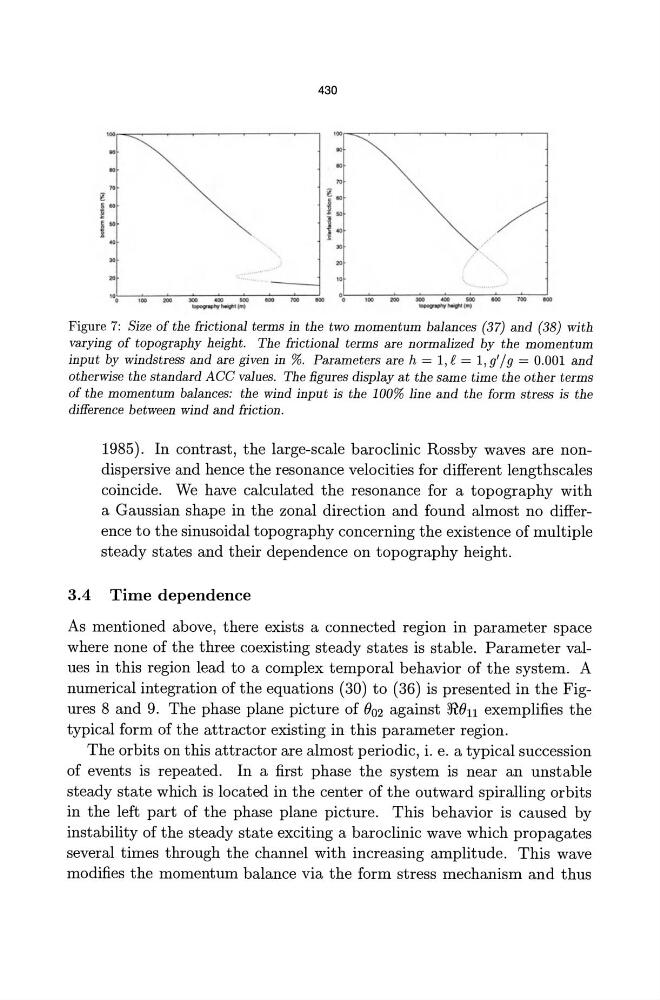
Figure 7: Size of the frictional terms in the two momentum balances (37) and (38) with
varying of topography height. The frictional terms are normalized by the momentum
input by windstress and are given in %. Parameters are h = 1,£ = 1, 9'/9 = 0.001 and
otherwise the standard ACC values. The figures display at the same time the other terms
of the momentum balances: the wind input is the 100% line and the form stress is the
difference between wind and friction.
1985). In contrast, the large-scale baroclinic Rossby waves are nondispersive and hence the resonance velocities for different lengths cales
coincide. We have calculated the resonance for a topography with
a Gaussian shape in the zonal direction and found almost no difference to the sinusoidal topography concerning the existence of multiple
steady states and their dependence on topography height.
3.4 Time dependence
As mentioned above, there exists a connected region in parameter space
where none of the three coexisting steady states is stable. Parameter values in this region lead to a complex temporal behavior of the system. A
numerical integration of the equations (30) to (36) is presented in the Figures 8 and 9. The phase plane picture of 002 against ROn exemplifies the
typical form of the attractor existing in this parameter region.
The orbits on this attractor are almost periodic, i. e. a typical succession
of events is repeated. In a first phase the system is near an unstable
steady state which is located in the center of the outward spiralling orbits
in the left part of the phase plane picture. This behavior is caused by
instability of the steady state exciting a baroclinic wave which propagates
several times through the channel with increasing amplitude. This wave
modifies the momentum balance via the form stress mechanism and thus
. .
,.
"
... 1\lO
430
. .
eo
,.
l ..
L.
1
t" ,.
. .
"
0
... 0 100 200 300 <100 SOO 100 700 100
~~c~
Figure 7: Size of the frictional terms in the two momentum balances (37) and (38) with
varying of topography height. The frictional terms are normalized by the momentum
input by windstress and are given in %. Parameters are h = 1,£ = 1, 9'/9 = 0.001 and
otherwise the standard ACC values. The figures display at the same time the other terms
of the momentum balances: the wind input is the 100% line and the form stress is the
difference between wind and friction.
1985). In contrast, the large-scale baroclinic Rossby waves are nondispersive and hence the resonance velocities for different lengths cales
coincide. We have calculated the resonance for a topography with
a Gaussian shape in the zonal direction and found almost no difference to the sinusoidal topography concerning the existence of multiple
steady states and their dependence on topography height.
3.4 Time dependence
As mentioned above, there exists a connected region in parameter space
where none of the three coexisting steady states is stable. Parameter values in this region lead to a complex temporal behavior of the system. A
numerical integration of the equations (30) to (36) is presented in the Figures 8 and 9. The phase plane picture of 002 against ROn exemplifies the
typical form of the attractor existing in this parameter region.
The orbits on this attractor are almost periodic, i. e. a typical succession
of events is repeated. In a first phase the system is near an unstable
steady state which is located in the center of the outward spiralling orbits
in the left part of the phase plane picture. This behavior is caused by
instability of the steady state exciting a baroclinic wave which propagates
several times through the channel with increasing amplitude. This wave
modifies the momentum balance via the form stress mechanism and thus