

X 10'"
. .
-2
..................................................... , ............................... .
....
boOm
....
~~--~--~~~.--~,~.--~'2~-'~.--~,.
U
xl~
x '0 ....
. .......................... , .... ,."., .. "'.
. , .. ,.,
428
..
-2
. .
-2
".
.... ,
. ..
t .••. ····••
""' 1
b_ .....
, 0
12
14
'8
.........
, ... , .. ,.
.,.'
.....
x '0'"
. ""'.:..L....-=,.".~ . . .... ::--,(.. .. ...... . .................. .
.....
b.l5Om
....
.,."
~
b.~
• ~~~-7--~~~.~~'~.--~ '2~-,~.--~, .
~~---7--~~~.--~,~.--~ , 2~-'~.--~ , •
u
Xl~
u
X 10'"
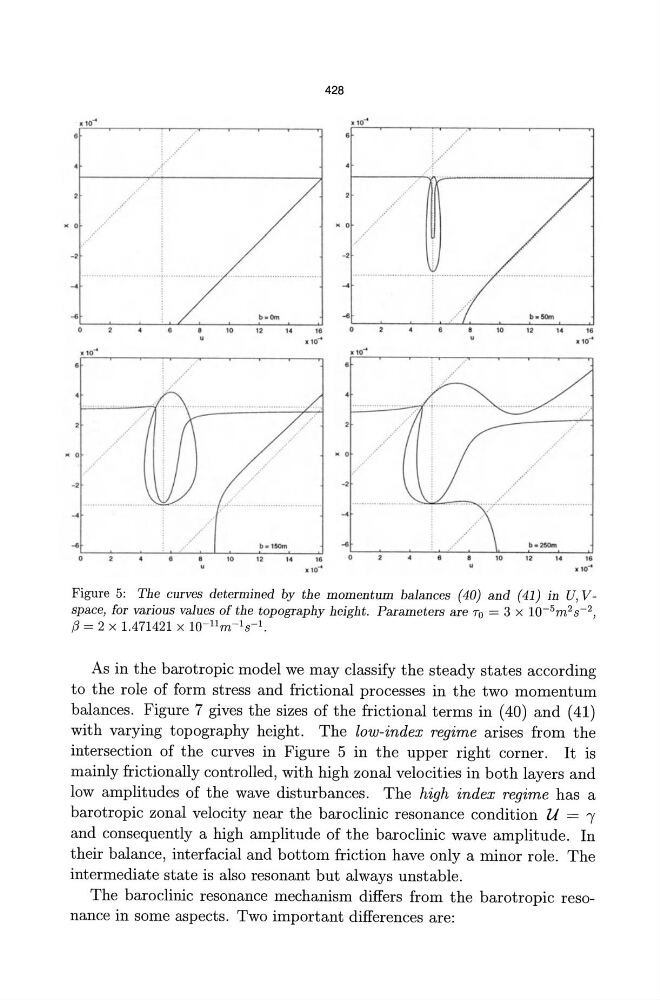
Figure 5: The curves determined by the momentum balances (40) and (41) in U, Vspace, for various values of the topography height. Parameters are TO = 3 x 1O-5m 2 s-2,
(3 = 2 x 1.471421 x 1O- llm- 1s- 1 .
As in the barotropic model we may classify the steady states according
to the role of form stress and frictional processes in the two momentum
balances. Figure 7 gives the sizes of the frictional terms in (40) and (41)
with varying topography height. The low-index regime arises from the
intersection of the curves in Figure 5 in the upper right corner. It is
mainly frictionally controlled, with high zonal velocities in both layers and
low amplitudes of the wave disturbances. The high index regime has a
barotropic zonal velocity near the baroclinic resonance condition U = I
and consequently a high amplitude of the baroclinic wave amplitude. In
their balance, interfacial and bottom friction have only a minor role. The
intermediate state is also resonant but always unstable.
The baroclinic resonance mechanism differs from the barotropic resonance in some aspects. Two important differences are:
. .
-2
..................................................... , ............................... .
....
boOm
....
~~--~--~~~.--~,~.--~'2~-'~.--~,.
U
xl~
x '0 ....
. .......................... , .... ,."., .. "'.
. , .. ,.,
428
..
-2
. .
-2
".
.... ,
. ..
t .••. ····••
""' 1
b_ .....
, 0
12
14
'8
.........
, ... , .. ,.
.,.'
.....
x '0'"
. ""'.:..L....-=,.".~ . . .... ::--,(.. .. ...... . .................. .
.....
b.l5Om
....
.,."
~
b.~
• ~~~-7--~~~.~~'~.--~ '2~-,~.--~, .
~~---7--~~~.--~,~.--~ , 2~-'~.--~ , •
u
Xl~
u
X 10'"
Figure 5: The curves determined by the momentum balances (40) and (41) in U, Vspace, for various values of the topography height. Parameters are TO = 3 x 1O-5m 2 s-2,
(3 = 2 x 1.471421 x 1O- llm- 1s- 1 .
As in the barotropic model we may classify the steady states according
to the role of form stress and frictional processes in the two momentum
balances. Figure 7 gives the sizes of the frictional terms in (40) and (41)
with varying topography height. The low-index regime arises from the
intersection of the curves in Figure 5 in the upper right corner. It is
mainly frictionally controlled, with high zonal velocities in both layers and
low amplitudes of the wave disturbances. The high index regime has a
barotropic zonal velocity near the baroclinic resonance condition U = I
and consequently a high amplitude of the baroclinic wave amplitude. In
their balance, interfacial and bottom friction have only a minor role. The
intermediate state is also resonant but always unstable.
The baroclinic resonance mechanism differs from the barotropic resonance in some aspects. Two important differences are: