

425
to the lower layer zonal velocity U - h V) or at the interface (proportional to
the baroclinic velocity V) and form stresses caused by the waves. There is a
barotropic (rv
the interfacial form stress (rv
3.3 Steady states, stability and baroclinic resonance
A formal variable elimination in the steady versions of (30) to (36) leads to
a third-order polynomial in any of the variables with coefficients which are
complicated functions of the parameters. We will not present the tedious
procedure to determine the analytical solution of the steady states. Rather
we will try to highlight the analogies and differences to the barotropic CdV
model. To keep the expressions as simple as possible we consider here only
the special case h = £ = 1, i. e. a channel with equal layer thicknesses and
a ratio 2 of length to width.
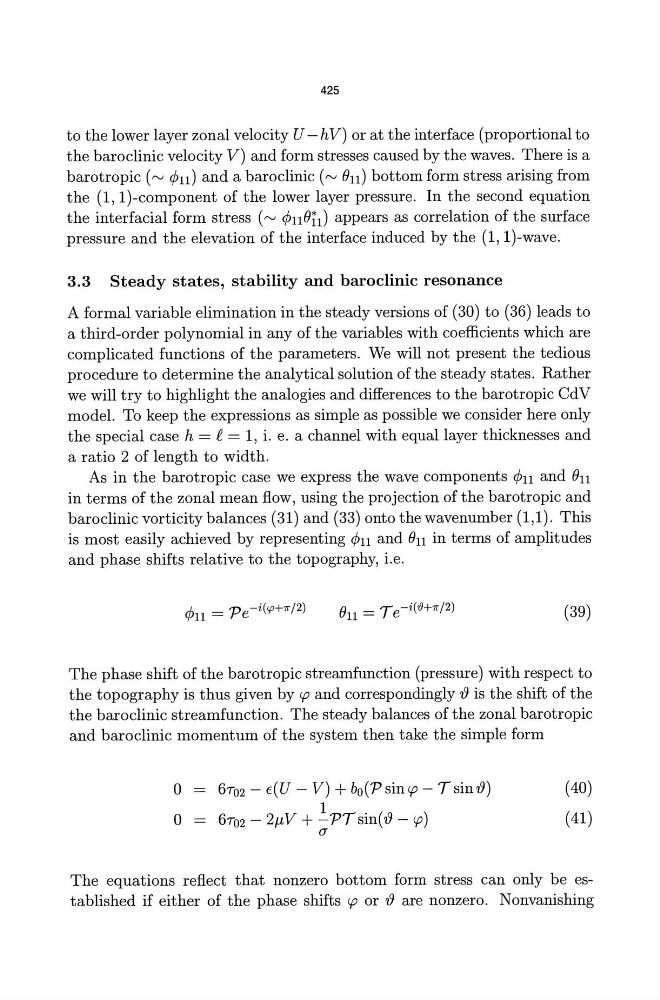
As in the barotropic case we express the wave components
baroclinic vorticity balances (31) and (33) onto the wavenumber (1,1). This
is most easily achieved by representing
(39)
The phase shift of the barotropic streamfunction (pressure) with respect to
the topography is thus given by cp and correspondingly fJ is the shift of the
the baroclinic streamfunction. The steady balances of the zonal barotropic
and baroclinic momentum of the system then take the simple form
o
o
6T02 - E(U - V) + bo(P sin cp - T sin fJ)
6T02 - 2f.1'v + ! PT sin( fJ - cp)
I j
(40)
( 41)
The equations reflect that nonzero bottom form stress can only be established if either of the phase shifts cp or fJ are nonzero. Nonvanishing
to the lower layer zonal velocity U - h V) or at the interface (proportional to
the baroclinic velocity V) and form stresses caused by the waves. There is a
barotropic (rv
the interfacial form stress (rv
3.3 Steady states, stability and baroclinic resonance
A formal variable elimination in the steady versions of (30) to (36) leads to
a third-order polynomial in any of the variables with coefficients which are
complicated functions of the parameters. We will not present the tedious
procedure to determine the analytical solution of the steady states. Rather
we will try to highlight the analogies and differences to the barotropic CdV
model. To keep the expressions as simple as possible we consider here only
the special case h = £ = 1, i. e. a channel with equal layer thicknesses and
a ratio 2 of length to width.
As in the barotropic case we express the wave components
baroclinic vorticity balances (31) and (33) onto the wavenumber (1,1). This
is most easily achieved by representing
(39)
The phase shift of the barotropic streamfunction (pressure) with respect to
the topography is thus given by cp and correspondingly fJ is the shift of the
the baroclinic streamfunction. The steady balances of the zonal barotropic
and baroclinic momentum of the system then take the simple form
o
o
6T02 - E(U - V) + bo(P sin cp - T sin fJ)
6T02 - 2f.1'v + ! PT sin( fJ - cp)
I j
(40)
( 41)
The equations reflect that nonzero bottom form stress can only be established if either of the phase shifts cp or fJ are nonzero. Nonvanishing