

424
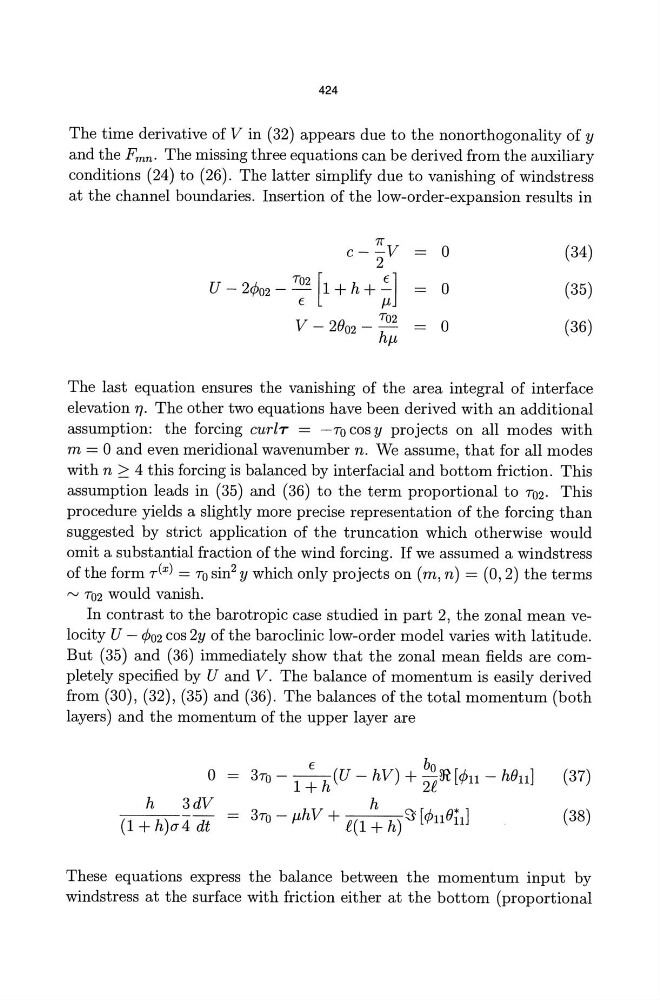
The time derivative of V in (32) appears due to the nonorthogonality of y
and the Fmn. The missing three equations can be derived from the auxiliary
conditions (24) to (26). The latter simplify due to vanishing of windstress
at the channel boundaries. Insertion of the low-order-expansion results in
7r
c--v 2
0
(34)
T02 [
E]
U - 2¢02 - --;- 1 + h + ~
0
(35)
T02
0
(36)
V - 20 02 - -
hf1
The last equation ensures the vanishing of the area integral of interface
elevation'Tl. The other two equations have been derived with an additional
assumption: the forcing curlr = -TO cos y projects on all modes with
m = 0 and even meridional wavenumber n. We assume, that for all modes
with n ~ 4 this forcing is balanced by interfacial and bottom friction. This
assumption leads in (35) and (36) to the term proportional to T02. This
procedure yields a slightly more precise representation of the forcing than
suggested by strict application of the truncation which otherwise would
omit a substantial fraction of the wind forcing. If we assumed a windstress
of the form T(x) = TO sin 2 y which only projects on (m, n) = (0,2) the terms
rv T02 would vanish.
In contrast to the barotropic case studied in part 2, the zonal mean velocity U - ¢02 cos 2y of the baroclinic low-order model varies with latitude.
But (35) and (36) immediately show that the zonal mean fields are completely specified by U and V. The balance of momentum is easily derived
from (30), (32), (35) and (36). The balances ofthe total momentum (both
layers) and the momentum of the upper layer are
o
h
3dV
(1 + h)0"4 dt
E
bo
3To - --(U - hV) + -R [¢ll - hell]
1 + h
2£
3To - f1hV + £(1: h)
(38)
These equations express the balance between the momentum input by
windstress at the surface with friction either at the bottom (proportional
The time derivative of V in (32) appears due to the nonorthogonality of y
and the Fmn. The missing three equations can be derived from the auxiliary
conditions (24) to (26). The latter simplify due to vanishing of windstress
at the channel boundaries. Insertion of the low-order-expansion results in
7r
c--v 2
0
(34)
T02 [
E]
U - 2¢02 - --;- 1 + h + ~
0
(35)
T02
0
(36)
V - 20 02 - -
hf1
The last equation ensures the vanishing of the area integral of interface
elevation'Tl. The other two equations have been derived with an additional
assumption: the forcing curlr = -TO cos y projects on all modes with
m = 0 and even meridional wavenumber n. We assume, that for all modes
with n ~ 4 this forcing is balanced by interfacial and bottom friction. This
assumption leads in (35) and (36) to the term proportional to T02. This
procedure yields a slightly more precise representation of the forcing than
suggested by strict application of the truncation which otherwise would
omit a substantial fraction of the wind forcing. If we assumed a windstress
of the form T(x) = TO sin 2 y which only projects on (m, n) = (0,2) the terms
rv T02 would vanish.
In contrast to the barotropic case studied in part 2, the zonal mean velocity U - ¢02 cos 2y of the baroclinic low-order model varies with latitude.
But (35) and (36) immediately show that the zonal mean fields are completely specified by U and V. The balance of momentum is easily derived
from (30), (32), (35) and (36). The balances ofthe total momentum (both
layers) and the momentum of the upper layer are
o
h
3dV
(1 + h)0"4 dt
E
bo
3To - --(U - hV) + -R [¢ll - hell]
1 + h
2£
3To - f1hV + £(1: h)
(38)
These equations express the balance between the momentum input by
windstress at the surface with friction either at the bottom (proportional