

422
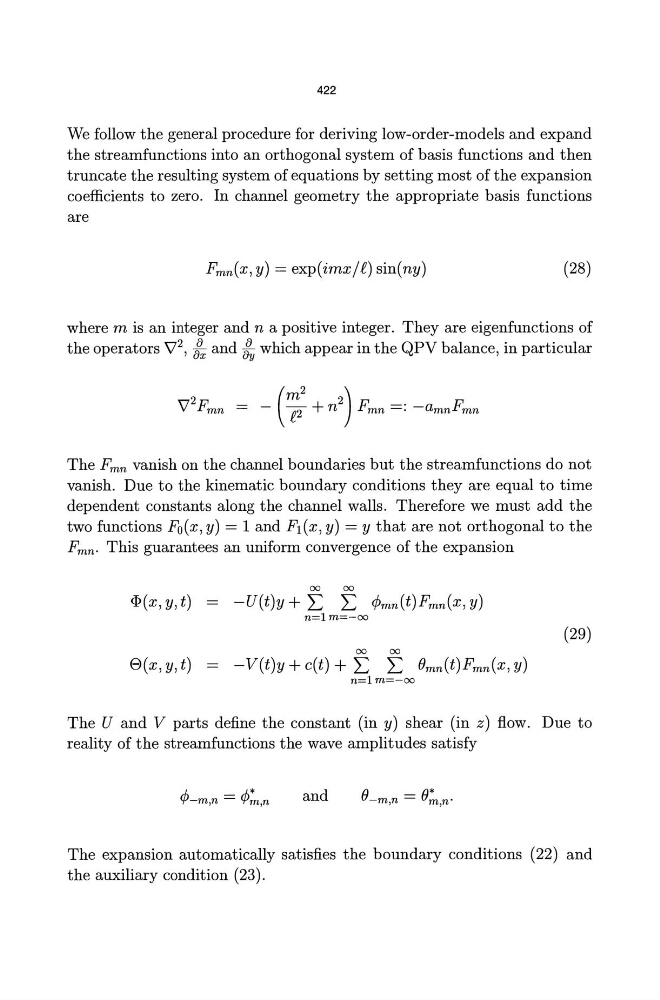
We follow the general procedure for deriving low-order-models and expand
the streamfunctions into an orthogonal system of basis functions and then
truncate the resulting system of equations by setting most of the expansion
coefficients to zero. In channel geometry the appropriate basis functions
are
Fmn(x, y) = exp(imx/£) sin(ny)
(28)
where m is an integer and n a positive integer. They are eigenfunctions of
the operators \7 2 , tx and t y which appear in the QPV balance, in particular
2
m
2
(
2
)
'V Fmn = - f:i" + n Fmn =: -amnFmn
The F mn vanish on the channel boundaries but the streamfunctions do not
vanish. Due to the kinematic boundary conditions they are equal to time
dependent constants along the channel walls. Therefore we must add the
two functions Fo (x, y) = 1 and Fl (x, y) = y that are not orthogonal to the
Fmn. This guarantees an uniform convergence of the expansion
00
00
(x, y, t)
-U(t)y + L L
(29)
00
00
8(x,y, t)
-V(t)y + c(t) + L L Omn(t) Fmn(x, y)
n=lm=-oo
The U and V parts define the constant (in y) shear (in z) flow. Due to
reality of the streamfunctions the wave amplitudes satisfy
and
o -m,n = O:n,n"
The expansion automatically satisfies the boundary conditions (22) and
the auxiliary condition (23).
We follow the general procedure for deriving low-order-models and expand
the streamfunctions into an orthogonal system of basis functions and then
truncate the resulting system of equations by setting most of the expansion
coefficients to zero. In channel geometry the appropriate basis functions
are
Fmn(x, y) = exp(imx/£) sin(ny)
(28)
where m is an integer and n a positive integer. They are eigenfunctions of
the operators \7 2 , tx and t y which appear in the QPV balance, in particular
2
m
2
(
2
)
'V Fmn = - f:i" + n Fmn =: -amnFmn
The F mn vanish on the channel boundaries but the streamfunctions do not
vanish. Due to the kinematic boundary conditions they are equal to time
dependent constants along the channel walls. Therefore we must add the
two functions Fo (x, y) = 1 and Fl (x, y) = y that are not orthogonal to the
Fmn. This guarantees an uniform convergence of the expansion
00
00
(x, y, t)
-U(t)y + L L
(29)
00
00
8(x,y, t)
-V(t)y + c(t) + L L Omn(t) Fmn(x, y)
n=lm=-oo
The U and V parts define the constant (in y) shear (in z) flow. Due to
reality of the streamfunctions the wave amplitudes satisfy
and
o -m,n = O:n,n"
The expansion automatically satisfies the boundary conditions (22) and
the auxiliary condition (23).