

421
The sign of the topography term is here given for the southern hemisphere
where fo is negative. Equation (21) is the vorticity balance for the upper
layer, expressed in terms of the barotropic and baroclinic streamfunctions.
Kinematic boundary conditions appropriate to the channel geometry
are
q?(x, y) = q?(x + 21ft, y)
aq?1 _ 0
ax y=O,1f
(22)
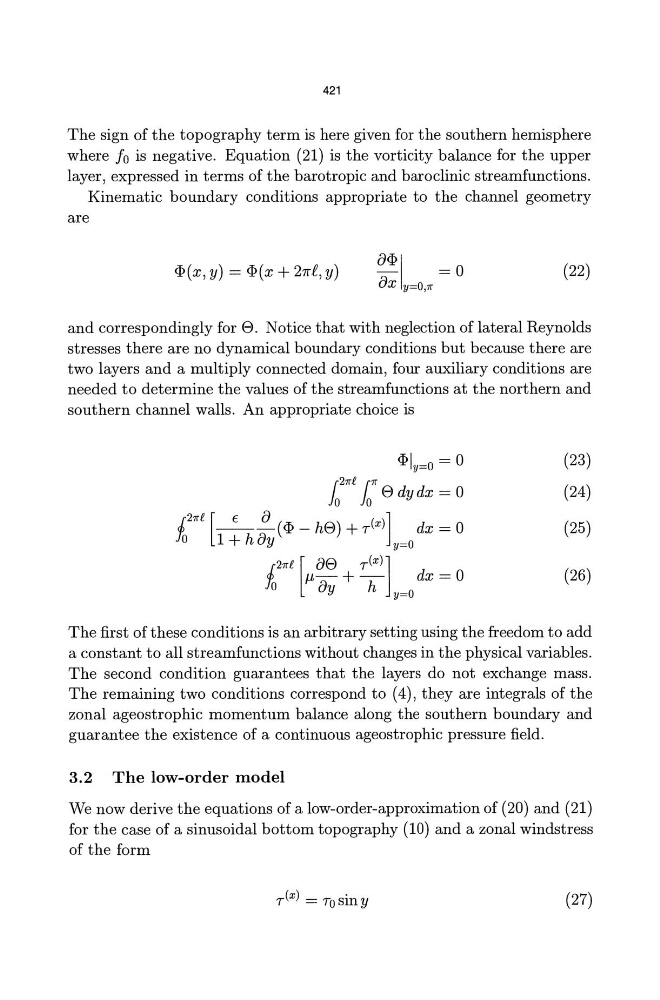
and correspondingly for e. Notice that with neglection of lateral Reynolds
stresses there are no dynamical boundary conditions but because there are
two layers and a multiply connected domain, four auxiliary conditions are
needed to determine the values of the streamfunctions at the northern and
southern channel walls. An appropriate choice is
wly=o = 0
{21ft (1f
Jo Jo e dy dx = 0
121ft [
f a ]
Jr
---(w - he) + T(x) dx = 0
o
1 + hay
y=O
i
21ft [ae T(X)]
f - l - + -
dx=O
o
ay
h y=O
(23)
(24)
(25)
(26)
The first of these conditions is an arbitrary setting using the freedom to add
a constant to all streamfunctions without changes in the physical variables.
The second condition guarantees that the layers do not exchange mass.
The remaining two conditions correspond to (4), they are integrals of the
zonal ageostrophic momentum balance along the southern boundary and
guarantee the existence of a continuous ageostrophic pressure field.
3.2 The low-order model
We now derive the equations of a low-order-approximation of (20) and (21)
for the case of a sinusoidal bottom topography (10) and a zonal winds tress
of the form
T(X) = TO sin y
(27)
The sign of the topography term is here given for the southern hemisphere
where fo is negative. Equation (21) is the vorticity balance for the upper
layer, expressed in terms of the barotropic and baroclinic streamfunctions.
Kinematic boundary conditions appropriate to the channel geometry
are
q?(x, y) = q?(x + 21ft, y)
aq?1 _ 0
ax y=O,1f
(22)
and correspondingly for e. Notice that with neglection of lateral Reynolds
stresses there are no dynamical boundary conditions but because there are
two layers and a multiply connected domain, four auxiliary conditions are
needed to determine the values of the streamfunctions at the northern and
southern channel walls. An appropriate choice is
wly=o = 0
{21ft (1f
Jo Jo e dy dx = 0
121ft [
f a ]
Jr
---(w - he) + T(x) dx = 0
o
1 + hay
y=O
i
21ft [ae T(X)]
f - l - + -
dx=O
o
ay
h y=O
(23)
(24)
(25)
(26)
The first of these conditions is an arbitrary setting using the freedom to add
a constant to all streamfunctions without changes in the physical variables.
The second condition guarantees that the layers do not exchange mass.
The remaining two conditions correspond to (4), they are integrals of the
zonal ageostrophic momentum balance along the southern boundary and
guarantee the existence of a continuous ageostrophic pressure field.
3.2 The low-order model
We now derive the equations of a low-order-approximation of (20) and (21)
for the case of a sinusoidal bottom topography (10) and a zonal winds tress
of the form
T(X) = TO sin y
(27)