

410
temporal variability of a dynamical system: is it driven by variations in
the forcing (windstress or buoyancy flux in case of the ACC), is it due to
internal instability of the system (structural instability of the large-scale
components) or is it caused by the perturbation of phase space trajectories
around the stable and unstable steady states by some internally or externally generated noise (e. g. unresolved waves of smaller scale or meso-scale
eddies)? These questions must be considered open as well for the anomalous atmospheric circulation in mid-latitudes: the extensive collection of
observational examples and theoretical investigations of externally forced
and internally generated variability in the atmospheric circulation in Benzi
et al. (1986) give the strong impression of lack of adequate data and lack
of dynamical concepts to find the causes of variability.
700
800
7DO
5DD
-s
L
e 500
i
i
! 4DO
! 3DO
."lD
~
J 200
100
-1000
20
40
60
eo
100
120
140
160
180
00
20
40
60
80
100
120
140
160
180
llme(a)
tlme(a)
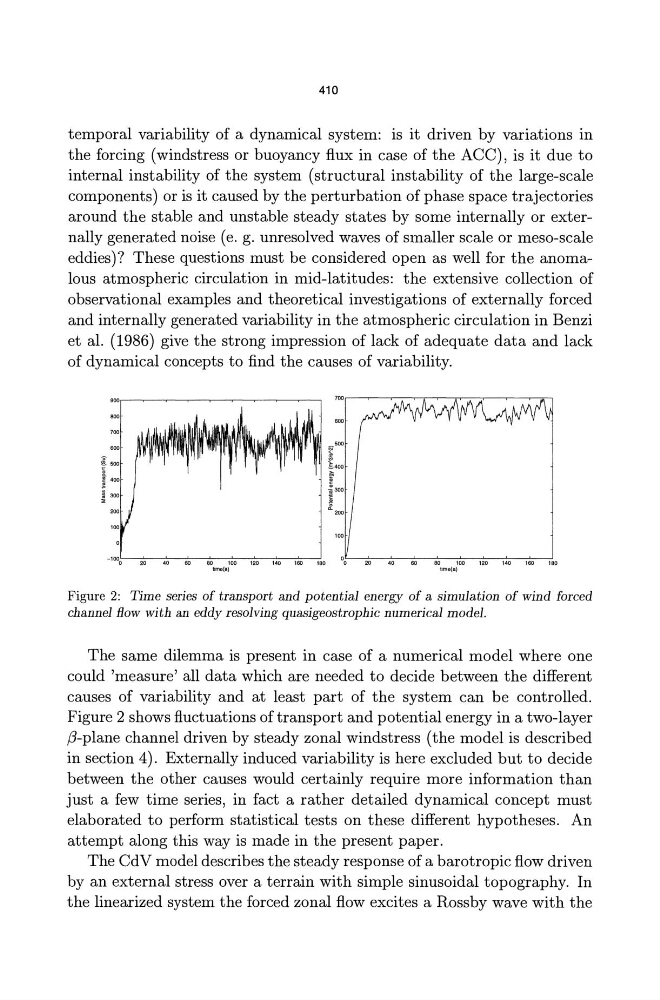
Figure 2: Time series of transport and potential energy of a simulation of wind forced
channel flow with an eddy resolving quasigeostrophic numerical model.
The same dilemma is present in case of a numerical model where one
could 'measure' all data which are needed to decide between the different
causes of variability and at least part of the system can be controlled.
Figure 2 shows fluctuations of transport and potential energy in a two-layer
,6-plane channel driven by steady zonal windstress (the model is described
in section 4). Externally induced variability is here excluded but to decide
between the other causes would certainly require more information than
just a few time series, in fact a rather detailed dynamical concept must
elaborated to perform statistical tests on these different hypotheses. An
attempt along this way is made in the present paper.
The CdV model describes the steady response of a barotropic flow driven
by an external stress over a terrain with simple sinusoidal topography. In
the linearized system the forced zonal flow excites a Rossby wave with the
temporal variability of a dynamical system: is it driven by variations in
the forcing (windstress or buoyancy flux in case of the ACC), is it due to
internal instability of the system (structural instability of the large-scale
components) or is it caused by the perturbation of phase space trajectories
around the stable and unstable steady states by some internally or externally generated noise (e. g. unresolved waves of smaller scale or meso-scale
eddies)? These questions must be considered open as well for the anomalous atmospheric circulation in mid-latitudes: the extensive collection of
observational examples and theoretical investigations of externally forced
and internally generated variability in the atmospheric circulation in Benzi
et al. (1986) give the strong impression of lack of adequate data and lack
of dynamical concepts to find the causes of variability.
700
800
7DO
5DD
-s
L
e 500
i
i
! 4DO
! 3DO
."lD
~
J 200
100
-1000
20
40
60
eo
100
120
140
160
180
00
20
40
60
80
100
120
140
160
180
llme(a)
tlme(a)
Figure 2: Time series of transport and potential energy of a simulation of wind forced
channel flow with an eddy resolving quasigeostrophic numerical model.
The same dilemma is present in case of a numerical model where one
could 'measure' all data which are needed to decide between the different
causes of variability and at least part of the system can be controlled.
Figure 2 shows fluctuations of transport and potential energy in a two-layer
,6-plane channel driven by steady zonal windstress (the model is described
in section 4). Externally induced variability is here excluded but to decide
between the other causes would certainly require more information than
just a few time series, in fact a rather detailed dynamical concept must
elaborated to perform statistical tests on these different hypotheses. An
attempt along this way is made in the present paper.
The CdV model describes the steady response of a barotropic flow driven
by an external stress over a terrain with simple sinusoidal topography. In
the linearized system the forced zonal flow excites a Rossby wave with the