

400
a) BASIN
MAX STREAMFUNCTION
. 186E 03
227 yr
.149E 03
.... ~
....
. 1l2E 03
-...
....
........
.... 95%
........
....
. 74SE 02
....... 90 Ct /o ....
, ........ ....
. ,8.0%-",
-.373E 02
.000E 00
0.00 0.40 0.80 1.20 1.60 2.00
CYCLES I 100 YEARS
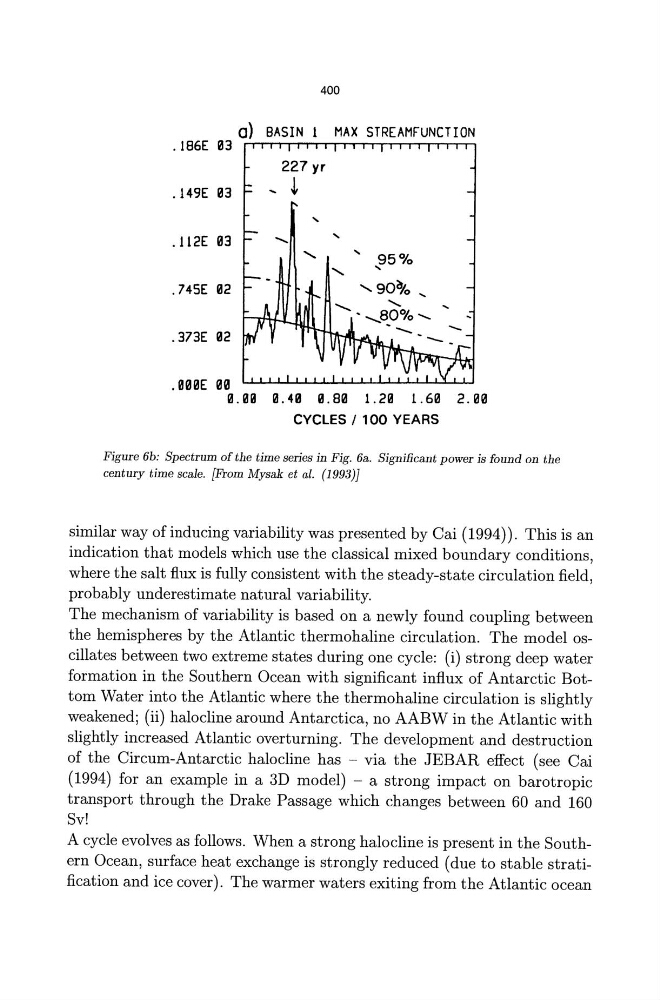
Figure 6b: Spectrum of the time series in Fig. 6a. Significant power is found on the
century time scale. [From Mysak et al. (1993)J
similar way of inducing variability was presented by Cai (1994)). This is an
indication that models which use the classical mixed boundary conditions,
where the salt flux is fully consistent with the steady-state circulation field,
probably underestimate natural variability.
The mechanism of variability is based on a newly found coupling between
the hemispheres by the Atlantic thermohaline circulation. The model oscillates between two extreme states during one cycle: (i) strong deep water
formation in the Southern Ocean with significant influx of Antarctic Bottom Water into the Atlantic where the thermohaline circulation is slightly
weakened; (ii) halo cline around Antarctica, no AABW in the Atlantic with
slightly increased Atlantic overturning. The development and destruction
of the Circum-Antarctic halo cline has - via the JEBAR effect (see Cai
(1994) for an example in a 3D model) - a strong impact on barotropic
transport through the Drake Passage which changes between 60 and 160
Sv!
A cycle evolves as follows. When a strong halo cline is present in the Southern Ocean, surface heat exchange is strongly reduced (due to stable stratification and ice cover). The warmer waters exiting from the Atlantic ocean
a) BASIN
MAX STREAMFUNCTION
. 186E 03
227 yr
.149E 03
.... ~
....
. 1l2E 03
-...
....
........
.... 95%
........
....
. 74SE 02
....... 90 Ct /o ....
, ........ ....
. ,8.0%-",
-.373E 02
.000E 00
0.00 0.40 0.80 1.20 1.60 2.00
CYCLES I 100 YEARS
Figure 6b: Spectrum of the time series in Fig. 6a. Significant power is found on the
century time scale. [From Mysak et al. (1993)J
similar way of inducing variability was presented by Cai (1994)). This is an
indication that models which use the classical mixed boundary conditions,
where the salt flux is fully consistent with the steady-state circulation field,
probably underestimate natural variability.
The mechanism of variability is based on a newly found coupling between
the hemispheres by the Atlantic thermohaline circulation. The model oscillates between two extreme states during one cycle: (i) strong deep water
formation in the Southern Ocean with significant influx of Antarctic Bottom Water into the Atlantic where the thermohaline circulation is slightly
weakened; (ii) halo cline around Antarctica, no AABW in the Atlantic with
slightly increased Atlantic overturning. The development and destruction
of the Circum-Antarctic halo cline has - via the JEBAR effect (see Cai
(1994) for an example in a 3D model) - a strong impact on barotropic
transport through the Drake Passage which changes between 60 and 160
Sv!
A cycle evolves as follows. When a strong halo cline is present in the Southern Ocean, surface heat exchange is strongly reduced (due to stable stratification and ice cover). The warmer waters exiting from the Atlantic ocean