

399
meridional overturning. The authors trace these anomalies along the entire
loop of overturning so that they eventually surface again in the South Atlantic/Southern Ocean region. Although much diffused and diminished by
that time, they are the seed of new anomalies that start their northbound
travel at the sea surface.
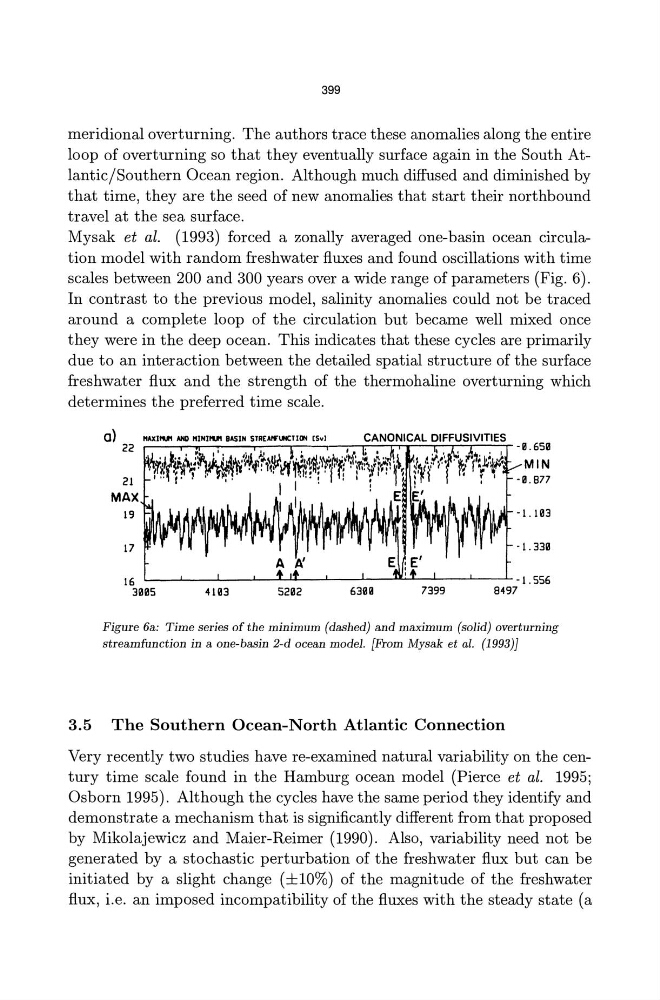
Mysak et al. (1993) forced a zonally averaged one-basin ocean circulation model with random freshwater fluxes and found oscillations with time
scales between 200 and 300 years over a wide range of parameters (Fig. 6).
In contrast to the previous model, salinity anomalies could not be traced
around a complete loop of the circulation but became well mixed once
they were in the deep ocean. This indicates that these cycles are primarily
due to an interaction between the detailed spatial structure of the surface
freshwater flux and the strength of the thermohaline overturning which
determines the preferred time scale.
a)
22
-8.650
MIN
21
-0.877
MAX
19
-1. 103
17
-1.330
16
-1. 556
3005
4103
5202
6301a
7399
8497
Figure 6a: Time series oftbe minimum (dasbed) and maximum (solid) overturning
streamfunction in a one-basin 2-d ocean model. [From Mysak et al. (1993)J
3.5 The Southern Ocean-North Atlantic Connection
Very recently two studies have re-examined natural variability on the century time scale found in the Hamburg ocean model (Pierce et al. 1995;
Osborn 1995). Although the cycles have the same period they identify and
demonstrate a mechanism that is significantly different from that proposed
by Mikolajewicz and Maier-Reimer (1990). Also, variability need not be
generated by a stochastic perturbation of the freshwater flux but can be
initiated by a slight change (±10%) of the magnitude of the freshwater
flux, i.e. an imposed incompatibility of the fluxes with the steady state (a
meridional overturning. The authors trace these anomalies along the entire
loop of overturning so that they eventually surface again in the South Atlantic/Southern Ocean region. Although much diffused and diminished by
that time, they are the seed of new anomalies that start their northbound
travel at the sea surface.
Mysak et al. (1993) forced a zonally averaged one-basin ocean circulation model with random freshwater fluxes and found oscillations with time
scales between 200 and 300 years over a wide range of parameters (Fig. 6).
In contrast to the previous model, salinity anomalies could not be traced
around a complete loop of the circulation but became well mixed once
they were in the deep ocean. This indicates that these cycles are primarily
due to an interaction between the detailed spatial structure of the surface
freshwater flux and the strength of the thermohaline overturning which
determines the preferred time scale.
a)
22
-8.650
MIN
21
-0.877
MAX
19
-1. 103
17
-1.330
16
-1. 556
3005
4103
5202
6301a
7399
8497
Figure 6a: Time series oftbe minimum (dasbed) and maximum (solid) overturning
streamfunction in a one-basin 2-d ocean model. [From Mysak et al. (1993)J
3.5 The Southern Ocean-North Atlantic Connection
Very recently two studies have re-examined natural variability on the century time scale found in the Hamburg ocean model (Pierce et al. 1995;
Osborn 1995). Although the cycles have the same period they identify and
demonstrate a mechanism that is significantly different from that proposed
by Mikolajewicz and Maier-Reimer (1990). Also, variability need not be
generated by a stochastic perturbation of the freshwater flux but can be
initiated by a slight change (±10%) of the magnitude of the freshwater
flux, i.e. an imposed incompatibility of the fluxes with the steady state (a