

( 0) Mean=18 .28
Stdev=O .89
397
YEAR
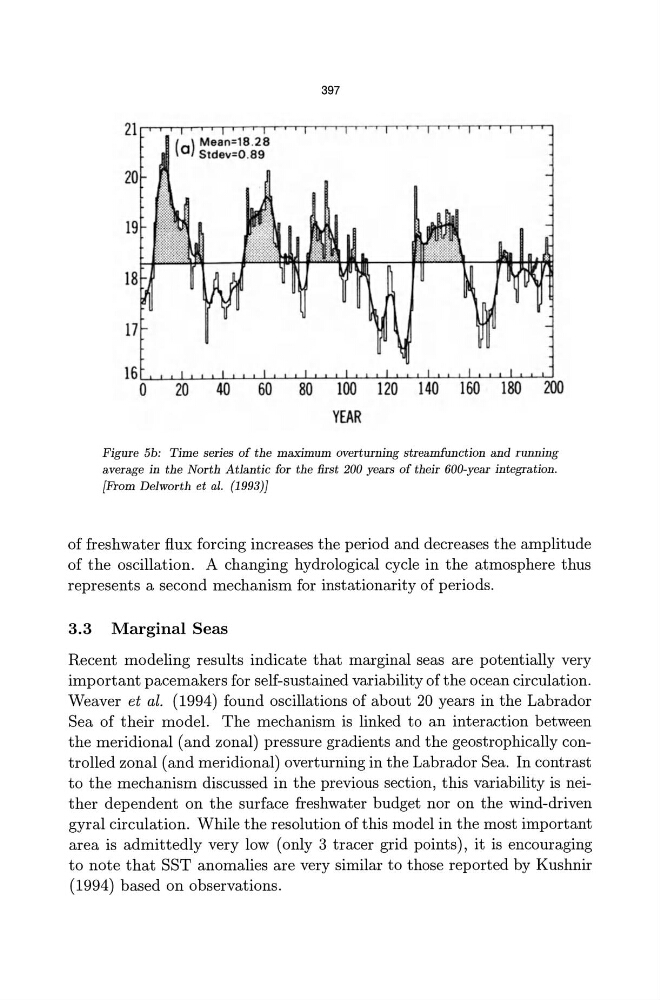
Figure 5b: Time series of the maximum overturning streamfunction and running
average in the North Atlantic for the first 200 years of their 600-year integration.
[From Delworth et al. (1993)]
of freshwater flux forcing increases the period and decreases the amplitude
of the oscillation. A changing hydrological cycle in the atmosphere thus
represents a second mechanism for instationarity of periods.
3.3 Marginal Seas
Recent modeling results indicate that marginal seas are potentially very
important pacemakers for self-sustained variability of the ocean circulation.
Weaver et al. (1994) found oscillations of about 20 years in the Labrador
Sea of their model. The mechanism is linked to an interaction between
the meridional (and zonal) pressure gradients and the geostrophically controlled zonal (and meridional) overturning in the Labrador Sea. In contrast
to the mechanism discussed in the previous section, this variability is neither dependent on the surface freshwater budget nor on the wind-driven
gyral circulation. While the resolution of this model in the most important
area is admittedly very low (only 3 tracer grid points), it is encouraging
to note that SST anomalies are very similar to those reported by Kushnir
(1994) based on observations.
Stdev=O .89
397
YEAR
Figure 5b: Time series of the maximum overturning streamfunction and running
average in the North Atlantic for the first 200 years of their 600-year integration.
[From Delworth et al. (1993)]
of freshwater flux forcing increases the period and decreases the amplitude
of the oscillation. A changing hydrological cycle in the atmosphere thus
represents a second mechanism for instationarity of periods.
3.3 Marginal Seas
Recent modeling results indicate that marginal seas are potentially very
important pacemakers for self-sustained variability of the ocean circulation.
Weaver et al. (1994) found oscillations of about 20 years in the Labrador
Sea of their model. The mechanism is linked to an interaction between
the meridional (and zonal) pressure gradients and the geostrophically controlled zonal (and meridional) overturning in the Labrador Sea. In contrast
to the mechanism discussed in the previous section, this variability is neither dependent on the surface freshwater budget nor on the wind-driven
gyral circulation. While the resolution of this model in the most important
area is admittedly very low (only 3 tracer grid points), it is encouraging
to note that SST anomalies are very similar to those reported by Kushnir
(1994) based on observations.