

388
350
0, Camp Century (350)
B: Maine (330)
300 B' California (300)
0: Quelccaya (300)
--.. ...
~
250
0: Quelccaya (250)
11)
"-!
-.J
\..)
)...
T'Lapland (204)
\..) 200 c, L a Jolla (200)
li..
B: Cali fornia (170)
0' Camp Century (170)
a
(;:)
C' La Jolla (160)
a ...... 150
Q::
"-!
B: Wiscounsin (125)
H: Russia (130)
Q..
0' Quelccaya (110)
0' C.C. (110)
T: Nevada (110)
0: Cr~te (100)
T: Alps (120)
100
B: New York (95)
T' Lapland (90)
I: Central England (100)
•
•
•
T: Nevada (70)
0: C.C.,Cr~te (70)
T' E,W America (60)
0: C.C. (55)
B: Quebec (50-60)
GH: Iceland (50)
GI: Alps (60-70)
50
AMERICA
GREENLAND-AREA
EURDPE
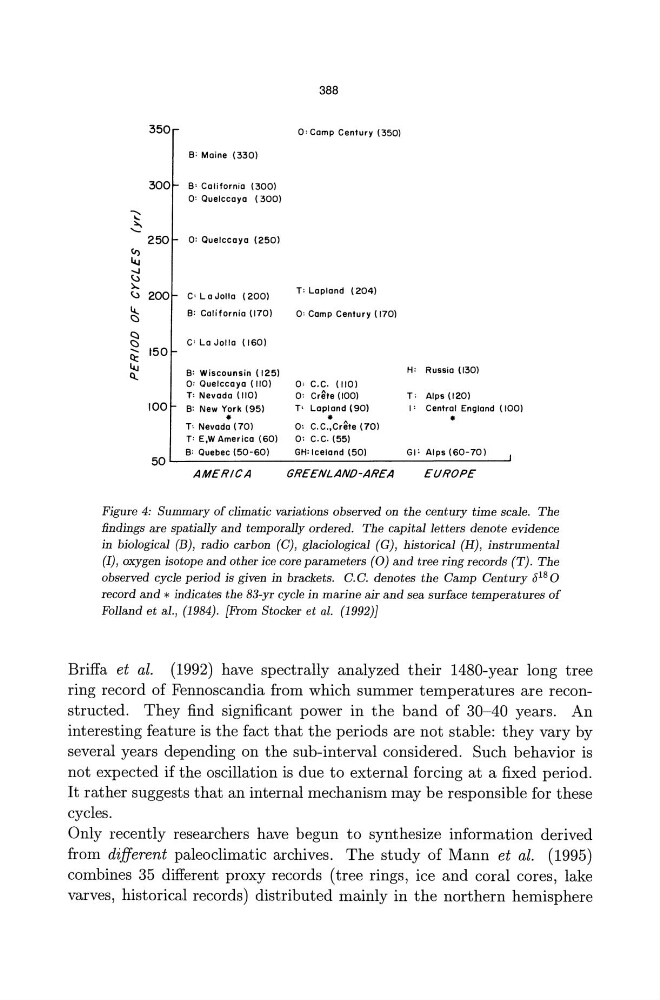
Figure 4: Summary of climatic variations observed on the century time scale. The
findings are spatially and temporally ordered. The capital letters denote evidence
in biological (B), radio carbon (C), glaciological (G), historical (H), instrumental
(I), oxygen isotope and other ice core parameters (0) and tree ring records (T). The
observed cycle period is given in brackets. C. C. denotes the Camp Century 8 18 0
record and * indicates the 83-yr cycle in marine air and sea surface temperatures of
Folland et al., (1984). [From Stocker et al. (1992)]
Briffa et al. (1992) have spectrally analyzed their 1480-year long tree
ring record of Fennoscandia from which summer temperatures are reconstructed. They find significant power in the band of 30-40 years. An
interesting feature is the fact that the periods are not stable: they vary by
several years depending on the sub-interval considered. Such behavior is
not expected if the oscillation is due to external forcing at a fixed period.
It rather suggests that an internal mechanism may be responsible for these
cycles.
Only recently researchers have begun to synthesize information derived
from different paleoclimatic archives. The study of Mann et al. (1995)
combines 35 different proxy records (tree rings, ice and coral cores, lake
varves, historical records) distributed mainly in the northern hemisphere
350
0, Camp Century (350)
B: Maine (330)
300 B' California (300)
0: Quelccaya (300)
--.. ...
~
250
0: Quelccaya (250)
11)
"-!
-.J
\..)
)...
T'Lapland (204)
\..) 200 c, L a Jolla (200)
li..
B: Cali fornia (170)
0' Camp Century (170)
a
(;:)
C' La Jolla (160)
a ...... 150
Q::
"-!
B: Wiscounsin (125)
H: Russia (130)
Q..
0' Quelccaya (110)
0' C.C. (110)
T: Nevada (110)
0: Cr~te (100)
T: Alps (120)
100
B: New York (95)
T' Lapland (90)
I: Central England (100)
•
•
•
T: Nevada (70)
0: C.C.,Cr~te (70)
T' E,W America (60)
0: C.C. (55)
B: Quebec (50-60)
GH: Iceland (50)
GI: Alps (60-70)
50
AMERICA
GREENLAND-AREA
EURDPE
Figure 4: Summary of climatic variations observed on the century time scale. The
findings are spatially and temporally ordered. The capital letters denote evidence
in biological (B), radio carbon (C), glaciological (G), historical (H), instrumental
(I), oxygen isotope and other ice core parameters (0) and tree ring records (T). The
observed cycle period is given in brackets. C. C. denotes the Camp Century 8 18 0
record and * indicates the 83-yr cycle in marine air and sea surface temperatures of
Folland et al., (1984). [From Stocker et al. (1992)]
Briffa et al. (1992) have spectrally analyzed their 1480-year long tree
ring record of Fennoscandia from which summer temperatures are reconstructed. They find significant power in the band of 30-40 years. An
interesting feature is the fact that the periods are not stable: they vary by
several years depending on the sub-interval considered. Such behavior is
not expected if the oscillation is due to external forcing at a fixed period.
It rather suggests that an internal mechanism may be responsible for these
cycles.
Only recently researchers have begun to synthesize information derived
from different paleoclimatic archives. The study of Mann et al. (1995)
combines 35 different proxy records (tree rings, ice and coral cores, lake
varves, historical records) distributed mainly in the northern hemisphere