

367
Phase space trajectory
4 . 4 0 , - - - - - - - - - - - - - - - - - - - - - - ,
4.35
4.30
4.25
1.2
......
.....
"",."'"
...... -....... ~
.",.. "",.
.............
..
.""
.......
,..-. .. ...-.-. .
",.". .",.. .~ .......... ::...---. . ---.---. ..-.
.... :.:.:.-.. ..-.. --1.3
1.4
10 3 f3 S
1.5
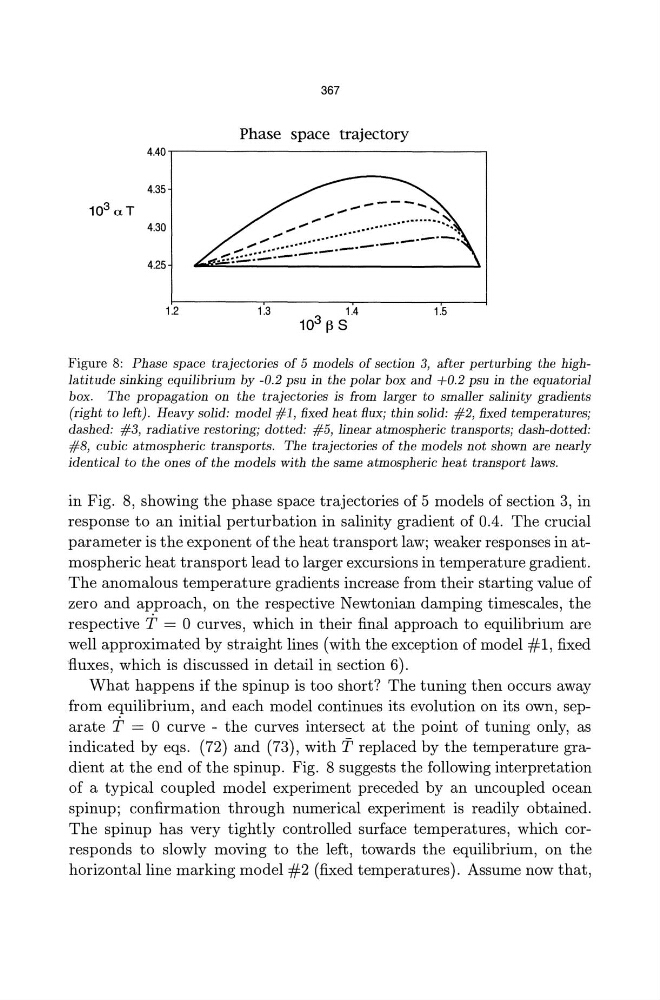
Figure 8: Phase space trajectories of 5 models of section 3, after perturbing the highlatitude sinking equilibrium by -0.2 psu in the polar box and +0.2 psu in the equatorial
box. The propagation on the trajectories is from larger to smaller salinity gradients
(right to left). Heavy solid: model #1, fixed heat flux; thin solid: #2, fixed temperatures;
dashed: #3, radiative restoring; dotted: #5, linear atmospheric transports; dash-dotted:
#8, cubic atmospheric transports. The trajectories of the models not shown are nearly
identical to the ones of the models with the same atmospheric heat transport laws.
in Fig. 8, showing the phase space trajectories of 5 models of section 3, in
response to an initial perturbation in salinity gradient of 004. The crucial
parameter is the exponent of the heat transport law; weaker responses in atmospheric heat transport lead to larger excursions in temperature gradient.
The anomalous temperature gradients increase from their starting value of
zero and approach, on the respective Newtonian damping timescales, the
respective T = 0 curves, which in their final approach to equilibrium are
well approximated by straight lines (with the exception of model #1, fixed
fluxes, which is discussed in detail in section 6).
What happens if the spinup is too short? The tuning then occurs away
from equilibrium, and each model continues its evolution on its own, separate T = 0 curve - the curves intersect at the point of tuning only, as
indicated by eqs. (72) and (73), with f' replaced by the temperature gradient at the end of the spinup. Fig. 8 suggests the following interpretation
of a typical coupled model experiment preceded by an uncoupled ocean
spinup; confirmation through numerical experiment is readily obtained.
The spinup has very tightly controlled surface temperatures, which corresponds to slowly moving to the left, towards the equilibrium, on the
horizontal line marking model #2 (fixed temperatures). Assume now that,
Phase space trajectory
4 . 4 0 , - - - - - - - - - - - - - - - - - - - - - - ,
4.35
4.30
4.25
1.2
......
.....
"",."'"
...... -....... ~
.",.. "",.
.............
..
.""
.......
,..-. .. ...-.-. .
",.". .",.. .~ .......... ::...---. . ---.---. ..-.
.... :.:.:.-.. ..-.. --1.3
1.4
10 3 f3 S
1.5
Figure 8: Phase space trajectories of 5 models of section 3, after perturbing the highlatitude sinking equilibrium by -0.2 psu in the polar box and +0.2 psu in the equatorial
box. The propagation on the trajectories is from larger to smaller salinity gradients
(right to left). Heavy solid: model #1, fixed heat flux; thin solid: #2, fixed temperatures;
dashed: #3, radiative restoring; dotted: #5, linear atmospheric transports; dash-dotted:
#8, cubic atmospheric transports. The trajectories of the models not shown are nearly
identical to the ones of the models with the same atmospheric heat transport laws.
in Fig. 8, showing the phase space trajectories of 5 models of section 3, in
response to an initial perturbation in salinity gradient of 004. The crucial
parameter is the exponent of the heat transport law; weaker responses in atmospheric heat transport lead to larger excursions in temperature gradient.
The anomalous temperature gradients increase from their starting value of
zero and approach, on the respective Newtonian damping timescales, the
respective T = 0 curves, which in their final approach to equilibrium are
well approximated by straight lines (with the exception of model #1, fixed
fluxes, which is discussed in detail in section 6).
What happens if the spinup is too short? The tuning then occurs away
from equilibrium, and each model continues its evolution on its own, separate T = 0 curve - the curves intersect at the point of tuning only, as
indicated by eqs. (72) and (73), with f' replaced by the temperature gradient at the end of the spinup. Fig. 8 suggests the following interpretation
of a typical coupled model experiment preceded by an uncoupled ocean
spinup; confirmation through numerical experiment is readily obtained.
The spinup has very tightly controlled surface temperatures, which corresponds to slowly moving to the left, towards the equilibrium, on the
horizontal line marking model #2 (fixed temperatures). Assume now that,