

359
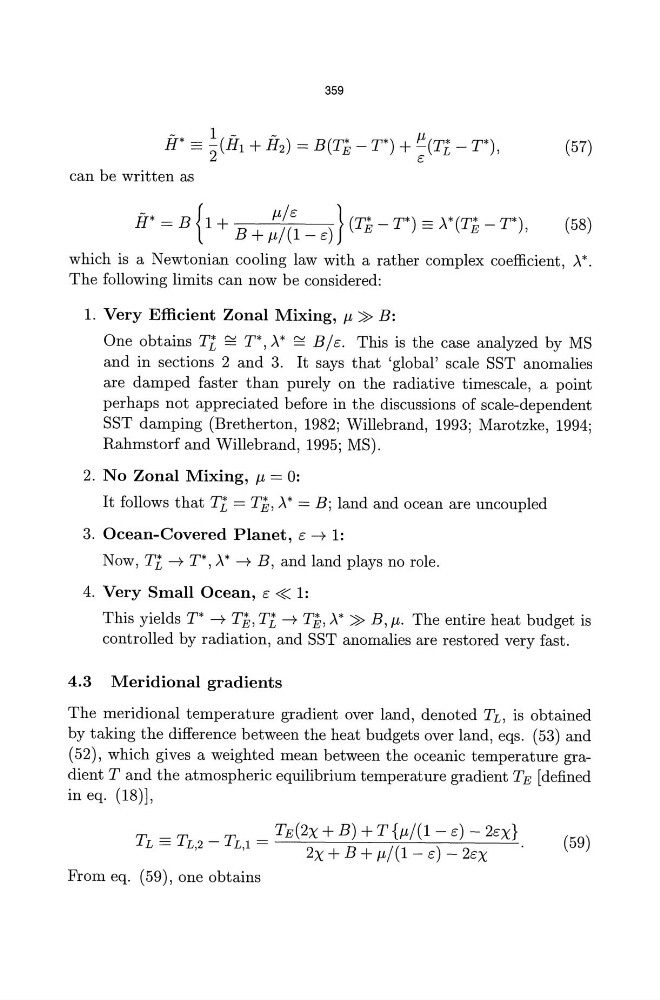
H* == ~(Hl + H2) = B(Ti - T*) + ~(Tl- T*),
(57)
2
e
can be written as
H* = B {I + /-lIe } (T* - T*) == )..*(T* - T*) (58)
B+/-lI(I-e)
E
E ,
which is a Newtonian cooling law with a rather complex coefficient, )..*.
The following limits can now be considered:
1. Very Efficient Zonal Mixing, /-l» B:
One obtains Tl ~ T*,)..* ~ Ble. This is the case analyzed by MS
and in sections 2 and 3. It says that 'global' scale SST anomalies
are damped faster than purely on the radiative timescale, a point
perhaps not appreciated before in the discussions of scale-dependent
SST damping (Bretherton, 1982; Willebrand, 1993; Marotzke, 1994;
Rahmstorf and Willebrand, 1995; MS).
2. No Zonal Mixing, /-l = 0:
It follows that Tl = T E ,)..* = B; land and ocean are uncoupled
3. Ocean-Covered Planet, e -+ 1:
Now, Tl -+ T*,)..* -+ B, and land plays no role.
4. Very Small Ocean, e« 1:
This yields T* -+ T E , Tl -+ T E ,)..* » B, /-l. The entire heat budget is
controlled by radiation, and SST anomalies are restored very fast.
4.3 Meridional gradients
The meridional temperature gradient over land, denoted TL , is obtained
by taking the difference between the heat budgets over land, eqs. (53) and
(52), which gives a weighted mean between the oceanic temperature gradient T and the atmospheric equilibrium temperature gradient TE [defined
in eq. (18)],
TL = TL2 _ TLI = TE (2X+ B) +T{/-lI(I- e) - 2eX}
(59)
- ,
,
2X+B+/-lI(I-e)-2eX·
From eq. (59), one obtains
H* == ~(Hl + H2) = B(Ti - T*) + ~(Tl- T*),
(57)
2
e
can be written as
H* = B {I + /-lIe } (T* - T*) == )..*(T* - T*) (58)
B+/-lI(I-e)
E
E ,
which is a Newtonian cooling law with a rather complex coefficient, )..*.
The following limits can now be considered:
1. Very Efficient Zonal Mixing, /-l» B:
One obtains Tl ~ T*,)..* ~ Ble. This is the case analyzed by MS
and in sections 2 and 3. It says that 'global' scale SST anomalies
are damped faster than purely on the radiative timescale, a point
perhaps not appreciated before in the discussions of scale-dependent
SST damping (Bretherton, 1982; Willebrand, 1993; Marotzke, 1994;
Rahmstorf and Willebrand, 1995; MS).
2. No Zonal Mixing, /-l = 0:
It follows that Tl = T E ,)..* = B; land and ocean are uncoupled
3. Ocean-Covered Planet, e -+ 1:
Now, Tl -+ T*,)..* -+ B, and land plays no role.
4. Very Small Ocean, e« 1:
This yields T* -+ T E , Tl -+ T E ,)..* » B, /-l. The entire heat budget is
controlled by radiation, and SST anomalies are restored very fast.
4.3 Meridional gradients
The meridional temperature gradient over land, denoted TL , is obtained
by taking the difference between the heat budgets over land, eqs. (53) and
(52), which gives a weighted mean between the oceanic temperature gradient T and the atmospheric equilibrium temperature gradient TE [defined
in eq. (18)],
TL = TL2 _ TLI = TE (2X+ B) +T{/-lI(I- e) - 2eX}
(59)
- ,
,
2X+B+/-lI(I-e)-2eX·
From eq. (59), one obtains