

344
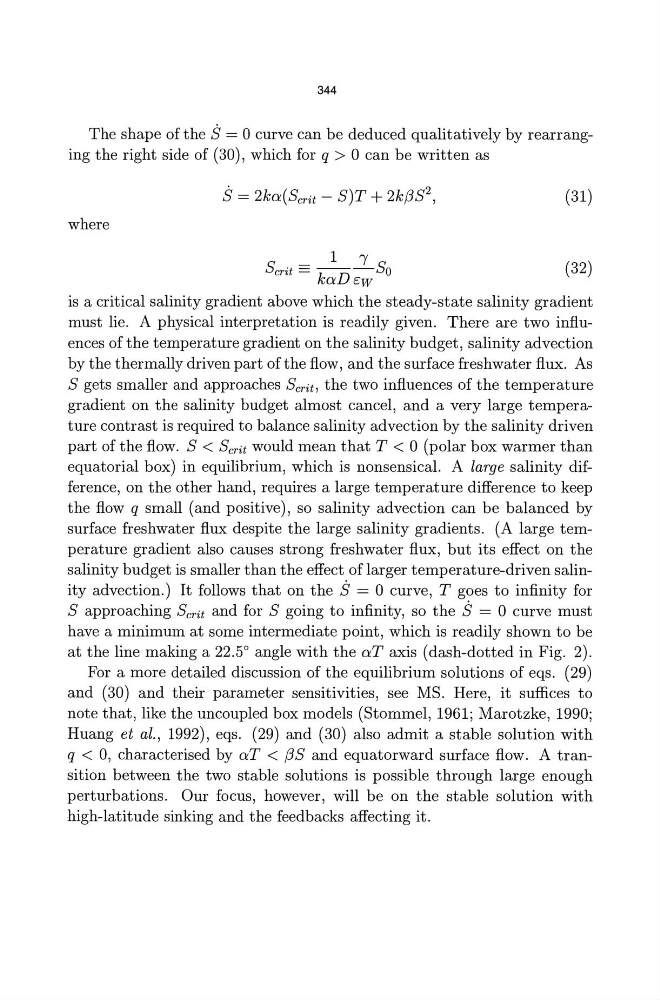
The shape of the S = 0 curve can be deduced qualitatively by rearranging the right side of (30), which for q > 0 can be written as
where
S = 2ka(8crit - 8)T + 2k(38 2 ,
1 '"Y
8crit == ----80
kaDcw
(31)
(32)
is a critical salinity gradient above which the steady-state salinity gradient
must lie. A physical interpretation is readily given. There are two influences of the temperature gradient on the salinity budget, salinity advection
by the thermally driven part of the flow, and the surface freshwater flux. As
8 gets smaller and approaches 8crit, the two influences of the temperature
gradient on the salinity budget almost cancel, and a very large temperature contrast is required to balance salinity advection by the salinity driven
part of the flow. 8 < 8crit would mean that T < 0 (polar box warmer than
equatorial box) in equilibrium, which is nonsensical. A large salinity difference, on the other hand, requires a large temperature difference to keep
the flow q small (and positive), so salinity advection can be balanced by
surface freshwater flux despite the large salinity gradients. (A large temperature gradient also causes strong freshwater flux, but its effect on the
salinity budget is smaller than the effect of larger temperature-driven salinity advection.) It follows that on the S = 0 curve, T goes to infinity for
8 approaching 8crit and for 8 going to infinity, so the S = 0 curve must
have a minimum at some intermediate point, which is readily shown to be
at the line making a 22.5° angle with the aT axis (dash-dotted in Fig. 2).
For a more detailed discussion of the equilibrium solutions of eqs. (29)
and (30) and their parameter sensitivities, see MS. Here, it suffices to
note that, like the uncoupled box models (Stommel, 1961; Marotzke, 1990;
Huang et al., 1992), eqs. (29) and (30) also admit a stable solution with
q < 0, characterised by aT < (38 and equatorward surface flow. A transition between the two stable solutions is possible through large enough
perturbations. Our focus, however, will be on the stable solution with
high-latitude sinking and the feedbacks affecting it.
The shape of the S = 0 curve can be deduced qualitatively by rearranging the right side of (30), which for q > 0 can be written as
where
S = 2ka(8crit - 8)T + 2k(38 2 ,
1 '"Y
8crit == ----80
kaDcw
(31)
(32)
is a critical salinity gradient above which the steady-state salinity gradient
must lie. A physical interpretation is readily given. There are two influences of the temperature gradient on the salinity budget, salinity advection
by the thermally driven part of the flow, and the surface freshwater flux. As
8 gets smaller and approaches 8crit, the two influences of the temperature
gradient on the salinity budget almost cancel, and a very large temperature contrast is required to balance salinity advection by the salinity driven
part of the flow. 8 < 8crit would mean that T < 0 (polar box warmer than
equatorial box) in equilibrium, which is nonsensical. A large salinity difference, on the other hand, requires a large temperature difference to keep
the flow q small (and positive), so salinity advection can be balanced by
surface freshwater flux despite the large salinity gradients. (A large temperature gradient also causes strong freshwater flux, but its effect on the
salinity budget is smaller than the effect of larger temperature-driven salinity advection.) It follows that on the S = 0 curve, T goes to infinity for
8 approaching 8crit and for 8 going to infinity, so the S = 0 curve must
have a minimum at some intermediate point, which is readily shown to be
at the line making a 22.5° angle with the aT axis (dash-dotted in Fig. 2).
For a more detailed discussion of the equilibrium solutions of eqs. (29)
and (30) and their parameter sensitivities, see MS. Here, it suffices to
note that, like the uncoupled box models (Stommel, 1961; Marotzke, 1990;
Huang et al., 1992), eqs. (29) and (30) also admit a stable solution with
q < 0, characterised by aT < (38 and equatorward surface flow. A transition between the two stable solutions is possible through large enough
perturbations. Our focus, however, will be on the stable solution with
high-latitude sinking and the feedbacks affecting it.