

1985
307
2035
time[yrs]
2085
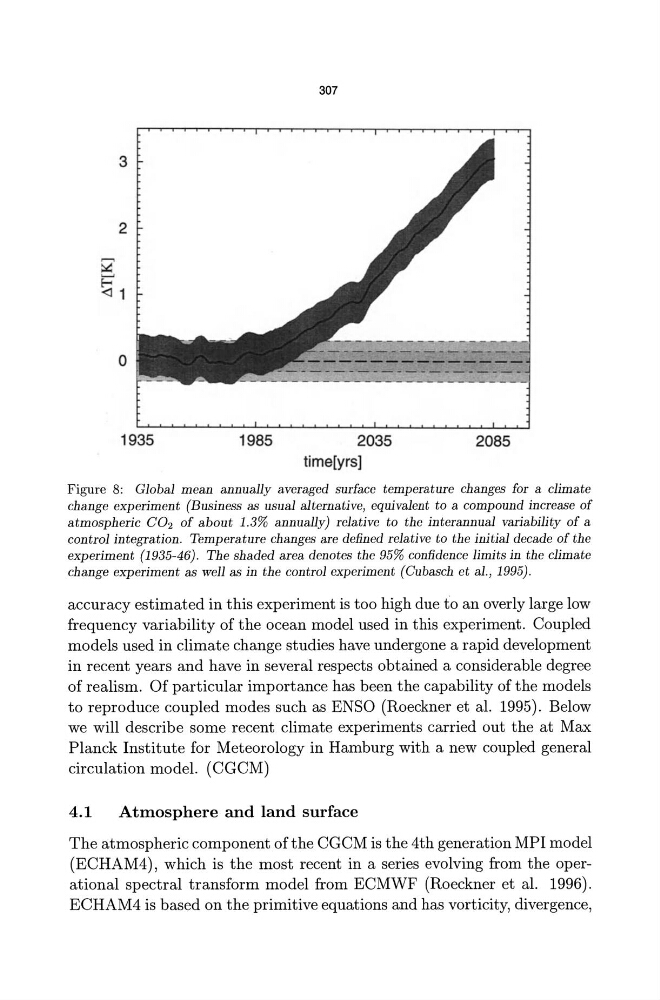
Figure 8: Global mean annually averaged surface temperature cbanges for a climate
change experiment (Business as usual alternative, equivalent to a compound increase of
atmospberic CO2 of about 1.3% annually) relative to tbe interannual variability of a
control integration. Temp erature changes are defined relative to the initial decade of the
experiment (1935-46). The shaded area denotes tbe 95% confidence limits in the climate
cbange experiment as well as in tbe control experiment (Cubascb et aI., 1995).
accuracy estimated in this experiment is too high due to an overly large low
frequency variability of the ocean model used in this experiment. Coupled
models used in climate change studies have undergone a rapid development
in recent years and have in several respects obtained a considerable degree
of realism. Of particular importance has been the capability of the models
to reproduce coupled modes such as ENSO (Roeckner et al. 1995). Below
we will describe some recent climate experiments carried out the at Max
Planck Institute for Meteorology in Hamburg with a new coupled general
circulation model. (CGCM)
4.1
Atmosphere and land surface
The atmospheric component of the CGCM is the 4th generation MPI model
(ECHAM4), which is the most recent in a series evolving from the operational spectral transform model from ECMWF (Roeckner et al. 1996).
ECHAM4 is based on the primitive equations and has vorticity, divergence,
307
2035
time[yrs]
2085
Figure 8: Global mean annually averaged surface temperature cbanges for a climate
change experiment (Business as usual alternative, equivalent to a compound increase of
atmospberic CO2 of about 1.3% annually) relative to tbe interannual variability of a
control integration. Temp erature changes are defined relative to the initial decade of the
experiment (1935-46). The shaded area denotes tbe 95% confidence limits in the climate
cbange experiment as well as in tbe control experiment (Cubascb et aI., 1995).
accuracy estimated in this experiment is too high due to an overly large low
frequency variability of the ocean model used in this experiment. Coupled
models used in climate change studies have undergone a rapid development
in recent years and have in several respects obtained a considerable degree
of realism. Of particular importance has been the capability of the models
to reproduce coupled modes such as ENSO (Roeckner et al. 1995). Below
we will describe some recent climate experiments carried out the at Max
Planck Institute for Meteorology in Hamburg with a new coupled general
circulation model. (CGCM)
4.1
Atmosphere and land surface
The atmospheric component of the CGCM is the 4th generation MPI model
(ECHAM4), which is the most recent in a series evolving from the operational spectral transform model from ECMWF (Roeckner et al. 1996).
ECHAM4 is based on the primitive equations and has vorticity, divergence,