

301
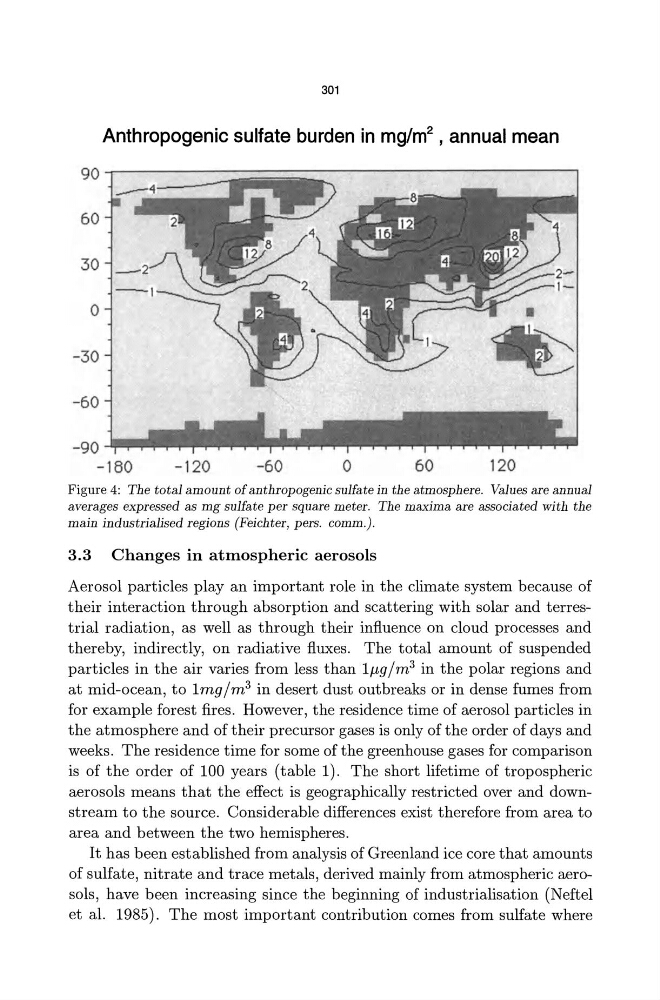
Anthropogenic sulfate burden in mg/m2, annual mean
90~-----------------------------------------'
60
30
o
-30
-60
-90
-180
-120
-60
o
60
120
Figure 4: The total amount of anthropogenic sulfate in the atmosphere. Values are annual
averages expressed as mg sulfate per square meter. The maxima are associated with the
main industrialised regions (Feichter, pers. comm.).
3.3 Changes in atmospheric aerosols
Aerosol particles play an important role in the climate system because of
their interaction through absorption and scattering with solar and terrestrial radiation, as well as through their influence on cloud processes and
thereby, indirectly, on radiative fluxes . The total amount of suspended
particles in the air varies from less than 1p,g/m 3 in the polar regions and
at mid-ocean, to 1mg/m 3 in desert dust outbreaks or in dense fumes from
for example forest fires. However, the residence time of aerosol particles in
the atmosphere and of their precursor gases is only of the order of days and
weeks. The residence time for some of the greenhouse gases for comparison
is of the order of 100 years (table 1). The short lifetime of tropospheric
aerosols means that the effect is geographically restricted over and downstream to the source. Considerable differences exist therefore from area to
area and between the two hemispheres.
It has been established from analysis of Greenland ice core that amounts
of sulfate, nitrate and trace metals, derived mainly from atmospheric aerosols, have been increasing since the beginning of industrialisation (Neftel
et al. 1985). The most important contribution comes from sulfate where
Anthropogenic sulfate burden in mg/m2, annual mean
90~-----------------------------------------'
60
30
o
-30
-60
-90
-180
-120
-60
o
60
120
Figure 4: The total amount of anthropogenic sulfate in the atmosphere. Values are annual
averages expressed as mg sulfate per square meter. The maxima are associated with the
main industrialised regions (Feichter, pers. comm.).
3.3 Changes in atmospheric aerosols
Aerosol particles play an important role in the climate system because of
their interaction through absorption and scattering with solar and terrestrial radiation, as well as through their influence on cloud processes and
thereby, indirectly, on radiative fluxes . The total amount of suspended
particles in the air varies from less than 1p,g/m 3 in the polar regions and
at mid-ocean, to 1mg/m 3 in desert dust outbreaks or in dense fumes from
for example forest fires. However, the residence time of aerosol particles in
the atmosphere and of their precursor gases is only of the order of days and
weeks. The residence time for some of the greenhouse gases for comparison
is of the order of 100 years (table 1). The short lifetime of tropospheric
aerosols means that the effect is geographically restricted over and downstream to the source. Considerable differences exist therefore from area to
area and between the two hemispheres.
It has been established from analysis of Greenland ice core that amounts
of sulfate, nitrate and trace metals, derived mainly from atmospheric aerosols, have been increasing since the beginning of industrialisation (Neftel
et al. 1985). The most important contribution comes from sulfate where