

AO
w
?
0:
::>
... ..
'" w .. ::I w ...
TIME
214
ARCTIC OCEAN
GREENLAND SEA
.'.:. a,s
a,s
: ..• ,: ' to:".
FRAM
STRAIT
8
oc
GS
1980
11180
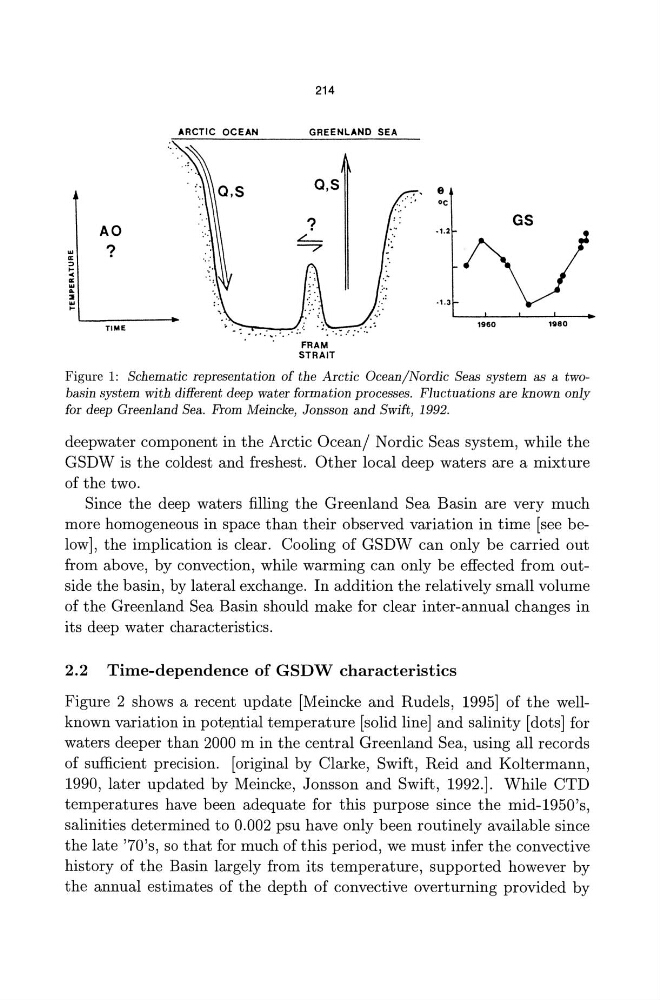
Figure 1: Schematic representation of the Arctic Ocean/Nordic Seas system as a twobasin system with different deep water formation processes. Fluctuations are known only
for deep Greenland Sea. From Meincke, Jonsson and Swift, 1992.
deepwater component in the Arctic Ocean/ Nordic Seas system, while the
GSDW is the coldest and freshest. Other local deep waters are a mixture
of the two.
Since the deep waters filling the Greenland Sea Basin are very much
more homogeneous in space than their observed variation in time [see below], the implication is clear. Cooling of GSDW can only be carried out
from above, by convection, while warming can only be effected from outside the basin, by lateral exchange. In addition the relatively small volume
of the Greenland Sea Basin should make for clear inter-annual changes in
its deep water characteristics.
2.2 Time-dependence of GSDW characteristics
Figure 2 shows a recent update [Meincke and Rudels, 1995] of the wellknown variation in pote;ntial temperature [solid line] and salinity [dots] for
waters deeper than 2000 m in the central Greenland Sea, using all records
of sufficient precision. [original by Clarke, Swift, Reid and Koltermann,
1990, later updated by Meincke, Jonsson and Swift, 1992.]. While CTD
temperatures have been adequate for this purpose since the mid-1950's,
salinities determined to 0.002 psu have only been routinely available since
the late '70's, so that for much of this period, we must infer the convective
history of the Basin largely from its temperature, supported however by
the annual estimates of the depth of convective overturning provided by
w
?
0:
::>
... ..
'" w .. ::I w ...
TIME
214
ARCTIC OCEAN
GREENLAND SEA
.'.:. a,s
a,s
: ..• ,: ' to:".
FRAM
STRAIT
8
oc
GS
1980
11180
Figure 1: Schematic representation of the Arctic Ocean/Nordic Seas system as a twobasin system with different deep water formation processes. Fluctuations are known only
for deep Greenland Sea. From Meincke, Jonsson and Swift, 1992.
deepwater component in the Arctic Ocean/ Nordic Seas system, while the
GSDW is the coldest and freshest. Other local deep waters are a mixture
of the two.
Since the deep waters filling the Greenland Sea Basin are very much
more homogeneous in space than their observed variation in time [see below], the implication is clear. Cooling of GSDW can only be carried out
from above, by convection, while warming can only be effected from outside the basin, by lateral exchange. In addition the relatively small volume
of the Greenland Sea Basin should make for clear inter-annual changes in
its deep water characteristics.
2.2 Time-dependence of GSDW characteristics
Figure 2 shows a recent update [Meincke and Rudels, 1995] of the wellknown variation in pote;ntial temperature [solid line] and salinity [dots] for
waters deeper than 2000 m in the central Greenland Sea, using all records
of sufficient precision. [original by Clarke, Swift, Reid and Koltermann,
1990, later updated by Meincke, Jonsson and Swift, 1992.]. While CTD
temperatures have been adequate for this purpose since the mid-1950's,
salinities determined to 0.002 psu have only been routinely available since
the late '70's, so that for much of this period, we must infer the convective
history of the Basin largely from its temperature, supported however by
the annual estimates of the depth of convective overturning provided by