

198
PV=l/F=O
SURFACE HEAT FLUX (F=O)
O ~~
- 0.2 t----l--+--+-+--~n'
0.02 r-----~----_____,
0.01
- 0.4
-O.S
-0.8
- 0.01
- 1 ~----~----~
-0 . 02 '------~----....J
o
0.5
o
0.5
(a)
MAX PSI = 0.01601
(b)
PV=1/F=2
0.02 ,-------~----__,
0.01
HEAT FLUX
(c)
O _ _ _ __ -r--0.01
FRESHENING
-0 . 02 '------~-------'
o
0.5
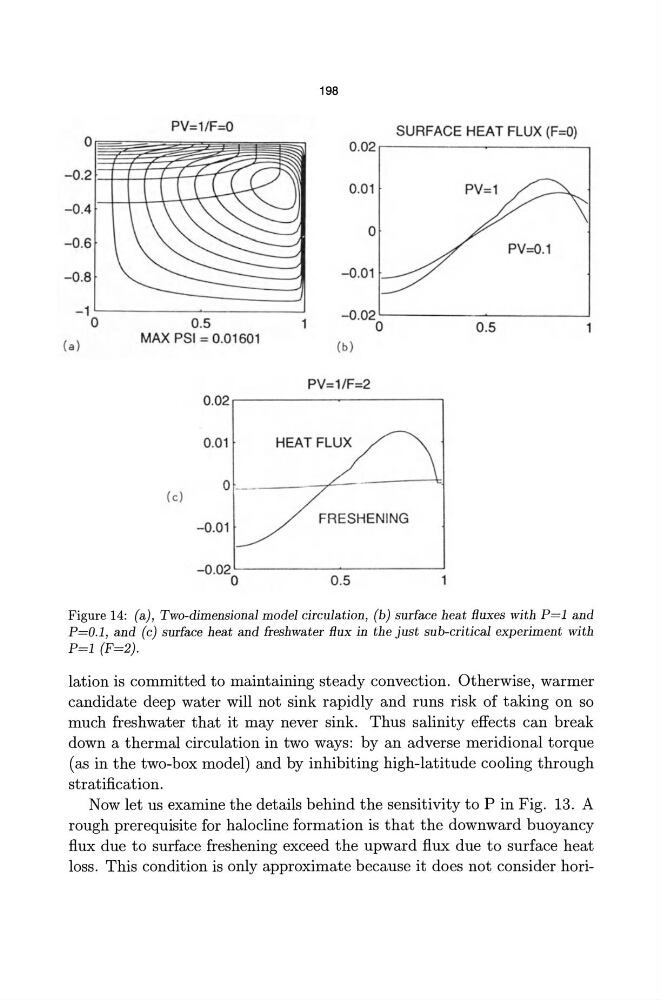
Figure 14: (a), T wo-dimensional model circulation, (b) surface heat fluxes with P=l and
P=O.l , and (c) surface heat and freshwater flux in the just sub-critical experiment with
P=l (F=2) .
lation is committed to maintaining steady convection. Otherwise, warmer
candidate deep water will not sink rapidly and runs risk of taking on so
much freshwater that it may never sink. Thus salinity effects can break
down a thermal circulation in two ways: by an adverse meridional torque
(as in the two-box model) and by inhibiting high-latitude cooling through
stratification.
Now let us examine the details behind the sensitivity to P in Fig. 13. A
rough prerequisite for halo cline formation is that the downward buoyancy
flux due to surface freshening exceed the upward flux due to surface heat
loss. This condition is only approximate because it does not consider hori-
PV=l/F=O
SURFACE HEAT FLUX (F=O)
O ~~
- 0.2 t----l--+--+-+--~n'
0.02 r-----~----_____,
0.01
- 0.4
-O.S
-0.8
- 0.01
- 1 ~----~----~
-0 . 02 '------~----....J
o
0.5
o
0.5
(a)
MAX PSI = 0.01601
(b)
PV=1/F=2
0.02 ,-------~----__,
0.01
HEAT FLUX
(c)
O _ _ _ __ -r--0.01
FRESHENING
-0 . 02 '------~-------'
o
0.5
Figure 14: (a), T wo-dimensional model circulation, (b) surface heat fluxes with P=l and
P=O.l , and (c) surface heat and freshwater flux in the just sub-critical experiment with
P=l (F=2) .
lation is committed to maintaining steady convection. Otherwise, warmer
candidate deep water will not sink rapidly and runs risk of taking on so
much freshwater that it may never sink. Thus salinity effects can break
down a thermal circulation in two ways: by an adverse meridional torque
(as in the two-box model) and by inhibiting high-latitude cooling through
stratification.
Now let us examine the details behind the sensitivity to P in Fig. 13. A
rough prerequisite for halo cline formation is that the downward buoyancy
flux due to surface freshening exceed the upward flux due to surface heat
loss. This condition is only approximate because it does not consider hori-