

197
BREAKDOWN POINT
10
23%
9
"
8
26%
7
z
Z
22%
w 5
I
CI)
11%
NO CONV. ADJUST.
w
II
U. 4
3
5%
2
0%
OL-------__ L-________ L-________ L-______ ~ ________ ~ __ ~
o
0.2
0.4
0.6
0.8
THERMAL B. C. PISTON VELOCITY
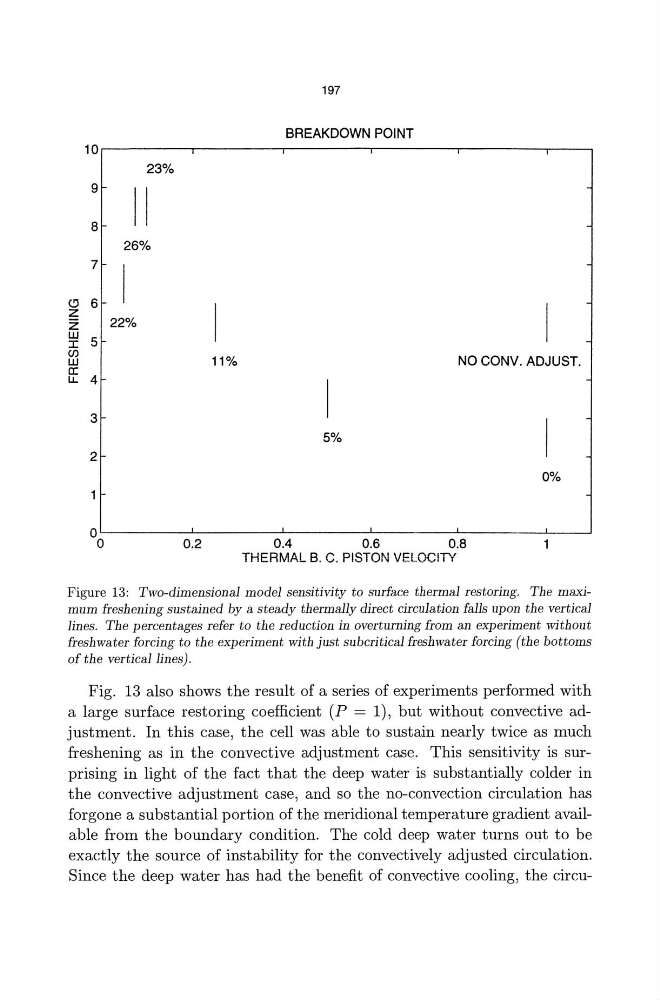
Figure 13: Two-dimensional model sensitivity to surface thermal restoring. The maximum freshening sustained by a steady thermally direct circulation falls upon the vertical
lines. The percentages refer to the reduction in overturning from an experiment without
freshwater forcing to the experiment with just subcritical freshwater forcing (the bottoms
of the vertical lines).
Fig. 13 also shows the result of a series of experiments performed with
a large surface restoring coefficient (P = 1), but without convective adjustment. In this case, the cell was able to sustain nearly twice as much
freshening as in the convective adjustment case. This sensitivity is surprising in light of the fact that the deep water is substantially colder in
the convective adjustment case, and so the no-convection circulation has
forgone a substantial portion of the meridional temperature gradient available from the boundary condition. The cold deep water turns out to be
exactly the source of instability for the convectively adjusted circulation.
Since the deep water has had the benefit of convective cooling, the circu-
BREAKDOWN POINT
10
23%
9
"
8
26%
7
z
Z
22%
w 5
I
CI)
11%
NO CONV. ADJUST.
w
II
U. 4
3
5%
2
0%
OL-------__ L-________ L-________ L-______ ~ ________ ~ __ ~
o
0.2
0.4
0.6
0.8
THERMAL B. C. PISTON VELOCITY
Figure 13: Two-dimensional model sensitivity to surface thermal restoring. The maximum freshening sustained by a steady thermally direct circulation falls upon the vertical
lines. The percentages refer to the reduction in overturning from an experiment without
freshwater forcing to the experiment with just subcritical freshwater forcing (the bottoms
of the vertical lines).
Fig. 13 also shows the result of a series of experiments performed with
a large surface restoring coefficient (P = 1), but without convective adjustment. In this case, the cell was able to sustain nearly twice as much
freshening as in the convective adjustment case. This sensitivity is surprising in light of the fact that the deep water is substantially colder in
the convective adjustment case, and so the no-convection circulation has
forgone a substantial portion of the meridional temperature gradient available from the boundary condition. The cold deep water turns out to be
exactly the source of instability for the convectively adjusted circulation.
Since the deep water has had the benefit of convective cooling, the circu-