

185
with enormous calving events off of the Laurentide ice sheet have been
discovered in the subpolar North Atlantic (see review in Broecker, 1994).
These "Heinrich" events are typically spaced at 10,000 year intervals and
occur during the cold part of the Dansgaard-Oeschger (D-O) cycles. The
volume of ice involved in these discharges has been estimated to be nearly
half of the current Greenland ice sheet or 5% of the Laurentide Ice sheet
at its maximum (MacAyeal, 1993). MacAyeal estimates the associated
freshwater flux at 0.16 Sv (about 1/2 of the current net freshening of the
subpolar North Atlantic). The Heinrich events occur within the D-O cold
phases and precede warm phases, sometimes by a substantial interval. The
HI event, for example, preceded the warming at 12,700 14C years BP by
some 1,400 14C years. Thus these large impulsive salinity forcings are not
easily connected to changes in NADW production.
Another possibility is that the Dansgaard-Oeschger events arise as an
internal response of the ocean to the changed environment of the glacial
period. This hypothesis finds support from some very simple modeling
experiments using simplified geometries- we shall describe one here. Winton and Sarachik (1993) produced and analyzed a millennial oscillation in
a sector OGCM under steady mixed boundary condition forcing. These
oscillations were named "deep-decoupling oscillations" because there are
small and large heat fluxes associated with the absence and presence of
deep overturning respectively. A variant of this theory (Winton, 1993)
uses spherical coordinates in a general circulation model based upon the
diagnostic horizontal momentum balance:
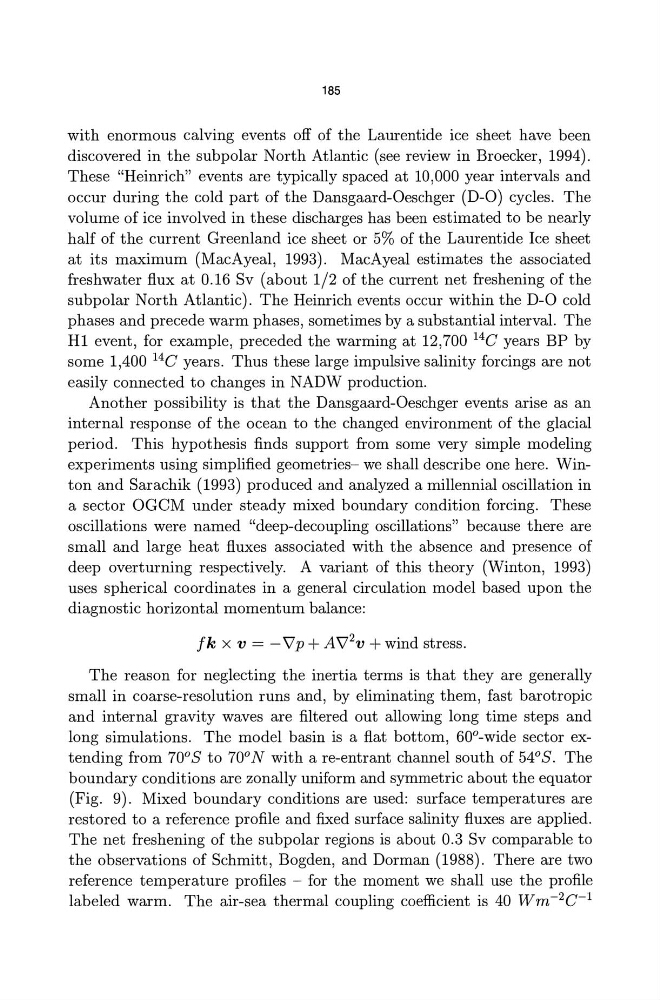
fk x v = - 'Vp + A'V 2 v + wind stress.
The reason for neglecting the inertia terms is that they are generally
small in coarse-resolution runs and, by eliminating them, fast barotropic
and internal gravity waves are filtered out allowing long time steps and
long simulations. The model basin is a flat bottom, 60°-wide sector extending from 70° S to 70° N with a re-entrant channel south of 54° S. The
boundary conditions are zonally uniform and symmetric about the equator
(Fig. 9). Mixed boundary conditions are used: surface temperatures are
restored to a reference profile and fixed surface salinity fluxes are applied.
The net freshening of the subpolar regions is about 0.3 Sv comparable to
the observations of Schmitt, Bogden, and Dorman (1988). There are two
reference temperature profiles - for the moment we shall use the profile
labeled warm. The air-sea thermal coupling coefficient is 40 Wm- 2 C- 1
with enormous calving events off of the Laurentide ice sheet have been
discovered in the subpolar North Atlantic (see review in Broecker, 1994).
These "Heinrich" events are typically spaced at 10,000 year intervals and
occur during the cold part of the Dansgaard-Oeschger (D-O) cycles. The
volume of ice involved in these discharges has been estimated to be nearly
half of the current Greenland ice sheet or 5% of the Laurentide Ice sheet
at its maximum (MacAyeal, 1993). MacAyeal estimates the associated
freshwater flux at 0.16 Sv (about 1/2 of the current net freshening of the
subpolar North Atlantic). The Heinrich events occur within the D-O cold
phases and precede warm phases, sometimes by a substantial interval. The
HI event, for example, preceded the warming at 12,700 14C years BP by
some 1,400 14C years. Thus these large impulsive salinity forcings are not
easily connected to changes in NADW production.
Another possibility is that the Dansgaard-Oeschger events arise as an
internal response of the ocean to the changed environment of the glacial
period. This hypothesis finds support from some very simple modeling
experiments using simplified geometries- we shall describe one here. Winton and Sarachik (1993) produced and analyzed a millennial oscillation in
a sector OGCM under steady mixed boundary condition forcing. These
oscillations were named "deep-decoupling oscillations" because there are
small and large heat fluxes associated with the absence and presence of
deep overturning respectively. A variant of this theory (Winton, 1993)
uses spherical coordinates in a general circulation model based upon the
diagnostic horizontal momentum balance:
fk x v = - 'Vp + A'V 2 v + wind stress.
The reason for neglecting the inertia terms is that they are generally
small in coarse-resolution runs and, by eliminating them, fast barotropic
and internal gravity waves are filtered out allowing long time steps and
long simulations. The model basin is a flat bottom, 60°-wide sector extending from 70° S to 70° N with a re-entrant channel south of 54° S. The
boundary conditions are zonally uniform and symmetric about the equator
(Fig. 9). Mixed boundary conditions are used: surface temperatures are
restored to a reference profile and fixed surface salinity fluxes are applied.
The net freshening of the subpolar regions is about 0.3 Sv comparable to
the observations of Schmitt, Bogden, and Dorman (1988). There are two
reference temperature profiles - for the moment we shall use the profile
labeled warm. The air-sea thermal coupling coefficient is 40 Wm- 2 C- 1