

131
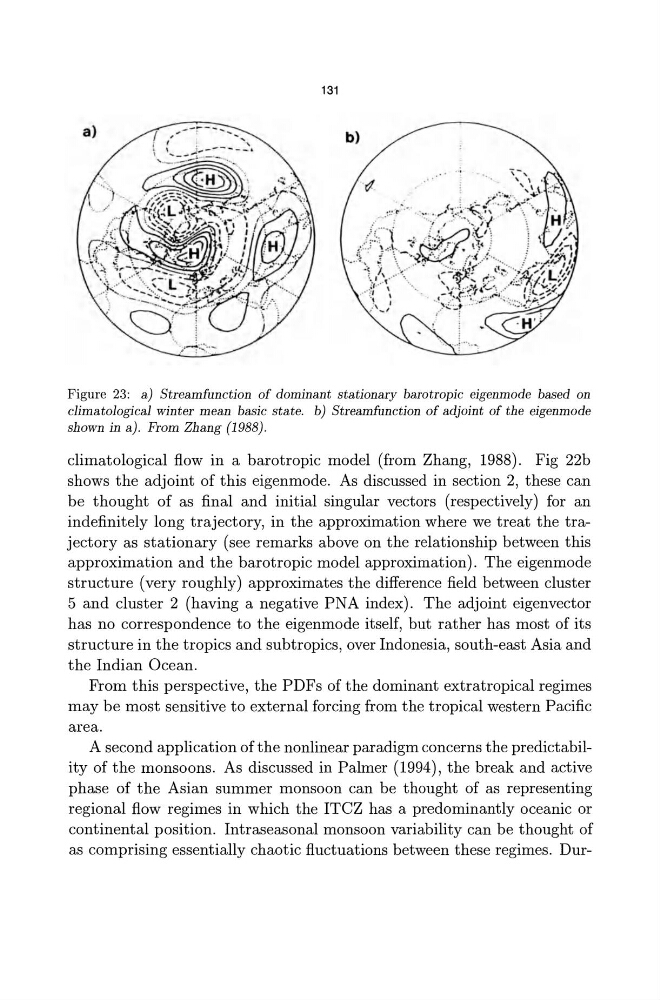
Figure 23: a) Streamfunction of dominant stationary barotropic eigenmode based on
climatological winter mean basic state. b) Streamfunction of adjoint of the eigenmode
shown in a). From Zhang (1988).
climatological flow in a barotropic model (from Zhang, 1988). Fig 22b
shows the adjoint of this eigenmode. As discussed in section 2, these can
be thought of as final and initial singular vectors (respectively) for an
indefinitely long trajectory, in the approximation where we treat the trajectory as stationary (see remarks above on the relationship between this
approximation and the barotropic model approximation). The eigenmode
structure (very roughly) approximates the difference field between cluster
5 and cluster 2 (having a negative PNA index). The adjoint eigenvector
has no correspondence to the eigenmode itself, but rather has most of its
structure in the tropics and subtropics, over Indonesia, south-east Asia and
the Indian Ocean.
From this perspective, the PDFs of the dominant extratropical regimes
may be most sensitive to external forcing from the tropical western Pacific
area.
A second application of the nonlinear paradigm concerns the predictability of the monsoons. As discussed in Palmer (1994), the break and active
phase of the Asian summer monsoon can be thought of as representing
regional flow regimes in which the ITCZ has a predominantly oceanic or
continental position. Intraseasonal monsoon variability can be thought of
as comprising essentially chaotic fluctuations between these regimes. Dur-
Figure 23: a) Streamfunction of dominant stationary barotropic eigenmode based on
climatological winter mean basic state. b) Streamfunction of adjoint of the eigenmode
shown in a). From Zhang (1988).
climatological flow in a barotropic model (from Zhang, 1988). Fig 22b
shows the adjoint of this eigenmode. As discussed in section 2, these can
be thought of as final and initial singular vectors (respectively) for an
indefinitely long trajectory, in the approximation where we treat the trajectory as stationary (see remarks above on the relationship between this
approximation and the barotropic model approximation). The eigenmode
structure (very roughly) approximates the difference field between cluster
5 and cluster 2 (having a negative PNA index). The adjoint eigenvector
has no correspondence to the eigenmode itself, but rather has most of its
structure in the tropics and subtropics, over Indonesia, south-east Asia and
the Indian Ocean.
From this perspective, the PDFs of the dominant extratropical regimes
may be most sensitive to external forcing from the tropical western Pacific
area.
A second application of the nonlinear paradigm concerns the predictability of the monsoons. As discussed in Palmer (1994), the break and active
phase of the Asian summer monsoon can be thought of as representing
regional flow regimes in which the ITCZ has a predominantly oceanic or
continental position. Intraseasonal monsoon variability can be thought of
as comprising essentially chaotic fluctuations between these regimes. Dur-