

126
1=0
1=2
20,0 r---~--~--~-------'
20,0 r-----~------~---_____,
0)
150.0
200,0
1=3
1=4
~0 r--------------------.
20.0 r---~--~--~--_____,
0 ,0
0.0
020, °0' -;:-, 0 - -----= ... ::- o -----:-: ,OO :!:c. 0:----~ ,50. :-:- 0 -----::l 200.0· -20·°0· ' =' ,
0 --------= .. 7 4 ----"OO ~,O :--------:-:' , .. :-:: .O- - - = 200.0
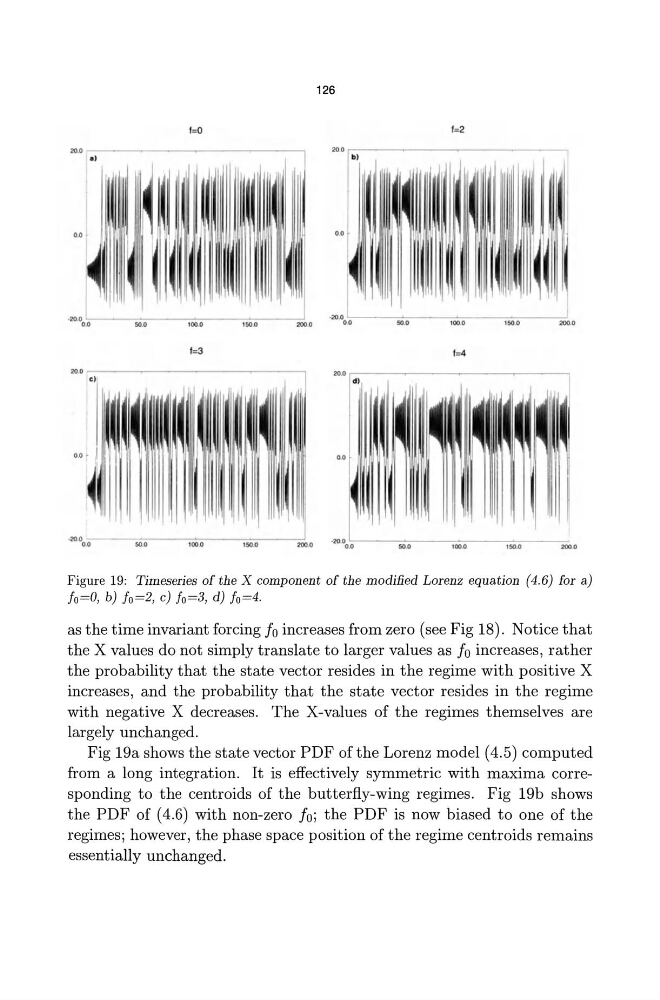
Figure 19: Timeseries of the X component of the modified Lorenz equation (4.6) for a)
10=0, b) 10=2, c) 10=3, d) 10=4.
as the time invariant forcing fo increases from zero (see Fig 18). Notice that
the X values do not simply translate to larger values as fo increases, rather
the probability that the state vector resides in the regime with positive X
increases, and the probability that the state vector resides in the regime
with negative X decreases. The X-values of the regimes themselves are
largely unchanged.
Fig 19a shows the state vector PDF of the Lorenz model (4.5) computed
from a long integration. It is effectively symmetric with maxima corresponding to the centroids of the butterfly-wing regimes. Fig 19b shows
the PDF of (4.6) with non-zero fo; the PDF is now biased to one of the
regimes; however, the phase space position of the regime centroids remains
essentially unchanged.
1=0
1=2
20,0 r---~--~--~-------'
20,0 r-----~------~---_____,
0)
150.0
200,0
1=3
1=4
~0 r--------------------.
20.0 r---~--~--~--_____,
0 ,0
0.0
020, °0' -;:-, 0 - -----= ... ::- o -----:-: ,OO :!:c. 0:----~ ,50. :-:- 0 -----::l 200.0· -20·°0· ' =' ,
0 --------= .. 7 4 ----"OO ~,O :--------:-:' , .. :-:: .O- - - = 200.0
Figure 19: Timeseries of the X component of the modified Lorenz equation (4.6) for a)
10=0, b) 10=2, c) 10=3, d) 10=4.
as the time invariant forcing fo increases from zero (see Fig 18). Notice that
the X values do not simply translate to larger values as fo increases, rather
the probability that the state vector resides in the regime with positive X
increases, and the probability that the state vector resides in the regime
with negative X decreases. The X-values of the regimes themselves are
largely unchanged.
Fig 19a shows the state vector PDF of the Lorenz model (4.5) computed
from a long integration. It is effectively symmetric with maxima corresponding to the centroids of the butterfly-wing regimes. Fig 19b shows
the PDF of (4.6) with non-zero fo; the PDF is now biased to one of the
regimes; however, the phase space position of the regime centroids remains
essentially unchanged.