

124
from the physical parametrisations. We have argued that a complete specification of the initial state would include not only the best estimate of the
initial conditions, but also a probability distribution of the error associated with that best estimate. Similarly, given the inherent uncertainties
in parametrising sub-gridscale processes, a complete specification of the
diabatic tendency in a grid box should include not only our best estimate
of the diabatic tendency (ie the parametrised tendency), but also a probability distribution of the error associated with that estimate.
When considering the probability distribution of parametrised diabatic
tendency, it is certainly not permissable to ignore the first moment. This
first moment can be thought of as defining what is generally referred to
as 'systematic error'. However, in addition to its systematic component,
the parametrised diabatic tendency will certainly have a stochastic component of error. Consider, for example, the parametrisation of convective
heating in terms, say, of resolved moisture fluxes or temperature profiles.
If convectively-driven mesoscale circulations occur on scales which are not
substantially smaller than the resolution of the model, then the usual assumptions of a quasi-equilibrium of convective heating elements within a
grid box will fail. This failure will generate a second moment of the PDF.
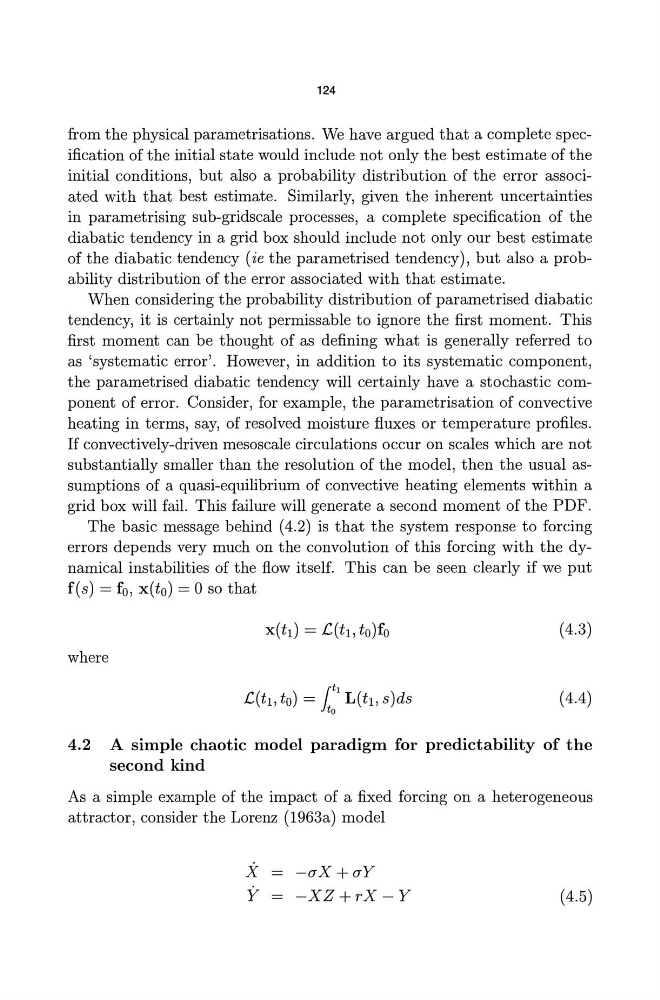
The basic message behind (4.2) is that the system response to forcing
errors depends very much on the convolution of this forcing with the dynamical instabilities of the flow itself. This can be seen clearly if we put
f(s) = fo, x(to) = 0 so that
(4.3)
where
(4.4)
4.2 A simple chaotic model paradigm for predictability of the
second kind
As a simple example of the impact of a fixed forcing on a heterogeneous
attractor, consider the Lorenz (1963a) model
x
Y
-aX + oY
-XZ+rX-Y
(4.5)
from the physical parametrisations. We have argued that a complete specification of the initial state would include not only the best estimate of the
initial conditions, but also a probability distribution of the error associated with that best estimate. Similarly, given the inherent uncertainties
in parametrising sub-gridscale processes, a complete specification of the
diabatic tendency in a grid box should include not only our best estimate
of the diabatic tendency (ie the parametrised tendency), but also a probability distribution of the error associated with that estimate.
When considering the probability distribution of parametrised diabatic
tendency, it is certainly not permissable to ignore the first moment. This
first moment can be thought of as defining what is generally referred to
as 'systematic error'. However, in addition to its systematic component,
the parametrised diabatic tendency will certainly have a stochastic component of error. Consider, for example, the parametrisation of convective
heating in terms, say, of resolved moisture fluxes or temperature profiles.
If convectively-driven mesoscale circulations occur on scales which are not
substantially smaller than the resolution of the model, then the usual assumptions of a quasi-equilibrium of convective heating elements within a
grid box will fail. This failure will generate a second moment of the PDF.
The basic message behind (4.2) is that the system response to forcing
errors depends very much on the convolution of this forcing with the dynamical instabilities of the flow itself. This can be seen clearly if we put
f(s) = fo, x(to) = 0 so that
(4.3)
where
(4.4)
4.2 A simple chaotic model paradigm for predictability of the
second kind
As a simple example of the impact of a fixed forcing on a heterogeneous
attractor, consider the Lorenz (1963a) model
x
Y
-aX + oY
-XZ+rX-Y
(4.5)