

168
M.B. Framiiian . M.P. EtaJa . E.M. Acha . R. A. Guerrero· C.A. Lasta . O.B. Brown
8.3.3
Storm Surges
The estuary is frequently affected by an extraordinary rise in the water level due to
atmospheric forcing. Northwestward winds are the major mechanism responsible for
this rise, by piling up of water. Winds blow onshore over the continental shelf, producing storm surges which increase their magnitude when they enter the very shallow water close to the Argentine coastline north of 38°S and at the mouth of the estuary. The worst flooding occurs during the atmospheric situation that local tradition
calls "sudestada". Strictly, this situation involves a migrating anticyclone moving over
the sea off Patagonia and an extratropical cyclogenesis that develops and evolves as it
moves to the northeast of Rio de la Plata (Seluchi 1995). Under this synoptic conditions, the "sudestada" may last several days. The estuary's low southwestern coastline,
highly populated, suffers severe flooding during the most intense of these events.
Moreover, the "sudestadas" are accompanied by localised and sustained heavy rain that
contributes to urban flooding. The "sudestadas" is not always related to cyclogenesis,
as was noted by Ciappesoni and Salio (1996), but it is always associated with a high
pressure system located south of the estuary. These authors identified twenty one cases
during the period 1990-1994; only six of them included cyclogenesis to the north.
Other mechanisms have been considered to produce water level rise in the estuary, although their consequences are not so extreme. Winds blowing equatorward can
generate surge waves on the shelf which propagate into the estuary from south to north.
Such events have been identified by Alvarez and Balay (1970). Romero (1994) studied
several cases, found correlations and established the propagation time along the shelf
for forecasting purposes. They found that in most cases these waves are associated
with strong extratropical cyclones moving off the coast and isobars parallel to the
-34.5
III - 35.0
"C
:::J
:=
iii
...J - 35.5
-36.0
-58.0
-57.5
-57.0
- 56.5
-56.0
- 55.5
Longitude
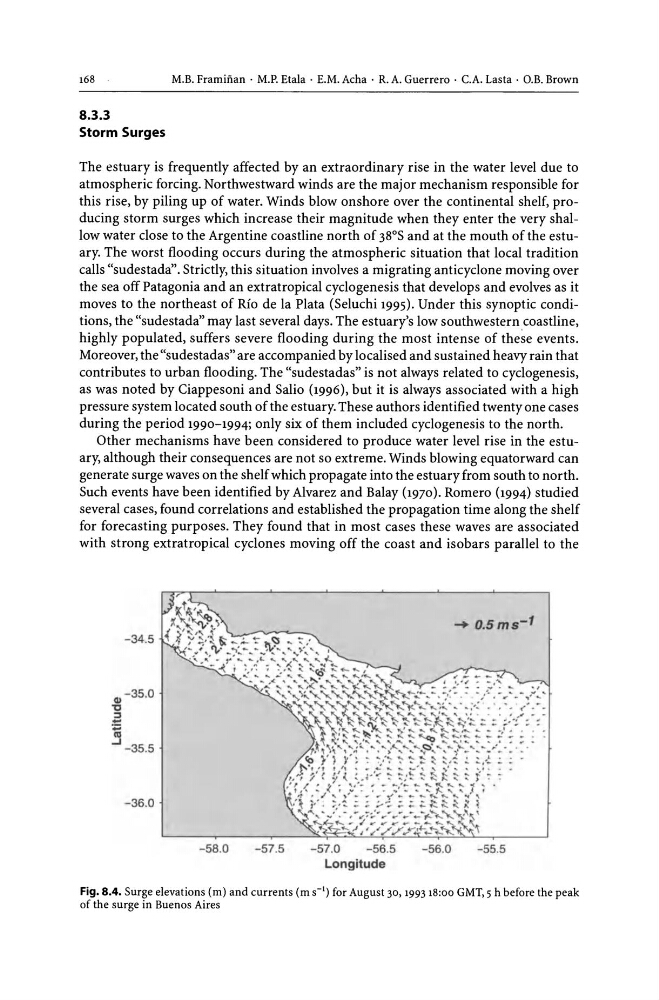
Fig. 8.4. Surge elevations (m) and currents (m S-I) for August 30,199318:00 GMT, 5 h before the peak
of the surge in Buenos Aires
M.B. Framiiian . M.P. EtaJa . E.M. Acha . R. A. Guerrero· C.A. Lasta . O.B. Brown
8.3.3
Storm Surges
The estuary is frequently affected by an extraordinary rise in the water level due to
atmospheric forcing. Northwestward winds are the major mechanism responsible for
this rise, by piling up of water. Winds blow onshore over the continental shelf, producing storm surges which increase their magnitude when they enter the very shallow water close to the Argentine coastline north of 38°S and at the mouth of the estuary. The worst flooding occurs during the atmospheric situation that local tradition
calls "sudestada". Strictly, this situation involves a migrating anticyclone moving over
the sea off Patagonia and an extratropical cyclogenesis that develops and evolves as it
moves to the northeast of Rio de la Plata (Seluchi 1995). Under this synoptic conditions, the "sudestada" may last several days. The estuary's low southwestern coastline,
highly populated, suffers severe flooding during the most intense of these events.
Moreover, the "sudestadas" are accompanied by localised and sustained heavy rain that
contributes to urban flooding. The "sudestadas" is not always related to cyclogenesis,
as was noted by Ciappesoni and Salio (1996), but it is always associated with a high
pressure system located south of the estuary. These authors identified twenty one cases
during the period 1990-1994; only six of them included cyclogenesis to the north.
Other mechanisms have been considered to produce water level rise in the estuary, although their consequences are not so extreme. Winds blowing equatorward can
generate surge waves on the shelf which propagate into the estuary from south to north.
Such events have been identified by Alvarez and Balay (1970). Romero (1994) studied
several cases, found correlations and established the propagation time along the shelf
for forecasting purposes. They found that in most cases these waves are associated
with strong extratropical cyclones moving off the coast and isobars parallel to the
-34.5
III - 35.0
"C
:::J
:=
iii
...J - 35.5
-36.0
-58.0
-57.5
-57.0
- 56.5
-56.0
- 55.5
Longitude
Fig. 8.4. Surge elevations (m) and currents (m S-I) for August 30,199318:00 GMT, 5 h before the peak
of the surge in Buenos Aires