

CHAPTER 8 . Physical Characteristics and Processes of the Rio de la Plata Estuary
169
coast. Within the estuary, the surge shows minimal or no correlation with local winds.
Sometimes, an intense high pressure system establishes over Patagonia and the center
of Argentina intensifying the equatorward winds, with a fetch that covers almost the
entire Argentine continental shelf and a duration close to one day. This situation produces strong alongshore currents on the shelf. In steady state, the elevated water level
in Rio de la Plata is geostrophically adjusted to the currents. The periodicity of extraordinarily high sea levels events in the Rio de la Plata was analysed by Balay (1959).
He found a significant relationship between the maximum annual heights over a period of 37 years, and the mean longitude of the lunar perigee and the ascending node
of the moon. According to his results, these astronomical factors produce a favourable
environment in which the local meteorological forcings described above in this section, would lead to the largest floods in the estuary. On these basis, he proposed a method
for prediction of the maximum annual heights, which was tested on a 21 year series.
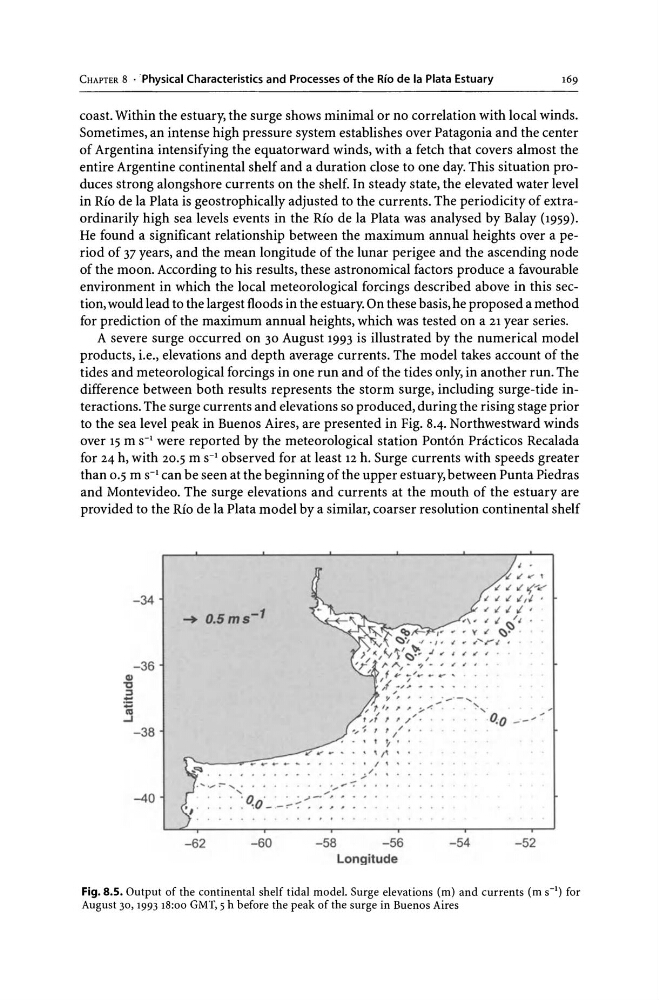
A severe surge occurred on 30 August 1993 is illustrated by the numerical model
products, i.e., elevations and depth average currents. The model takes account of the
tides and meteorological forcings in one run and of the tides only, in another run. The
difference between both results represents the storm surge, including surge-tide interactions. The surge currents and elevations so produced, during the rising stage prior
to the sea level peak in Buenos Aires, are presented in Fig. 8-4. Northwestward winds
over 15 m S-l were reported by the meteorological station Ponton Pnicticos Recalada
for 24 h, with 20.5 m S-l observed for at least 12 h. Surge currents with speeds greater
than 0.5 m S-l can be seen at the beginning of the upper estuary, between Punta Piedras
and Montevideo. The surge elevations and currents at the mouth of the estuary are
provided to the Rio de la Plata model by a similar, coarser resolution continental shelf
CII
"C
:::I
-
:;
...J
-34
-36
- 38
-40
- 62
-60
-58
/ ~/~~I'.;;'~
t ",t I , /
. .
..... ., , , ,/ .
t
~ •
, I'
1 ,
, ~/ .
-56
Longitude
I .
;(~ .... ,
'" '" ,/ >{;'"
" " '" '/,J '
" ,/ , " '
,\ . " , ~I
• Y "
~ • •
, , ...... r"
--- .... .
,
' :0.0 - -~ ~
-54
-52
Fig. 8.5. Output of the continental shelf tidal model. Surge elevations (m) and currents (m S-l) for
August 30, 1993 18:00 GMT, 5 h before the peak of the surge in Buenos Aires
169
coast. Within the estuary, the surge shows minimal or no correlation with local winds.
Sometimes, an intense high pressure system establishes over Patagonia and the center
of Argentina intensifying the equatorward winds, with a fetch that covers almost the
entire Argentine continental shelf and a duration close to one day. This situation produces strong alongshore currents on the shelf. In steady state, the elevated water level
in Rio de la Plata is geostrophically adjusted to the currents. The periodicity of extraordinarily high sea levels events in the Rio de la Plata was analysed by Balay (1959).
He found a significant relationship between the maximum annual heights over a period of 37 years, and the mean longitude of the lunar perigee and the ascending node
of the moon. According to his results, these astronomical factors produce a favourable
environment in which the local meteorological forcings described above in this section, would lead to the largest floods in the estuary. On these basis, he proposed a method
for prediction of the maximum annual heights, which was tested on a 21 year series.
A severe surge occurred on 30 August 1993 is illustrated by the numerical model
products, i.e., elevations and depth average currents. The model takes account of the
tides and meteorological forcings in one run and of the tides only, in another run. The
difference between both results represents the storm surge, including surge-tide interactions. The surge currents and elevations so produced, during the rising stage prior
to the sea level peak in Buenos Aires, are presented in Fig. 8-4. Northwestward winds
over 15 m S-l were reported by the meteorological station Ponton Pnicticos Recalada
for 24 h, with 20.5 m S-l observed for at least 12 h. Surge currents with speeds greater
than 0.5 m S-l can be seen at the beginning of the upper estuary, between Punta Piedras
and Montevideo. The surge elevations and currents at the mouth of the estuary are
provided to the Rio de la Plata model by a similar, coarser resolution continental shelf
CII
"C
:::I
-
:;
...J
-34
-36
- 38
-40
- 62
-60
-58
/ ~/~~I'.;;'~
t ",t I , /
. .
..... ., , , ,/ .
t
~ •
, I'
1 ,
, ~/ .
-56
Longitude
I .
;(~ .... ,
'" '" ,/ >{;'"
" " '" '/,J '
" ,/ , " '
,\ . " , ~I
• Y "
~ • •
, , ...... r"
--- .... .
,
' :0.0 - -~ ~
-54
-52
Fig. 8.5. Output of the continental shelf tidal model. Surge elevations (m) and currents (m S-l) for
August 30, 1993 18:00 GMT, 5 h before the peak of the surge in Buenos Aires