

CHAPTER 7 . Hydrography and Sediment Transport Characteristics of the Rio de la Plata
141
56'
55'
52·
33· ~--~~~~~~~------~------~------~~~~~~--~ 33"
35·
Clay
t:;::;) Shel l fragments
~~~.~ . . :: ::
~
. 0 . . .
. n ..
:: :0 :: !'.:: ::
. · n··
.. ·n· · . . ... .
n:::: :::: :::
.. n . . . . . .. .
34'
35'
36'
3r ~~----~~----~~----~------__ -------T-------T------~-L 3r
59"
58'
sr
56'
55'
54°
53·
52·
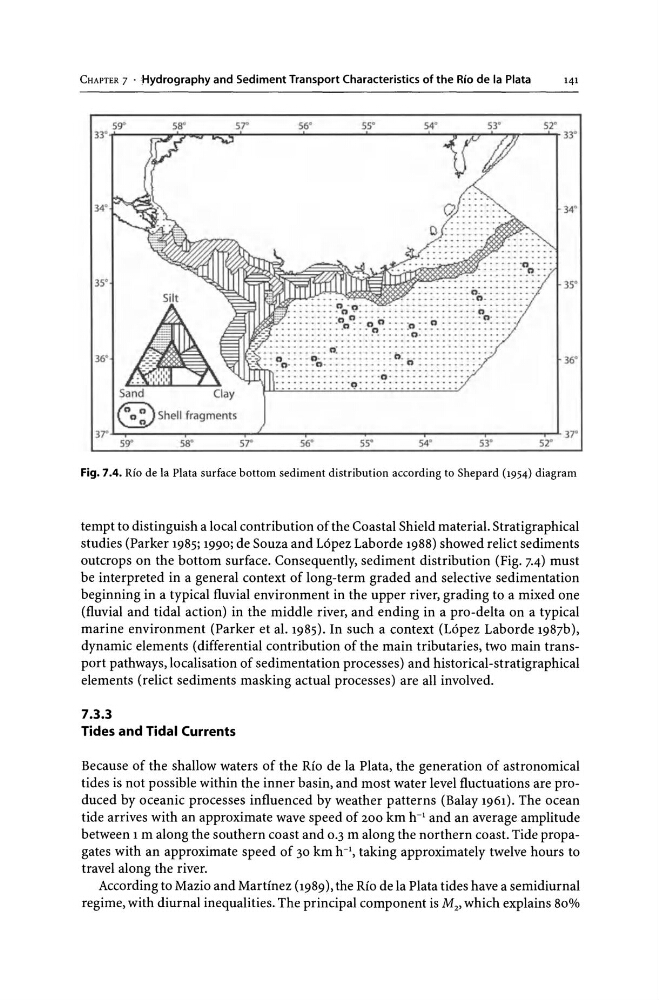
Fig. 7.4. Rio de la Plata surface bottom sediment distribution according to Shepard (1954) diagram
tempt to distinguish a local contribution of the Coastal Shield material. Stratigraphical
studies (Parker 1985; 1990; de Souza and Lopez Laborde 1988) showed relict sediments
outcrops on the bottom surface. Consequently, sediment distribution (Fig. 7.4) must
be interpreted in a general context of long-term graded and selective sedimentation
beginning in a typical fluvial environment in the upper river, grading to a mixed one
(fluvial and tidal action) in the middle river, and ending in a pro-delta on a typical
marine environment (Parker et al. 1985). In such a context (Lopez Laborde 1987b),
dynamic elements (differential contribution of the main tributaries, two main transport pathways, localisation of sedimentation processes) and historical-stratigraphical
elements (relict sediments masking actual processes) are all involved.
7.3.3
Tides and Tidal Currents
Because of the shallow waters of the Rio de la Plata, the generation of astronomical
tides is not possible within the inner basin, and most water level fluctuations are produced by oceanic processes influenced by weather patterns (Balay 1961). The ocean
tide arrives with an approximate wave speed of 200 km h- 1 and an average amplitude
between 1 m along the southern coast and 0.3 m along the northern coast. Tide propagates with an approximate speed of 30 km h-., taking approximately twelve hours to
travel along the river.
According to Mazio and Martinez (1989), the Rio de la Plata tides have a semidiurnal
regime, with diurnal inequalities. The principal component is M 2 , which explains 80%
141
56'
55'
52·
33· ~--~~~~~~~------~------~------~~~~~~--~ 33"
35·
Clay
t:;::;) Shel l fragments
~~~.~ . . :: ::
~
. 0 . . .
. n ..
:: :0 :: !'.:: ::
. · n··
.. ·n· · . . ... .
n:::: :::: :::
.. n . . . . . .. .
34'
35'
36'
3r ~~----~~----~~----~------__ -------T-------T------~-L 3r
59"
58'
sr
56'
55'
54°
53·
52·
Fig. 7.4. Rio de la Plata surface bottom sediment distribution according to Shepard (1954) diagram
tempt to distinguish a local contribution of the Coastal Shield material. Stratigraphical
studies (Parker 1985; 1990; de Souza and Lopez Laborde 1988) showed relict sediments
outcrops on the bottom surface. Consequently, sediment distribution (Fig. 7.4) must
be interpreted in a general context of long-term graded and selective sedimentation
beginning in a typical fluvial environment in the upper river, grading to a mixed one
(fluvial and tidal action) in the middle river, and ending in a pro-delta on a typical
marine environment (Parker et al. 1985). In such a context (Lopez Laborde 1987b),
dynamic elements (differential contribution of the main tributaries, two main transport pathways, localisation of sedimentation processes) and historical-stratigraphical
elements (relict sediments masking actual processes) are all involved.
7.3.3
Tides and Tidal Currents
Because of the shallow waters of the Rio de la Plata, the generation of astronomical
tides is not possible within the inner basin, and most water level fluctuations are produced by oceanic processes influenced by weather patterns (Balay 1961). The ocean
tide arrives with an approximate wave speed of 200 km h- 1 and an average amplitude
between 1 m along the southern coast and 0.3 m along the northern coast. Tide propagates with an approximate speed of 30 km h-., taking approximately twelve hours to
travel along the river.
According to Mazio and Martinez (1989), the Rio de la Plata tides have a semidiurnal
regime, with diurnal inequalities. The principal component is M 2 , which explains 80%