

142
Jorge Lopez Laborde· Gustavo J. Nagy
of the total spectral energy, with a significant participation of the 0, diurnal component. The size of the basin and the twelve hours that it takes tides to travel up to the
whole Rio de la Plata, produces a situation where high and low tides can occur simultaneously at different locations.
Balay (1961) stated that lines of equal amplitude shows the tidal differences between the two coasts. These tidal variations are caused by Coriolis force and by the
differences in amplitude of the incoming oceanic tides. Since the southern tide has
a greater range than the northern one, it has greater velocity, reaches the upper
river earlier and creates transverse currents between the southern and northern
coasts. The difference in amplitude and separation of tides across the outer section,
between Montevideo and San Clemente, are obvious. Further in, along the ColoniaBuenos Aires transverse section, these two tides tend to combine and form a single
wave with similar amplitude. The greater strength of the southern wave dominates
the combined tide; the tidal amplitude at the Parana River Delta and Martin Garcia
Island is larger than at Colonia. The progression of the tidal maxima up the Rio de la
Plata and the decay in tidal amplitude away from the Argentinean coast, are consistent with a Kelvin wave response of the Rio de la Plata to the tidal forcing on the shelf
(O'Connor 1991).
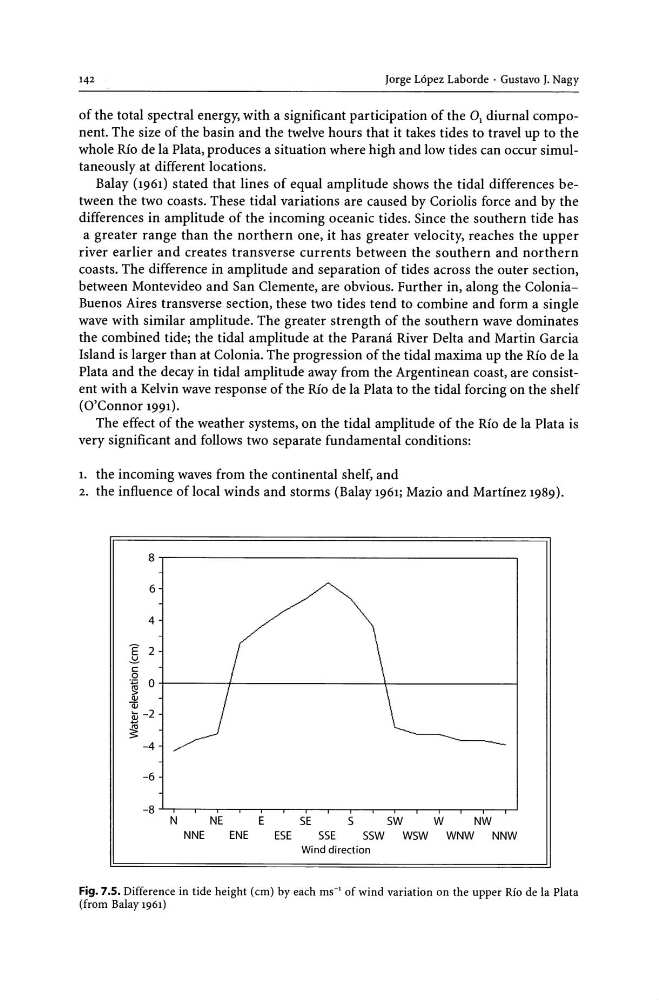
The effect of the weather systems, on the tidal amplitude of the Rio de la Plata is
very significant and follows two separate fundamental conditions:
1. the incoming waves from the continental shelf, and
2. the influence of local winds and storms (Balay 1961; Mazio and Martinez 1989).
8.----------------------------------------------,
6
4
E 2
~
0::::
o
.~ 0
Qj
Ci; -2
~
-4
-6
N
NE
E
SE
S
SW
W
NW
NNE
ENE
ESE
SSE
SSW
WSW
WNW
NNW
Wind direction
Fig. 7.5. Difference in tide height (em) by each ms- 1 of wind variation on the upper Rio de la Plata
(from Balay 1961)
Jorge Lopez Laborde· Gustavo J. Nagy
of the total spectral energy, with a significant participation of the 0, diurnal component. The size of the basin and the twelve hours that it takes tides to travel up to the
whole Rio de la Plata, produces a situation where high and low tides can occur simultaneously at different locations.
Balay (1961) stated that lines of equal amplitude shows the tidal differences between the two coasts. These tidal variations are caused by Coriolis force and by the
differences in amplitude of the incoming oceanic tides. Since the southern tide has
a greater range than the northern one, it has greater velocity, reaches the upper
river earlier and creates transverse currents between the southern and northern
coasts. The difference in amplitude and separation of tides across the outer section,
between Montevideo and San Clemente, are obvious. Further in, along the ColoniaBuenos Aires transverse section, these two tides tend to combine and form a single
wave with similar amplitude. The greater strength of the southern wave dominates
the combined tide; the tidal amplitude at the Parana River Delta and Martin Garcia
Island is larger than at Colonia. The progression of the tidal maxima up the Rio de la
Plata and the decay in tidal amplitude away from the Argentinean coast, are consistent with a Kelvin wave response of the Rio de la Plata to the tidal forcing on the shelf
(O'Connor 1991).
The effect of the weather systems, on the tidal amplitude of the Rio de la Plata is
very significant and follows two separate fundamental conditions:
1. the incoming waves from the continental shelf, and
2. the influence of local winds and storms (Balay 1961; Mazio and Martinez 1989).
8.----------------------------------------------,
6
4
E 2
~
0::::
o
.~ 0
Qj
Ci; -2
~
-4
-6
N
NE
E
SE
S
SW
W
NW
NNE
ENE
ESE
SSE
SSW
WSW
WNW
NNW
Wind direction
Fig. 7.5. Difference in tide height (em) by each ms- 1 of wind variation on the upper Rio de la Plata
(from Balay 1961)