

CHAPTER 6 . The Argentina Estuaries: A Review
109
The lagoon is connected to the sea by an elongated inlet channel, approximately
6 km and up 200 m wide. The inlet area is characterized by a small smoothly contoured seaward ebb delta highly variable, and therefore it was subject several studies
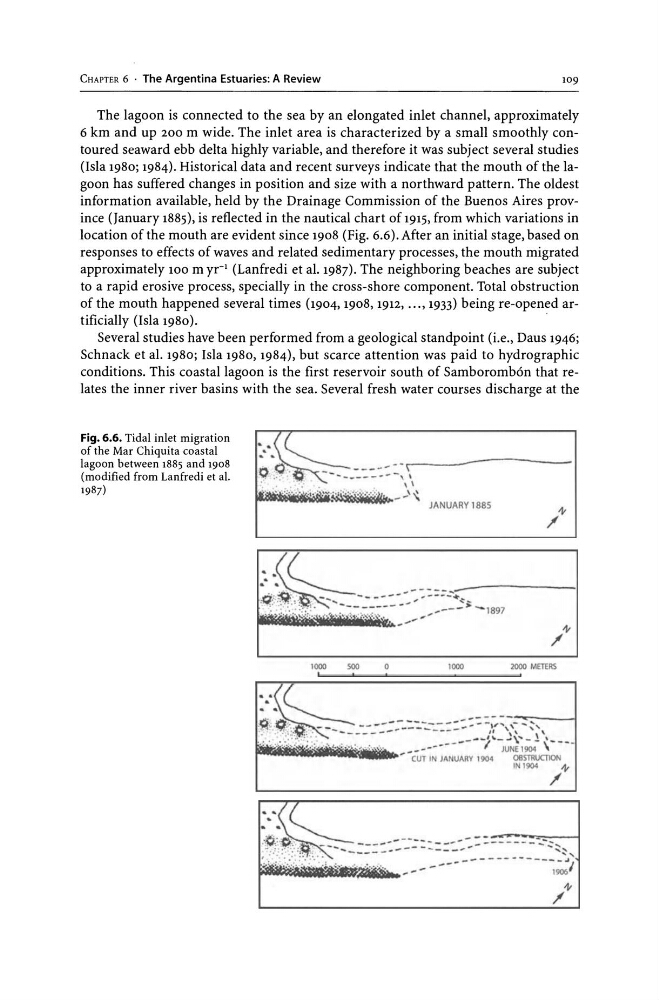
(Isla 1980; 1984). Historical data and recent surveys indicate that the mouth of the lagoon has suffered changes in position and size with a northward pattern. The oldest
information available, held by the Drainage Commission of the Buenos Aires province (January 1885), is reflected in the nautical chart of 1915, from which variations in
location of the mouth are evident since 1908 (Fig. 6.6). After an initial stage, based on
responses to effects of waves and related sedimentary processes, the mouth migrated
approximately 100 myel (Lanfredi et al. 1987). The neighboring beaches are subject
to a rapid erosive process, specially in the cross-shore component. Total obstruction
of the mouth happened several times (1904,1908,1912, ... ,1933) being re-opened artificially (Isla 1980).
.
Several studies have been performed from a geological standpoint (i.e., Daus 1946;
Schnack et al. 1980; Isla 1980, 1984), but scarce attention was paid to hydrographic
conditions. This coastal lagoon is the first reservoir south of Samborombon that relates the inner river basins with the sea. Several fresh water courses discharge at the
Fig. 6.6. Tidal inlet migration
of the Mar Chiquita coastal
lagoon between 1885 and 1908
(modified from Lanfredi et al.
1987)
' ..
.. .
.. .
___ ----r,---------------------JANUARY 1885
1000
SOO
o
1000
2000 METERS
t
t
-- --- ----:.:.--- - --::: :~,:~- -"',
---,. '\ ~ ' \
___
- - ~-i' ~:N}~~l ,---CUT I N JANUARY 1904
06STRUCTlON
IN 1904
4/
109
The lagoon is connected to the sea by an elongated inlet channel, approximately
6 km and up 200 m wide. The inlet area is characterized by a small smoothly contoured seaward ebb delta highly variable, and therefore it was subject several studies
(Isla 1980; 1984). Historical data and recent surveys indicate that the mouth of the lagoon has suffered changes in position and size with a northward pattern. The oldest
information available, held by the Drainage Commission of the Buenos Aires province (January 1885), is reflected in the nautical chart of 1915, from which variations in
location of the mouth are evident since 1908 (Fig. 6.6). After an initial stage, based on
responses to effects of waves and related sedimentary processes, the mouth migrated
approximately 100 myel (Lanfredi et al. 1987). The neighboring beaches are subject
to a rapid erosive process, specially in the cross-shore component. Total obstruction
of the mouth happened several times (1904,1908,1912, ... ,1933) being re-opened artificially (Isla 1980).
.
Several studies have been performed from a geological standpoint (i.e., Daus 1946;
Schnack et al. 1980; Isla 1980, 1984), but scarce attention was paid to hydrographic
conditions. This coastal lagoon is the first reservoir south of Samborombon that relates the inner river basins with the sea. Several fresh water courses discharge at the
Fig. 6.6. Tidal inlet migration
of the Mar Chiquita coastal
lagoon between 1885 and 1908
(modified from Lanfredi et al.
1987)
' ..
.. .
.. .
___ ----r,---------------------JANUARY 1885
1000
SOO
o
1000
2000 METERS
t
t
-- --- ----:.:.--- - --::: :~,:~- -"',
---,. '\ ~ ' \
___
- - ~-i' ~:N}~~l ,---CUT I N JANUARY 1904
06STRUCTlON
IN 1904
4/