

no
M. Cintia Piccolo· Gerardo M.E. Perillo
lagoon. They are Arroyo Chico, De las Gallinas, Cangrejos, De los Huesos, Los Pozos,
Grande, Dulce, Vivorata streams (Fig. 6.5) and several channels discharge into the lagoon (Grondona 1975).
Significant salinity variations characterize the lagoon as it fluctuates from oligohaline to hyperhaline conditions, ranging from less than 5 psu to more than 30 psu
(Alvarez et al. 1983). Hydrogeological investigations show the influence of the water
table in relation to the lagoon. This groundwater contribution plays an important role
for standard meteorological conditions with regards to the mean stored volume and
it is particularly significant in prolonged dry periods. The water table rise associated
with the rejected recharge effect inducing important variations in the lagoonal body
(Fasano et al. 1982). Intrusion of the saline wedge varies according the ocean tide and
the wind direction. Strong winds from the NE to SW direction during neap conditions prevent the entrance of marine waters into the lagoon. Winds from the Nand
NW directions aid the fast discharge of the lagoon water into the sea. On the other
hand, strong winds from the sea during spring tides helps the marine water to enter
into the lagoon several kilometres from the mouth (Reta et al. 1995).
Water temperature depends almost exclusively on the meteorological conditions
(insolation, daily variations of the air temperature, etc.). There is approximately 2° C
in water temperature variation between the mouth and the inner regions of the lagoon.
The minimum and maximum temperatures registered in the period 1994-1995 was
9° C and 25° C, respectively (Martos et al. 1995). Significant air-sea-soil interaction
processes in the area were observed. A diurnal energy balance study performed in the
area showed that evaporation is the most important term in the heat balance equation, followed by the sensible and the soil heat fluxes. In the lagoon beach, the sensible heat and the soil heat flux have the same order of magnitude (Piccolo et al. 1995).
During calm conditions, tides are observed as far as San Gabriel (Fig. 6.5) With a
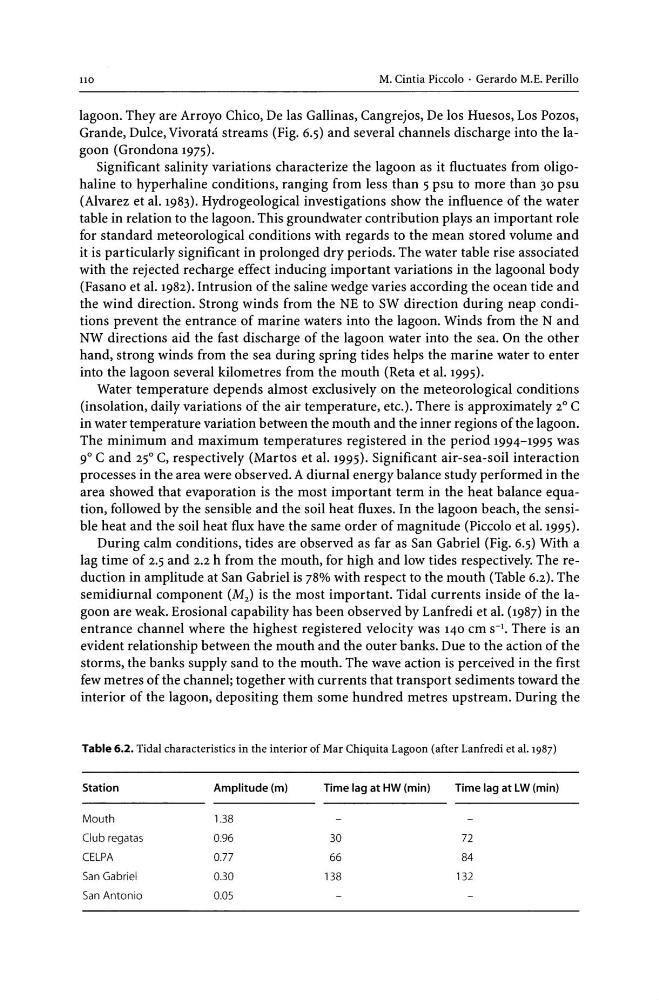
lag time of 2.5 and 2.2 h from the mouth, for high and low tides respectively. The reduction in amplitude at San Gabriel is 78% with respect to the mouth (Table 6.2). The
semidiurnal component (M2 ) is the most important. Tidal currents inside of the lagoon are weak. Erosional capability has been observed by Lanfredi et al. (1987) in the
entrance channel where the highest registered velocity was 140 cm S-I. There is an
evident relationship between the mouth and the outer banks. Due to the action of the
storms, the banks supply sand to the mouth. The wave action is perceived in the first
few metres of the channel; together with currents that transport sediments toward the
interior of the lagoon, depositing them some hundred metres upstream. During the
Table 6.2. Tidal characteristics in the interior of Mar Chiquita Lagoon (after Lanfredi et al. 1987)
Station
Amplitude (m)
Time lag at HW (min)
Time lag at LW (min)
Mouth
1.38
Club regatas
0.96
30
72
CELPA
0.77
66
84
San Gabriel
0.30
138
132
San Antonio
0.05
M. Cintia Piccolo· Gerardo M.E. Perillo
lagoon. They are Arroyo Chico, De las Gallinas, Cangrejos, De los Huesos, Los Pozos,
Grande, Dulce, Vivorata streams (Fig. 6.5) and several channels discharge into the lagoon (Grondona 1975).
Significant salinity variations characterize the lagoon as it fluctuates from oligohaline to hyperhaline conditions, ranging from less than 5 psu to more than 30 psu
(Alvarez et al. 1983). Hydrogeological investigations show the influence of the water
table in relation to the lagoon. This groundwater contribution plays an important role
for standard meteorological conditions with regards to the mean stored volume and
it is particularly significant in prolonged dry periods. The water table rise associated
with the rejected recharge effect inducing important variations in the lagoonal body
(Fasano et al. 1982). Intrusion of the saline wedge varies according the ocean tide and
the wind direction. Strong winds from the NE to SW direction during neap conditions prevent the entrance of marine waters into the lagoon. Winds from the Nand
NW directions aid the fast discharge of the lagoon water into the sea. On the other
hand, strong winds from the sea during spring tides helps the marine water to enter
into the lagoon several kilometres from the mouth (Reta et al. 1995).
Water temperature depends almost exclusively on the meteorological conditions
(insolation, daily variations of the air temperature, etc.). There is approximately 2° C
in water temperature variation between the mouth and the inner regions of the lagoon.
The minimum and maximum temperatures registered in the period 1994-1995 was
9° C and 25° C, respectively (Martos et al. 1995). Significant air-sea-soil interaction
processes in the area were observed. A diurnal energy balance study performed in the
area showed that evaporation is the most important term in the heat balance equation, followed by the sensible and the soil heat fluxes. In the lagoon beach, the sensible heat and the soil heat flux have the same order of magnitude (Piccolo et al. 1995).
During calm conditions, tides are observed as far as San Gabriel (Fig. 6.5) With a
lag time of 2.5 and 2.2 h from the mouth, for high and low tides respectively. The reduction in amplitude at San Gabriel is 78% with respect to the mouth (Table 6.2). The
semidiurnal component (M2 ) is the most important. Tidal currents inside of the lagoon are weak. Erosional capability has been observed by Lanfredi et al. (1987) in the
entrance channel where the highest registered velocity was 140 cm S-I. There is an
evident relationship between the mouth and the outer banks. Due to the action of the
storms, the banks supply sand to the mouth. The wave action is perceived in the first
few metres of the channel; together with currents that transport sediments toward the
interior of the lagoon, depositing them some hundred metres upstream. During the
Table 6.2. Tidal characteristics in the interior of Mar Chiquita Lagoon (after Lanfredi et al. 1987)
Station
Amplitude (m)
Time lag at HW (min)
Time lag at LW (min)
Mouth
1.38
Club regatas
0.96
30
72
CELPA
0.77
66
84
San Gabriel
0.30
138
132
San Antonio
0.05