

184
6 Construction of the Names of Complex Compounds
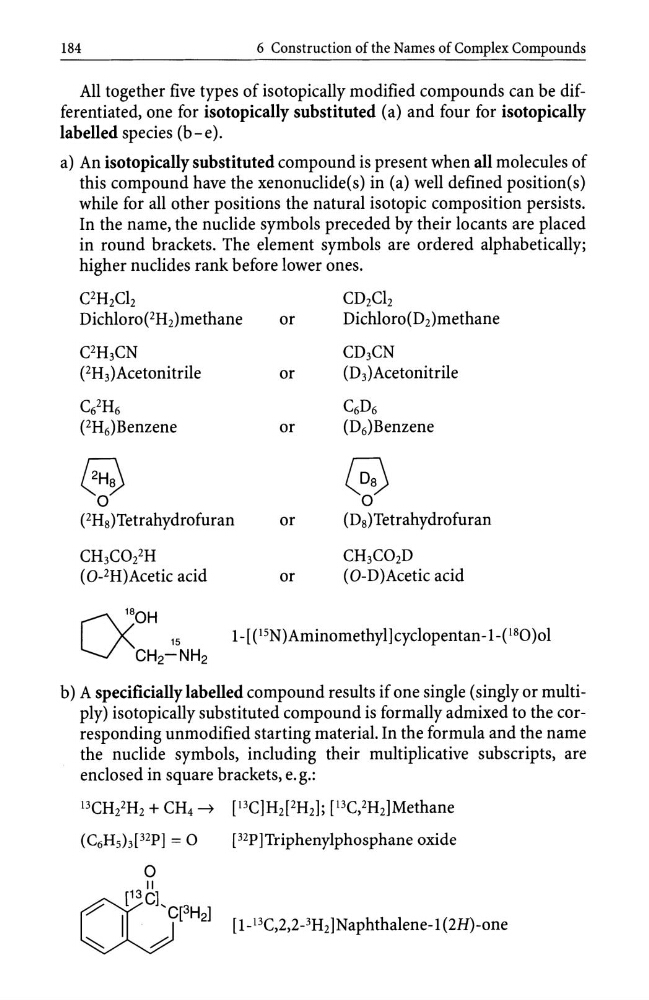
All together five types of isotopically modified compounds can be differentiated, one for isotopically substituted (a) and four for isotopically
labelled species (b - e).
a} An isotopically substituted compound is present when all molecules of
this compound have the xenonuclide(s} in (a) well defined position(s}
while for all other positions the natural isotopic composition persists.
In the name, the nuclide symbols preceded by their locants are placed
in round brackets. The element symbols are ordered alphabetically;
higher nuclides rank before lower ones.
CZH2Cb
Dichloro(2H2}methane
CZH3CN
(2H3}Acetonitrile
C6 2H 6
(2H6}Benzene
[£) o
(2Hs}Tetrahydrofuran
CH 3 C022H
(O-2H}Acetic acid
or
or
or
or
or
CD2Cb
Dichloro(D2}methane
CD3CN
(D3}Acetonitrile
C6D6
(D6}Benzene
Cr0 o
(Ds}Tetrahydrofuran
CH3C02D
(O-D}Acetic acid
o<
lB OH
15
1- [(1sN}Aminomethyll cyclopentan -1-( ISO }ol
CH 2 -NH 2
b) A specificially labelled compound results if one single (singly or multiply) isotopically substituted compound is formally admixed to the corresponding unmodified starting material. In the formula and the name
the nuclide symbols, including their multiplicative subscripts, are
enclosed in square brackets, e. g.:
13CHiH 2 + CH4 ~ (13C1H2[2H21; [13C,2H21Methane
(C 6 Hsh[32P] = 0
[32P]Triphenylphosphane oxide
o
II
~ I 'C[3H21
(b
13 C1
~
0
[1- 13 C,2,2- 3 H21Naphthalene-l (2H}-one
6 Construction of the Names of Complex Compounds
All together five types of isotopically modified compounds can be differentiated, one for isotopically substituted (a) and four for isotopically
labelled species (b - e).
a} An isotopically substituted compound is present when all molecules of
this compound have the xenonuclide(s} in (a) well defined position(s}
while for all other positions the natural isotopic composition persists.
In the name, the nuclide symbols preceded by their locants are placed
in round brackets. The element symbols are ordered alphabetically;
higher nuclides rank before lower ones.
CZH2Cb
Dichloro(2H2}methane
CZH3CN
(2H3}Acetonitrile
C6 2H 6
(2H6}Benzene
[£) o
(2Hs}Tetrahydrofuran
CH 3 C022H
(O-2H}Acetic acid
or
or
or
or
or
CD2Cb
Dichloro(D2}methane
CD3CN
(D3}Acetonitrile
C6D6
(D6}Benzene
Cr0 o
(Ds}Tetrahydrofuran
CH3C02D
(O-D}Acetic acid
o<
lB OH
15
1- [(1sN}Aminomethyll cyclopentan -1-( ISO }ol
CH 2 -NH 2
b) A specificially labelled compound results if one single (singly or multiply) isotopically substituted compound is formally admixed to the corresponding unmodified starting material. In the formula and the name
the nuclide symbols, including their multiplicative subscripts, are
enclosed in square brackets, e. g.:
13CHiH 2 + CH4 ~ (13C1H2[2H21; [13C,2H21Methane
(C 6 Hsh[32P] = 0
[32P]Triphenylphosphane oxide
o
II
~ I 'C[3H21
(b
13 C1
~
0
[1- 13 C,2,2- 3 H21Naphthalene-l (2H}-one