

6.6 Isotopically Modified Compounds
183
Hydro and subtractive preflxes could traditionally be treated as nondetachable or detachable (Chern. Abstr., Beilstein); according to a very
recent IUPAC proposal they are generally to be classified as non-detachable.
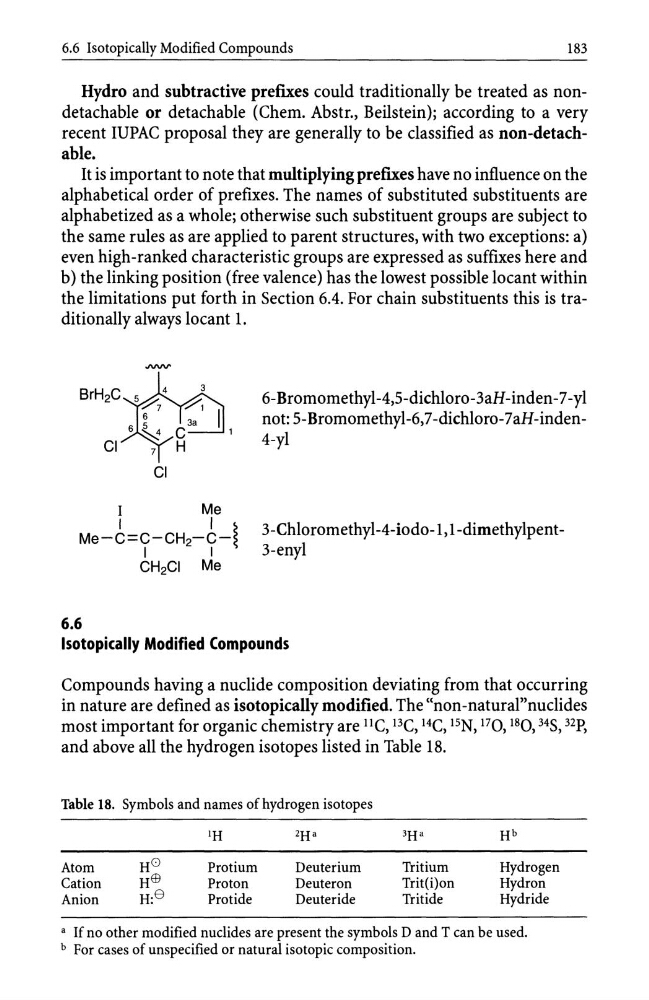
It is important to note that multiplying prefIxes have no influence on the
alphabetical order of prefixes. The names of substituted substituents are
alphabetized as a whole; otherwise such substituent groups are subject to
the same rules as are applied to parent structures, with two exceptions: a)
even high-ranked characteristic groups are expressed as suffixes here and
b) the linking position (free valence) has the lowest possible locant within
the limitations put forth in Section 6.4. For chain substituents this is traditionally always locant 1.
CI
6.6
6-Bromomethyl-4,5-dichloro-3aH-in den -7 -yl
not: 5-Bromomethyl-6,7 -dichloro-7 aH-inden4-yl
3-Chloromethyl-4-iodo-1, 1-dimethylpent3-enyl
Isotopically Modified Compounds
Compounds having a nuclide composition deviating from that occurring
in nature are defined as isotopically modifled. The "non-natural"nuclides
most important for organic chemistry are HC, l3C, 14C, 15N, 17 0, 18 0, 34S, 32p,
and above all the hydrogen isotopes listed in Table 18.
Table 18. Symbols and names of hydrogen isotopes
lH
2Ha
3Ha
Hb
Atom
H0
Protium
Deuterium
Tritium
Hydrogen
Cation
HEB
Proton
Deuteron
Trit(i)on
Hydron
Anion
H:8
Protide
Deuteride
Tritide
Hydride
a If no other modified nuclides are present the symbols D and T can be used.
b For cases of unspecified or natural isotopic composition.
183
Hydro and subtractive preflxes could traditionally be treated as nondetachable or detachable (Chern. Abstr., Beilstein); according to a very
recent IUPAC proposal they are generally to be classified as non-detachable.
It is important to note that multiplying prefIxes have no influence on the
alphabetical order of prefixes. The names of substituted substituents are
alphabetized as a whole; otherwise such substituent groups are subject to
the same rules as are applied to parent structures, with two exceptions: a)
even high-ranked characteristic groups are expressed as suffixes here and
b) the linking position (free valence) has the lowest possible locant within
the limitations put forth in Section 6.4. For chain substituents this is traditionally always locant 1.
CI
6.6
6-Bromomethyl-4,5-dichloro-3aH-in den -7 -yl
not: 5-Bromomethyl-6,7 -dichloro-7 aH-inden4-yl
3-Chloromethyl-4-iodo-1, 1-dimethylpent3-enyl
Isotopically Modified Compounds
Compounds having a nuclide composition deviating from that occurring
in nature are defined as isotopically modifled. The "non-natural"nuclides
most important for organic chemistry are HC, l3C, 14C, 15N, 17 0, 18 0, 34S, 32p,
and above all the hydrogen isotopes listed in Table 18.
Table 18. Symbols and names of hydrogen isotopes
lH
2Ha
3Ha
Hb
Atom
H0
Protium
Deuterium
Tritium
Hydrogen
Cation
HEB
Proton
Deuteron
Trit(i)on
Hydron
Anion
H:8
Protide
Deuteride
Tritide
Hydride
a If no other modified nuclides are present the symbols D and T can be used.
b For cases of unspecified or natural isotopic composition.