

6.6 Isotopically Modified Compounds
185
RS- [N,N,O,S-2H41 Cysteine
or:
or:
(DL}-[N,N,O,S-D41Cysteine
[ 17 01
II
CHrCHrO-C-[170]-CH3 O-Ethyl-170-methyl[1702]carbonate
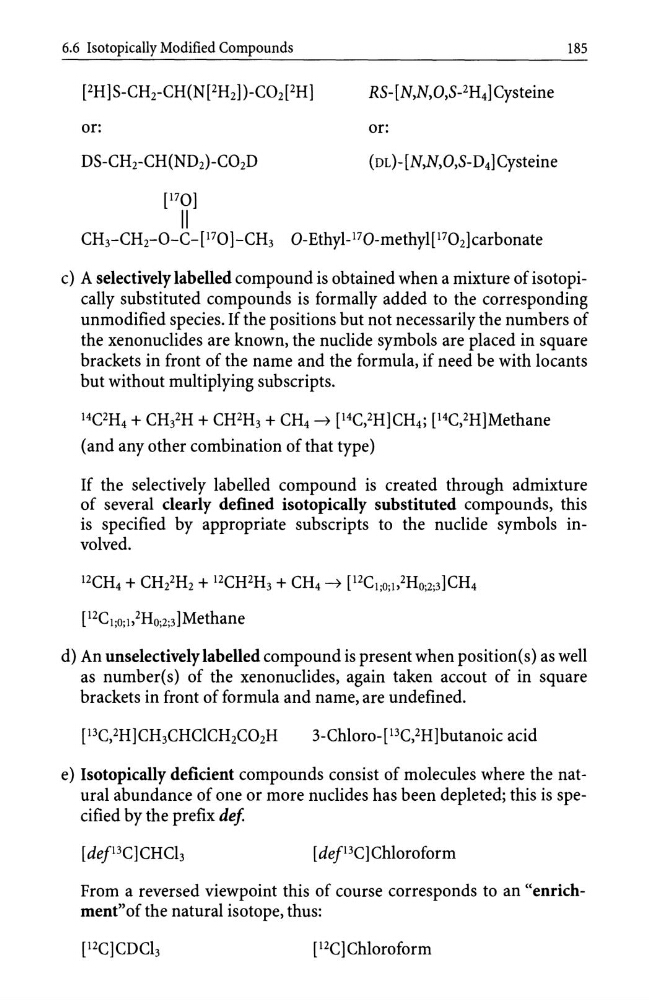
c) A selectively labelled compound is obtained when a mixture of isotopically substituted compounds is formally added to the corresponding
unmodified species. If the positions but not necessarily the numbers of
the xenonuclides are known, the nuclide symbols are placed in square
brackets in front of the name and the formula, if need be with locants
but without multiplying subscripts.
14CZH4 + CH32H + CH2H3 + CH4 ~ [14C,2H]CH4; (14C,2H]Methane
(and any other combination of that type)
If the selectively labelled compound is created through admixture
of several clearly defined isotopically substituted compounds, this
is specified by appropriate subscripts to the nuclide symbols involved.
[12CI ;O;i> 2HO;2;3] Methane
d} An unselectively labelled compound is present when position(s} as well
as number(s} of the xenonuclides, again taken accout of in square
brackets in front of formula and name, are undefined.
3-Chloro-[13C,2H]butanoic acid
e} Isotopically deficient compounds consist of molecules where the natural abundance of one or more nuclides has been depleted; this is specified by the prefix de!
[defI3C] Chloroform
From a reversed viewpoint this of course corresponds to an «enrichment" of the natural isotope, thus:
[12C]CDCh
[12C] Chloroform
185
RS- [N,N,O,S-2H41 Cysteine
or:
or:
(DL}-[N,N,O,S-D41Cysteine
[ 17 01
II
CHrCHrO-C-[170]-CH3 O-Ethyl-170-methyl[1702]carbonate
c) A selectively labelled compound is obtained when a mixture of isotopically substituted compounds is formally added to the corresponding
unmodified species. If the positions but not necessarily the numbers of
the xenonuclides are known, the nuclide symbols are placed in square
brackets in front of the name and the formula, if need be with locants
but without multiplying subscripts.
14CZH4 + CH32H + CH2H3 + CH4 ~ [14C,2H]CH4; (14C,2H]Methane
(and any other combination of that type)
If the selectively labelled compound is created through admixture
of several clearly defined isotopically substituted compounds, this
is specified by appropriate subscripts to the nuclide symbols involved.
[12CI ;O;i> 2HO;2;3] Methane
d} An unselectively labelled compound is present when position(s} as well
as number(s} of the xenonuclides, again taken accout of in square
brackets in front of formula and name, are undefined.
3-Chloro-[13C,2H]butanoic acid
e} Isotopically deficient compounds consist of molecules where the natural abundance of one or more nuclides has been depleted; this is specified by the prefix de!
[defI3C] Chloroform
From a reversed viewpoint this of course corresponds to an «enrichment" of the natural isotope, thus:
[12C]CDCh
[12C] Chloroform