

118
3 Brief Demonstration of the General Nomenclature Rules
Thiocarboxylic acids, sulf( on, in, en)ic acids, and their derivatives are
treated analogously; if necessary specific positions of esterification must
be marked separately by placing an indicative letter locant (in italics) in
front of the name of the esterifying group.
Ethanesulfonyl bromide (otherwise ethylsulfonyl!)
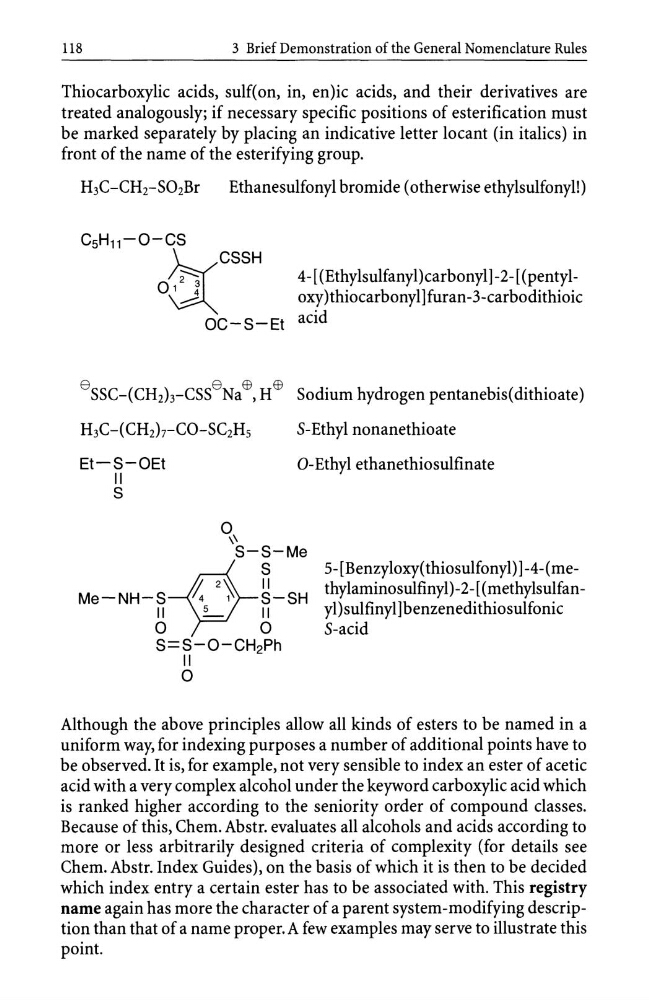
4- [(Ethylsulfanyl)carbonyl]-2- [(pentyloxy)thiocarbonyl]furan-3-carbodithioic
acid
e
e EEl EEl
SSC-(CH2h-CSS Na , H Sodium hydrogen pentanebis(dithioate)
H3C-( CH2h-CO-SC2HS
Et-S-OEt
II
S
o \\
S-Ethyl nonanethioate
0-Ethyl ethanethiosulfinate
S-S-Me
Me-NH-s-9- 4 2~ M-SH
II
_5_
II
o
0
S=S-O-CH2Ph
II
o
5- [Benzyloxy( thiosulfonyl) ]-4-(methylaminosulfinyl)-2- [(methylsulfanyl) sulfinyl] benzenedi thiosulfonic
S-acid
Although the above principles allow all kinds of esters to be named in a
uniform way, for indexing purposes a number of additional points have to
be observed. It is, for example, not very sensible to index an ester of acetic
acid with a very complex alcohol under the keyword carboxylic acid which
is ranked higher according to the seniority order of compound classes.
Because of this, Chern. Abstr. evaluates all alcohols and acids according to
more or less arbitrarily designed criteria of complexity (for details see
Chern. Abstr. Index Guides), on the basis of which it is then to be decided
which index entry a certain ester has to be associated with. This registry
name again has more the character of a parent system-modifying description than that of a name proper. A few examples may serve to illustrate this
point.
3 Brief Demonstration of the General Nomenclature Rules
Thiocarboxylic acids, sulf( on, in, en)ic acids, and their derivatives are
treated analogously; if necessary specific positions of esterification must
be marked separately by placing an indicative letter locant (in italics) in
front of the name of the esterifying group.
Ethanesulfonyl bromide (otherwise ethylsulfonyl!)
4- [(Ethylsulfanyl)carbonyl]-2- [(pentyloxy)thiocarbonyl]furan-3-carbodithioic
acid
e
e EEl EEl
SSC-(CH2h-CSS Na , H Sodium hydrogen pentanebis(dithioate)
H3C-( CH2h-CO-SC2HS
Et-S-OEt
II
S
o \\
S-Ethyl nonanethioate
0-Ethyl ethanethiosulfinate
S-S-Me
Me-NH-s-9- 4 2~ M-SH
II
_5_
II
o
0
S=S-O-CH2Ph
II
o
5- [Benzyloxy( thiosulfonyl) ]-4-(methylaminosulfinyl)-2- [(methylsulfanyl) sulfinyl] benzenedi thiosulfonic
S-acid
Although the above principles allow all kinds of esters to be named in a
uniform way, for indexing purposes a number of additional points have to
be observed. It is, for example, not very sensible to index an ester of acetic
acid with a very complex alcohol under the keyword carboxylic acid which
is ranked higher according to the seniority order of compound classes.
Because of this, Chern. Abstr. evaluates all alcohols and acids according to
more or less arbitrarily designed criteria of complexity (for details see
Chern. Abstr. Index Guides), on the basis of which it is then to be decided
which index entry a certain ester has to be associated with. This registry
name again has more the character of a parent system-modifying description than that of a name proper. A few examples may serve to illustrate this
point.