

Level 1 – Case 13
92
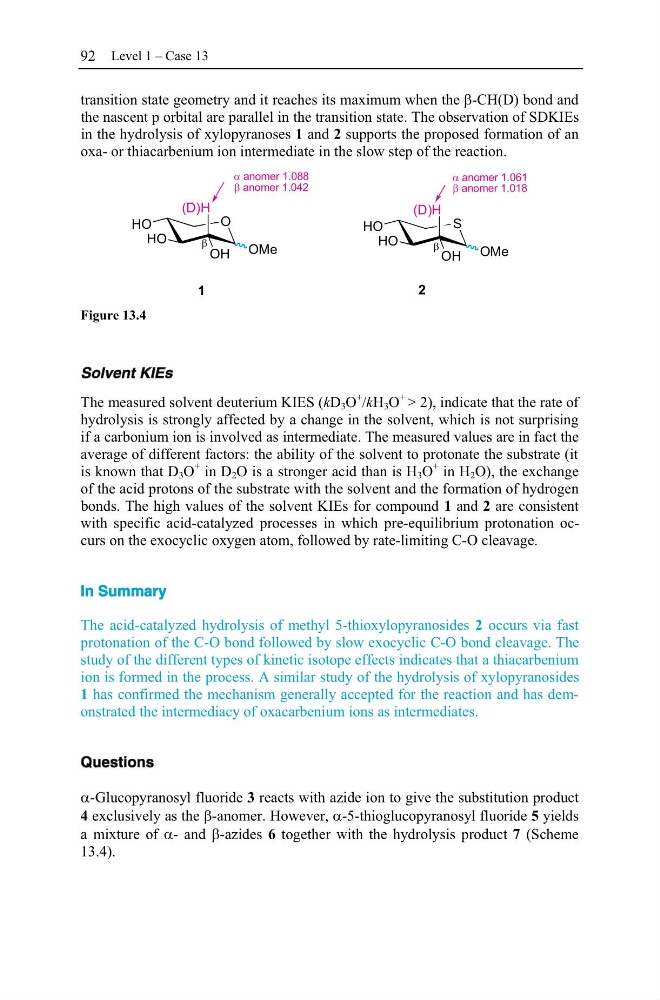
transition state geometry and it reaches its maximum when the E-CH(D) bond and
the nascent p orbital are parallel in the transition state. The observation of SDKIEs
in the hydrolysis of xylopyranoses 1 and 2 supports the proposed formation of an
oxa- or thiacarbenium ion intermediate in the slow step of the reaction.
HO
O
HO
OH OMe
HO
S
HO
OH OMe
1
2
DDanomer 1.088
E anomer 1.042
DDanomer 1.061
E anomer 1.018
(D)H
(D)H
E
E
Figure 13.4
S So ol lv ve ve v ve ve ve ve v ven nt t K KI K KI KI K KI K K E
IE I IE I I s
Es E Es Es Es E E
The measured solvent deuterium KIES (kD k k 3 O
+ /kH k k 3 O
+ > 2), indicate that the rate of
hydrolysis is strongly affected by a change in the solvent, which is not surprising
if a carbonium ion is involved as intermediate. The measured values are in fact the
average of different factors: the ability of the solvent to protonate the substrate (it
is known that D 3 O
+ in D 2 O is a stronger acid than is H 3 O
+ in H 2 O), the exchange
of the acid protons of the substrate with the solvent and the formation of hydrogen
bonds. The high values of the solvent KIEs for compound 1 and 2 are consistent
with specific acid-catalyzed processes in which pre-equilibrium protonation occurs on the exocyclic oxygen atom, followed by rate-limiting C-O cleavage.
In Summary
The acid-catalyzed hydrolysis of methyl 5-thioxylopyranosides 2 occurs via fast
protonation of the C-O bond followed by slow exocyclic C-O bond cleavage. The
study of the different types of kinetic isotope effects indicates that a thiacarbenium
ion is formed in the process. A similar study of the hydrolysis of xylopyranosides
1 has confirmed the mechanism generally accepted for the reaction and has demonstrated the intermediacy of oxacarbenium ions as intermediates.
Q Qu ue es st ti io on ns s
D-Glucopyranosyl fluoride 3 reacts with azide ion to give the substitution product
4 exclusively as the E-anomer. However, D-5-thioglucopyranosyl fluoride 5 yields
a mixture of D- and E-azides 6 together with the hydrolysis product 7 (Scheme
13.4).
92
transition state geometry and it reaches its maximum when the E-CH(D) bond and
the nascent p orbital are parallel in the transition state. The observation of SDKIEs
in the hydrolysis of xylopyranoses 1 and 2 supports the proposed formation of an
oxa- or thiacarbenium ion intermediate in the slow step of the reaction.
HO
O
HO
OH OMe
HO
S
HO
OH OMe
1
2
DDanomer 1.088
E anomer 1.042
DDanomer 1.061
E anomer 1.018
(D)H
(D)H
E
E
Figure 13.4
S So ol lv ve ve v ve ve ve ve v ven nt t K KI K KI KI K KI K K E
IE I IE I I s
Es E Es Es Es E E
The measured solvent deuterium KIES (kD k k 3 O
+ /kH k k 3 O
+ > 2), indicate that the rate of
hydrolysis is strongly affected by a change in the solvent, which is not surprising
if a carbonium ion is involved as intermediate. The measured values are in fact the
average of different factors: the ability of the solvent to protonate the substrate (it
is known that D 3 O
+ in D 2 O is a stronger acid than is H 3 O
+ in H 2 O), the exchange
of the acid protons of the substrate with the solvent and the formation of hydrogen
bonds. The high values of the solvent KIEs for compound 1 and 2 are consistent
with specific acid-catalyzed processes in which pre-equilibrium protonation occurs on the exocyclic oxygen atom, followed by rate-limiting C-O cleavage.
In Summary
The acid-catalyzed hydrolysis of methyl 5-thioxylopyranosides 2 occurs via fast
protonation of the C-O bond followed by slow exocyclic C-O bond cleavage. The
study of the different types of kinetic isotope effects indicates that a thiacarbenium
ion is formed in the process. A similar study of the hydrolysis of xylopyranosides
1 has confirmed the mechanism generally accepted for the reaction and has demonstrated the intermediacy of oxacarbenium ions as intermediates.
Q Qu ue es st ti io on ns s
D-Glucopyranosyl fluoride 3 reacts with azide ion to give the substitution product
4 exclusively as the E-anomer. However, D-5-thioglucopyranosyl fluoride 5 yields
a mixture of D- and E-azides 6 together with the hydrolysis product 7 (Scheme
13.4).