

Oxygen Versus Sulfur Stabilization of Carbenium Ions 93
HO
O
HO
OH
OH
HO
S
HO
F
OH
OH
N 3
N 3
HO
O
HO
OH
N 3
OH
HO
S
HO
OH
N 3
OH
HO
S
HO
N 3
OH
OH
HO
S
HO
OH
OH
OH
5
D-6
E-6
3
E-4
7
F
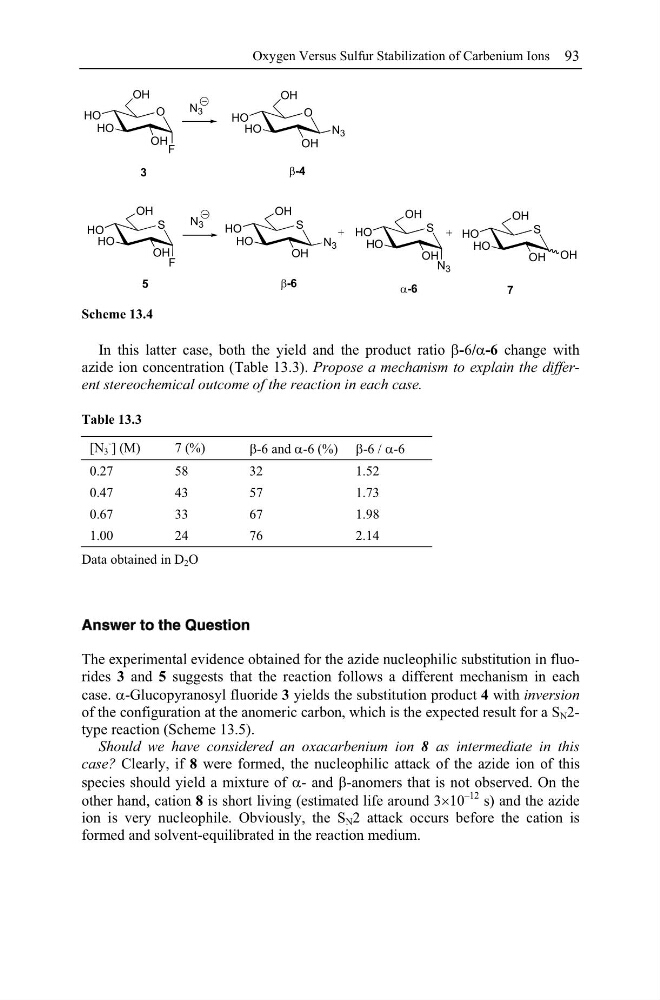
Scheme 13.4
In this latter case, both the yield and the product ratio E-/D-6 change with
azide ion concentration (Table 13.3). Propose a mechanism to explain the different stereochemical outcome of the reaction in each case.
f
Table 13.3
[N 3
- ] (M)
7 (%)
E-6 and D-6 E-6 / D-6
0.27
58
32
1.52
0.47
43
57
1.73
0.67
33
67
1.98
1.00
24
76
2.14
Data obtained in D 2 O
A An ns sw we er r t to o t th he e Q Qu ue es st ti io on n
The experimental evidence obtained for the azide nucleophilic substitution in fluorides 3 and 5 suggests that the reaction follows a different mechanism in each
case. D-Glucopyranosyl fluoride 3 yields the substitution product 4 with inversion
of the configuration at the anomeric carbon, which is the expected result for a S N 2type reaction (Scheme 13.5).
Should we have considered an oxacarbenium ion 8 as intermediate in this
case? Clearly, if 8 were formed, the nucleophilic attack of the azide ion of this
species should yield a mixture of D- and E-anomers that is not observed. On the
other hand, cation 8 is short living (estimated life around 3u10
–12 s) and the azide
ion is very nucleophile. Obviously, the S N 2 attack occurs before the cation is
formed and solvent-equilibrated in the reaction medium.
HO
O
HO
OH
OH
HO
S
HO
F
OH
OH
N 3
N 3
HO
O
HO
OH
N 3
OH
HO
S
HO
OH
N 3
OH
HO
S
HO
N 3
OH
OH
HO
S
HO
OH
OH
OH
5
D-6
E-6
3
E-4
7
F
Scheme 13.4
In this latter case, both the yield and the product ratio E-/D-6 change with
azide ion concentration (Table 13.3). Propose a mechanism to explain the different stereochemical outcome of the reaction in each case.
f
Table 13.3
[N 3
- ] (M)
7 (%)
E-6 and D-6 E-6 / D-6
0.27
58
32
1.52
0.47
43
57
1.73
0.67
33
67
1.98
1.00
24
76
2.14
Data obtained in D 2 O
A An ns sw we er r t to o t th he e Q Qu ue es st ti io on n
The experimental evidence obtained for the azide nucleophilic substitution in fluorides 3 and 5 suggests that the reaction follows a different mechanism in each
case. D-Glucopyranosyl fluoride 3 yields the substitution product 4 with inversion
of the configuration at the anomeric carbon, which is the expected result for a S N 2type reaction (Scheme 13.5).
Should we have considered an oxacarbenium ion 8 as intermediate in this
case? Clearly, if 8 were formed, the nucleophilic attack of the azide ion of this
species should yield a mixture of D- and E-anomers that is not observed. On the
other hand, cation 8 is short living (estimated life around 3u10
–12 s) and the azide
ion is very nucleophile. Obviously, the S N 2 attack occurs before the cation is
formed and solvent-equilibrated in the reaction medium.