

Level 1 – Case 13
94
HO
O
HO
OH
OH
HO
O
HO
OH
N 3
OH
N 3
HO
HO
OH
O
OH
3
8
S N 2
inversion product
not formed
E-4
F
Scheme 13.5
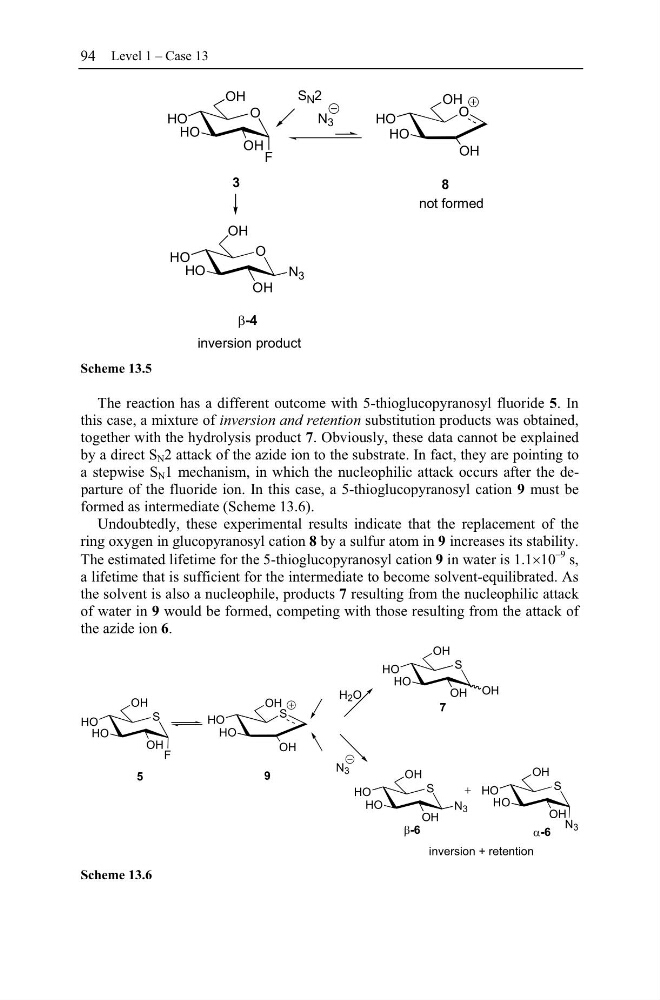
The reaction has a different outcome with 5-thioglucopyranosyl fluoride 5. In
this case, a mixture of inversion and retention substitution products was obtained,
together with the hydrolysis product 7. Obviously, these data cannot be explained
by a direct S N 2 attack of the azide ion to the substrate. In fact, they are pointing to
a stepwise S N 1 mechanism, in which the nucleophilic attack occurs after the departure of the fluoride ion. In this case, a 5-thioglucopyranosyl cation 9 must be
formed as intermediate (Scheme 13.6).
Undoubtedly, these experimental results indicate that the replacement of the
ring oxygen in glucopyranosyl cation 8 by a sulfur atom in 9 increases its stability.
The estimated lifetime for the 5-thioglucopyranosyl cation 9 in water is 1.1u10
–9 s,
a lifetime that is sufficient for the intermediate to become solvent-equilibrated. As
the solvent is also a nucleophile, products 7 resulting from the nucleophilic attack
of water in 9 would be formed, competing with those resulting from the attack of
the azide ion 6.
HO
S
HO
F
OH
OH
HO
HO
OH
S
OH
H 2 O
N 3
HO
S
HO
OH
N 3
OH
HO
S
HO
OH
OH
OH
HO
S
HO
N 3
OH
OH
5
9
inversion + retention
7
D-6
E-6
94
HO
O
HO
OH
OH
HO
O
HO
OH
N 3
OH
N 3
HO
HO
OH
O
OH
3
8
S N 2
inversion product
not formed
E-4
F
Scheme 13.5
The reaction has a different outcome with 5-thioglucopyranosyl fluoride 5. In
this case, a mixture of inversion and retention substitution products was obtained,
together with the hydrolysis product 7. Obviously, these data cannot be explained
by a direct S N 2 attack of the azide ion to the substrate. In fact, they are pointing to
a stepwise S N 1 mechanism, in which the nucleophilic attack occurs after the departure of the fluoride ion. In this case, a 5-thioglucopyranosyl cation 9 must be
formed as intermediate (Scheme 13.6).
Undoubtedly, these experimental results indicate that the replacement of the
ring oxygen in glucopyranosyl cation 8 by a sulfur atom in 9 increases its stability.
The estimated lifetime for the 5-thioglucopyranosyl cation 9 in water is 1.1u10
–9 s,
a lifetime that is sufficient for the intermediate to become solvent-equilibrated. As
the solvent is also a nucleophile, products 7 resulting from the nucleophilic attack
of water in 9 would be formed, competing with those resulting from the attack of
the azide ion 6.
HO
S
HO
F
OH
OH
HO
HO
OH
S
OH
H 2 O
N 3
HO
S
HO
OH
N 3
OH
HO
S
HO
OH
OH
OH
HO
S
HO
N 3
OH
OH
5
9
inversion + retention
7
D-6
E-6