

Oxygen Versus Sulfur Stabilization of Carbenium Ions 91
13 C KIEs (k 12 /k 13 ) for associative processes in glycopyranosides are estimated to
be in the range (1.03-1.08) whereas for dissociative substitution mechanisms are
about (1.00-1.01). The measured values for the
13 C KIEs in xylopyranosides 1
(1.006) suggest a S N 1 mechanism for the departure of the OMe group whereas for
5-thioxylopiranosides 2 (1.031 and 1.028 for D and E anomers, respectively) could
point to a solvent-assisted process.
S Se ec co on nd da da d da d da da d dar ry ry ry y y D DK KI K KI KI K KI K K E
IE I IE I I S
ES ES ES ES E E
The secondary deuterium KIEs (SDKIEs) are observed when the labeled position
is placed next to the reactive center. Although the bonds involving the labeled
atom are not broken in the rate-determining step, it is affected to some extent by
the changes that occur in the transition state. Depending on the distance from the
deuterium atom to the bond that is actually been broken, the SKIEs can be classified as D-SKIEs, E-SKIEs and more rarely J-SKIEs.
D- -S Se ec co on nd da da d da d da da d dar ry ry ry y y K KI K KI KI K KI K K E
IE I IE I I S
ES ES ES ES E E
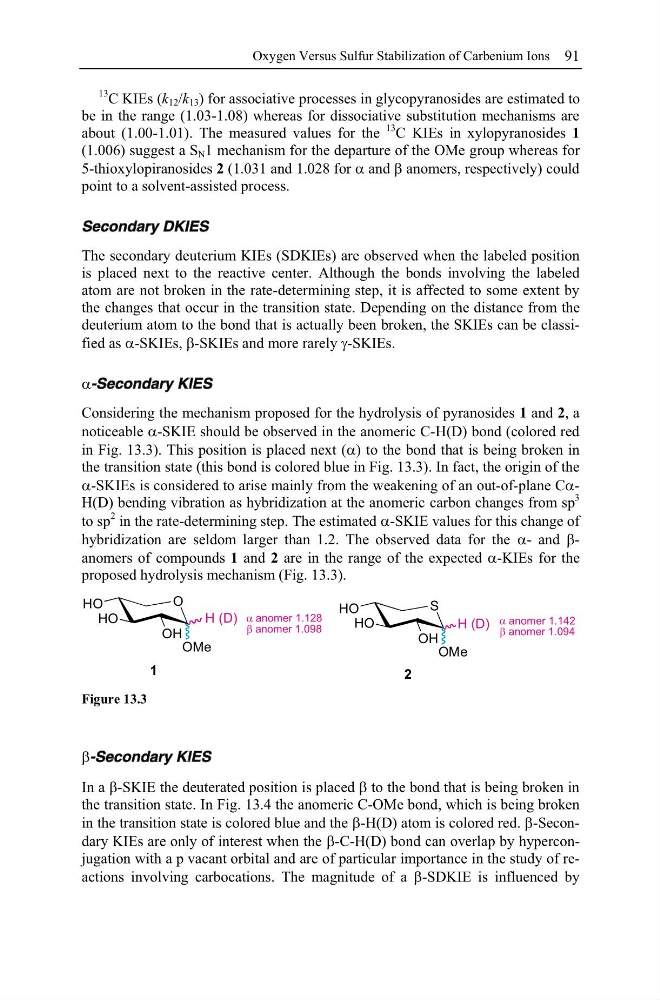
Considering the mechanism proposed for the hydrolysis of pyranosides 1 and 2, a
noticeable D-SKIE should be observed in the anomeric C-H(D) bond (colored red
in Fig. 13.3). This position is placed next (D) to the bond that is being broken in
the transition state (this bond is colored blue in Fig. 13.3). In fact, the origin of the
D-SKIEs is considered to arise mainly from the weakening of an out-of-plane CDH(D) bending vibration as hybridization at the anomeric carbon changes from sp
3
to sp
2 in the rate-determining step. The estimated D-SKIE values for this change of
hybridization are seldom larger than 1.2. The observed data for the D- and Eanomers of compounds 1 and 2 are in the range of the expected D-KIEs for the
proposed hydrolysis mechanism (Fig. 13.3).
H (D)
OMe
HO
O
HO
OH
HO
S
HO
OH
H (D)
OMe
1
2
DDanomer 1.128
E anomer 1.098
DDanomer 1.142
E anomer 1.094
Figure 13.3
E- -S Se ec co on nd da da d da d da da
d dar ry ry ry y y K KI K KI KI K KI K K E
IE I IE I I S
ES ES ES ES E E
In a E-SKIE the deuterated position is placed E to the bond that is being broken in
the transition state. In Fig. 13.4 the anomeric C-OMe bond, which is being broken
in the transition state is colored blue and the E-H(D) atom is colored red. E-Secondary KIEs are only of interest when the E-C-H(D) bond can overlap by hyperconjugation with a p vacant orbital and are of particular importance in the study of reactions involving carbocations. The magnitude of a E-SDKIE is influenced by
13 C KIEs (k 12 /k 13 ) for associative processes in glycopyranosides are estimated to
be in the range (1.03-1.08) whereas for dissociative substitution mechanisms are
about (1.00-1.01). The measured values for the
13 C KIEs in xylopyranosides 1
(1.006) suggest a S N 1 mechanism for the departure of the OMe group whereas for
5-thioxylopiranosides 2 (1.031 and 1.028 for D and E anomers, respectively) could
point to a solvent-assisted process.
S Se ec co on nd da da d da d da da d dar ry ry ry y y D DK KI K KI KI K KI K K E
IE I IE I I S
ES ES ES ES E E
The secondary deuterium KIEs (SDKIEs) are observed when the labeled position
is placed next to the reactive center. Although the bonds involving the labeled
atom are not broken in the rate-determining step, it is affected to some extent by
the changes that occur in the transition state. Depending on the distance from the
deuterium atom to the bond that is actually been broken, the SKIEs can be classified as D-SKIEs, E-SKIEs and more rarely J-SKIEs.
D- -S Se ec co on nd da da d da d da da d dar ry ry ry y y K KI K KI KI K KI K K E
IE I IE I I S
ES ES ES ES E E
Considering the mechanism proposed for the hydrolysis of pyranosides 1 and 2, a
noticeable D-SKIE should be observed in the anomeric C-H(D) bond (colored red
in Fig. 13.3). This position is placed next (D) to the bond that is being broken in
the transition state (this bond is colored blue in Fig. 13.3). In fact, the origin of the
D-SKIEs is considered to arise mainly from the weakening of an out-of-plane CDH(D) bending vibration as hybridization at the anomeric carbon changes from sp
3
to sp
2 in the rate-determining step. The estimated D-SKIE values for this change of
hybridization are seldom larger than 1.2. The observed data for the D- and Eanomers of compounds 1 and 2 are in the range of the expected D-KIEs for the
proposed hydrolysis mechanism (Fig. 13.3).
H (D)
OMe
HO
O
HO
OH
HO
S
HO
OH
H (D)
OMe
1
2
DDanomer 1.128
E anomer 1.098
DDanomer 1.142
E anomer 1.094
Figure 13.3
E- -S Se ec co on nd da da d da d da da
d dar ry ry ry y y K KI K KI KI K KI K K E
IE I IE I I S
ES ES ES ES E E
In a E-SKIE the deuterated position is placed E to the bond that is being broken in
the transition state. In Fig. 13.4 the anomeric C-OMe bond, which is being broken
in the transition state is colored blue and the E-H(D) atom is colored red. E-Secondary KIEs are only of interest when the E-C-H(D) bond can overlap by hyperconjugation with a p vacant orbital and are of particular importance in the study of reactions involving carbocations. The magnitude of a E-SDKIE is influenced by