

Level 1 – Case 13
90
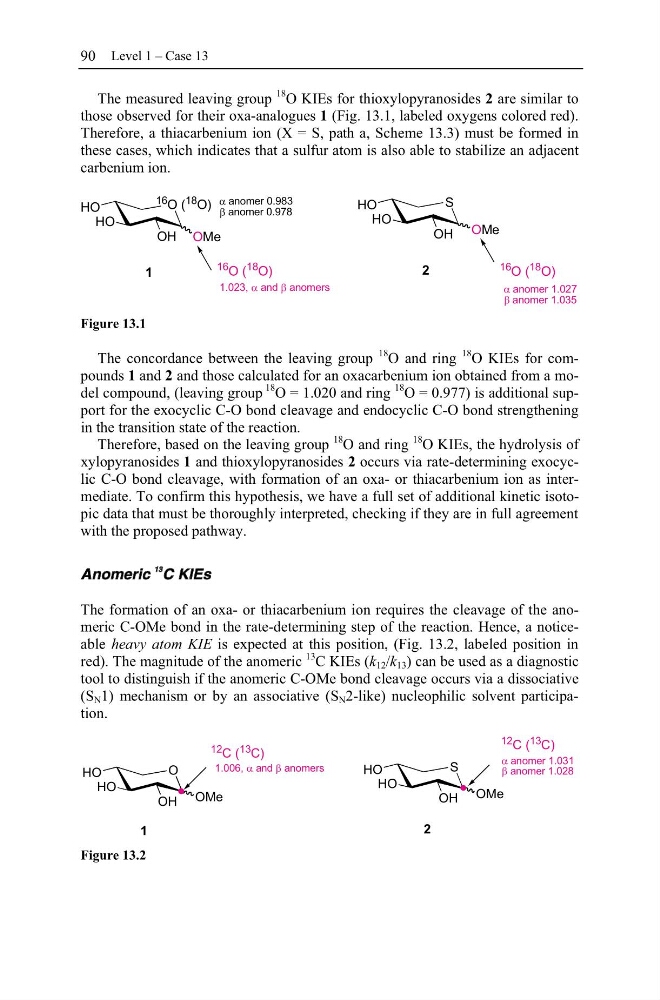
The measured leaving group
18
O KIEs for thioxylopyranosides 2 are similar to
those observed for their oxa-analogues 1 (Fig. 13.1, labeled oxygens colored red).
Therefore, a thiacarbenium ion (X = S, path a, Scheme 13.3) must be formed in
these cases, which indicates that a sulfur atom is also able to stabilize an adjacent
carbenium ion.
16 O ( 18 O)
OMe
HO
16 O ( 18 O)
HO
OH
HO
S
HO
OH OMe
16 O ( 18 O)
Danomer 0.983
E anomer 0.978
1.023, D and E anomers
2
DDanomer 1.027
E anomer 1.035
1
Figure 13.1
The concordance between th t e leaving group u
18 O and ring
18 O KIEs fo f f r compounds 1 and 2 and those calculated for an oxacarbenium ion obtained from a model compound, (leaving group
18 O = 1.020 and ring
18 O = 0.977) is additional support for the exocyclic C-O bond cleavage and endocyclic C-O bond strengthening
in the transition state of the reaction.
Therefore, based on the leaving group
18 O and ring
18 O KIEs, the hydrolysis of
xylopyranosides 1 and thioxylopyranosides 2 occurs via rate-determining exocyclic C-O bond cleavage, with formation of an oxa- or thiacarbenium ion as intermediate. To confirm this hypothesis, we have a full set of additional kinetic isotopic data that must be thoroughly interpreted, checking if they are in full agreement
with the proposed pathway.
A
An no om me er ri ri ri r ri
ri r ric ic ic ic i i
1 13 3
C C K KI K KI KI K KI K K E
IE I IE I I s
Es E Es Es Es E E
The formation of an oxa- or thiacarbenium ion requires the cleavage of the anomeric C-OMe bond in the rate-determining step of the reaction. Hence, a noticeable heavy atom KIE is expected at this position, (Fig. 13.2, labeled position in
E
red). The magnitude of the anomeric
13
C KIEs (k 12 /k 13 ) can be used as a diagnostic
tool to distinguish if the anomeric C-OMe bond cleavage occurs via a dissociative
(S N 1) mechanism or by an associative (S N 2-like) nucleophilic solvent participation.
12 C ( 13 C)
HO
O
HO
OH OMe
HO
S
HO
OH OMe
12 C ( 13 C)
1
2
D anomer 1.031
E anomer 1.028
1.006, D and E anomers
Figure 13.2
90
The measured leaving group
18
O KIEs for thioxylopyranosides 2 are similar to
those observed for their oxa-analogues 1 (Fig. 13.1, labeled oxygens colored red).
Therefore, a thiacarbenium ion (X = S, path a, Scheme 13.3) must be formed in
these cases, which indicates that a sulfur atom is also able to stabilize an adjacent
carbenium ion.
16 O ( 18 O)
OMe
HO
16 O ( 18 O)
HO
OH
HO
S
HO
OH OMe
16 O ( 18 O)
Danomer 0.983
E anomer 0.978
1.023, D and E anomers
2
DDanomer 1.027
E anomer 1.035
1
Figure 13.1
The concordance between th t e leaving group u
18 O and ring
18 O KIEs fo f f r compounds 1 and 2 and those calculated for an oxacarbenium ion obtained from a model compound, (leaving group
18 O = 1.020 and ring
18 O = 0.977) is additional support for the exocyclic C-O bond cleavage and endocyclic C-O bond strengthening
in the transition state of the reaction.
Therefore, based on the leaving group
18 O and ring
18 O KIEs, the hydrolysis of
xylopyranosides 1 and thioxylopyranosides 2 occurs via rate-determining exocyclic C-O bond cleavage, with formation of an oxa- or thiacarbenium ion as intermediate. To confirm this hypothesis, we have a full set of additional kinetic isotopic data that must be thoroughly interpreted, checking if they are in full agreement
with the proposed pathway.
A
An no om me er ri ri ri r ri
ri r ric ic ic ic i i
1 13 3
C C K KI K KI KI K KI K K E
IE I IE I I s
Es E Es Es Es E E
The formation of an oxa- or thiacarbenium ion requires the cleavage of the anomeric C-OMe bond in the rate-determining step of the reaction. Hence, a noticeable heavy atom KIE is expected at this position, (Fig. 13.2, labeled position in
E
red). The magnitude of the anomeric
13
C KIEs (k 12 /k 13 ) can be used as a diagnostic
tool to distinguish if the anomeric C-OMe bond cleavage occurs via a dissociative
(S N 1) mechanism or by an associative (S N 2-like) nucleophilic solvent participation.
12 C ( 13 C)
HO
O
HO
OH OMe
HO
S
HO
OH OMe
12 C ( 13 C)
1
2
D anomer 1.031
E anomer 1.028
1.006, D and E anomers
Figure 13.2