

Oxygen Versus Sulfur Stabilization of Carbenium Ions 89
Table 13.2. Kinetic Isotope Effects (KIEs) for the acid-catalyzed hydrolysis of methyl 5thio-xylopyranosides 2 at 80°C (average values).
Type of KIE
D-anomer
E-anomer
Secondary D-D
1.142
1.094
Secondary E-D
1.061
1.018
Leaving group
18
O
1.027
1.035
Anomeric
13
C
1.031
1.028
Solvent (kD k k 3 O
+
/kH k k 3 O
+ )
2.37
2.63
The calculated isotope effects (HF/4.31G) for the acid-catalyzed formation of
an oxacarbenium ion from methanediol as a model compound were: ring
18 O =
0.977 and leaving group
18
O = 1.020
D Di is sc cu us ss si io on n
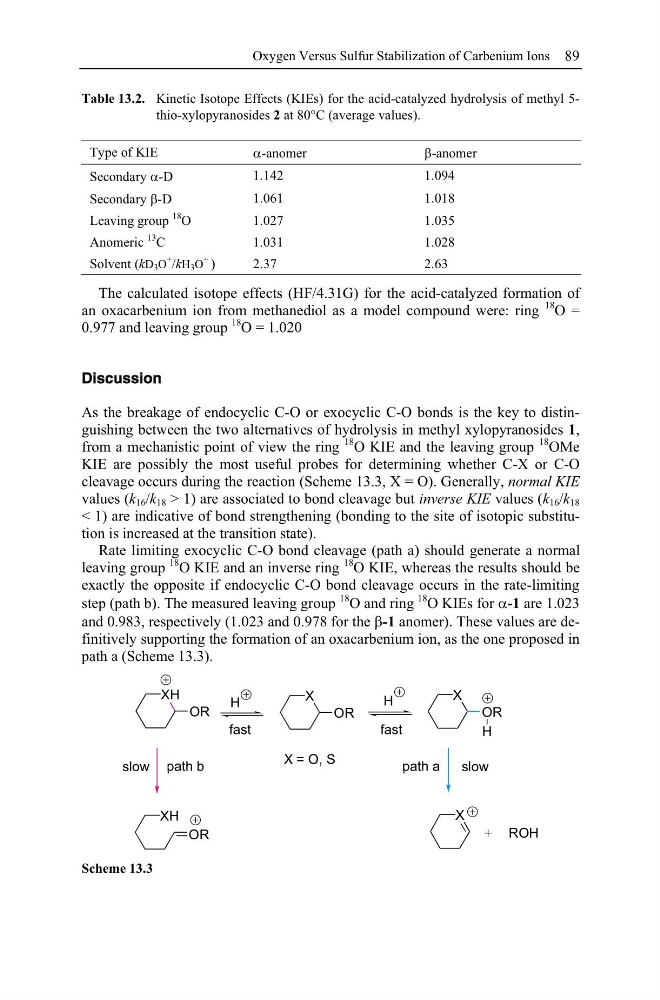
As the breakage of endocyclic C-O or exocyclic C-O bonds is the key to distinguishing between the two alternatives of hydrolysis in methyl xylopyranosides 1,
from a mechanistic point of view the ring
18
O KIE and the leaving group
18 OMe
KIE are possibly the most useful probes for determining whether C-X or C-O
cleavage occurs during the reaction (Scheme 13.3, X = O). Generally, normal KIE
values (k 16 /k 18 > 1) are associated to bond cleavage but inverse KIE values (
E
k 16 /k 18
< 1) are indicative of bond strengthening (bonding to the site of isotopic substitution is increased at the transition state).
Rate limiting exocyclic C-O bond cleavage (path a) should generate a normal
leaving group
18 O KIE and an inverse ring
18
O KIE, whereas the results should be
exactly the opposite if endocyclic C-O bond cleavage occurs in the rate-limiting
step (path b). The measured leaving group
18
O and ring
18 O KIEs for D-1 are 1.023
and 0.983, respectively (1.023 and 0.978 for the E-1 anomer). These values are definitively supporting the formation of an oxacarbenium ion, as the one proposed in
path a (Scheme 13.3).
ROH
X
X
OR
H
H
X
OR
XH
OR
H
XH
OR
slow
slow
X = O S
path b
path a
X = O S
fast
Scheme 13.3
Table 13.2. Kinetic Isotope Effects (KIEs) for the acid-catalyzed hydrolysis of methyl 5thio-xylopyranosides 2 at 80°C (average values).
Type of KIE
D-anomer
E-anomer
Secondary D-D
1.142
1.094
Secondary E-D
1.061
1.018
Leaving group
18
O
1.027
1.035
Anomeric
13
C
1.031
1.028
Solvent (kD k k 3 O
+
/kH k k 3 O
+ )
2.37
2.63
The calculated isotope effects (HF/4.31G) for the acid-catalyzed formation of
an oxacarbenium ion from methanediol as a model compound were: ring
18 O =
0.977 and leaving group
18
O = 1.020
D Di is sc cu us ss si io on n
As the breakage of endocyclic C-O or exocyclic C-O bonds is the key to distinguishing between the two alternatives of hydrolysis in methyl xylopyranosides 1,
from a mechanistic point of view the ring
18
O KIE and the leaving group
18 OMe
KIE are possibly the most useful probes for determining whether C-X or C-O
cleavage occurs during the reaction (Scheme 13.3, X = O). Generally, normal KIE
values (k 16 /k 18 > 1) are associated to bond cleavage but inverse KIE values (
E
k 16 /k 18
< 1) are indicative of bond strengthening (bonding to the site of isotopic substitution is increased at the transition state).
Rate limiting exocyclic C-O bond cleavage (path a) should generate a normal
leaving group
18 O KIE and an inverse ring
18
O KIE, whereas the results should be
exactly the opposite if endocyclic C-O bond cleavage occurs in the rate-limiting
step (path b). The measured leaving group
18
O and ring
18 O KIEs for D-1 are 1.023
and 0.983, respectively (1.023 and 0.978 for the E-1 anomer). These values are definitively supporting the formation of an oxacarbenium ion, as the one proposed in
path a (Scheme 13.3).
ROH
X
X
OR
H
H
X
OR
XH
OR
H
XH
OR
slow
slow
X = O S
path b
path a
X = O S
fast
Scheme 13.3