

Elimination Reactions of Benzaldehyde O-Benzoyloximes 81
E2 MECHANISM
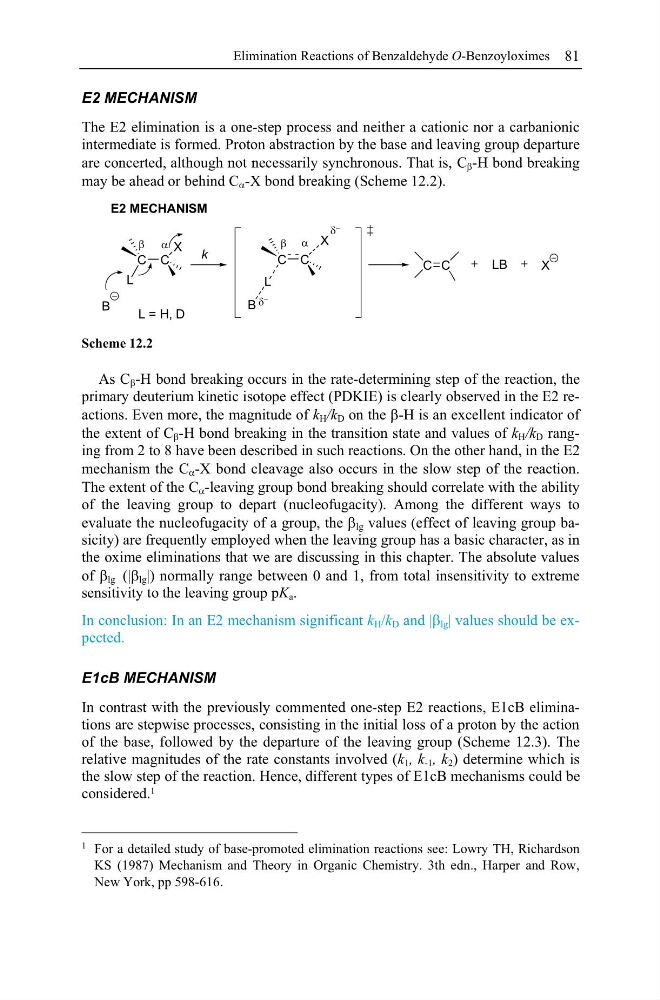
The E2 elimination is a one-step process and neither a cationic nor a carbanionic
intermediate is formed. Proton abstraction by the base and leaving group departure
are concerted, although not necessarily synchronous. That is, C E -H bond breaking
may be ahead or behind C D -X bond breaking (Scheme 12.2).
C C
L
X
G
D
B
C C
X
L
B G
C C
LB
X
E2 MECHANISM
E
k
L = H, D
E D
Scheme 12.2
As C E -H bond breaking occurs in the rate-determining step of the reaction, the
primary deuterium kinetic isotope effect (PDKIE) is clearly observed in the E2 reactions. Even more, the magnitude of k H
k k /k
H H D
k k on the E-H is an excellent indicator of
the extent of C E -H bond breaking in the transition state and values of k H
k k /k
H H D
k k ranging from 2 to 8 have been described in such reactions. On the other hand, in the E2
mechanism the C D -X bond cleavage also occurs in the slow step of the reaction.
The extent of the C D -leaving group bond breaking should correlate with the ability
of the leaving group to depart (nucleofugacity). Among the different ways to
evaluate the nucleofugacity of a group, the E lg values (effect of leaving group basicity) are frequently employed when the leaving group has a basic character, as in
the oxime eliminations that we are discussing in this chapter. The absolute values
of E lg |E lg |) normally range between 0 and 1, from total insensitivity to extreme
sensitivity to the leaving group pK a
K K .
In conclusion: In an E2 mechanism significant k H /k D and |E lg | values should be expected.
In contrast with the previously commented one-step E2 reactions, E1cB eliminations are stepwise processes, consisting in the initial loss of a proton by the action
of the base, followed by the departure of the leaving group (Scheme 12.3). The
relative magnitudes of the rate constants involved (k 1 , k -1
k k , k 2
k k ) determine which is
the slow step of the reaction. Hence, different types of E1cB mechanisms could be
considered.
1
1 For a detailed study of base-promoted elimination reactions see: Lowry TH, Richardson
KS (1987) Mechanism and Theory in Organic Chemistry. 3th edn., Harper and Row,
New York, pp 598-616.
E2 MECHANISM
The E2 elimination is a one-step process and neither a cationic nor a carbanionic
intermediate is formed. Proton abstraction by the base and leaving group departure
are concerted, although not necessarily synchronous. That is, C E -H bond breaking
may be ahead or behind C D -X bond breaking (Scheme 12.2).
C C
L
X
G
D
B
C C
X
L
B G
C C
LB
X
E2 MECHANISM
E
k
L = H, D
E D
Scheme 12.2
As C E -H bond breaking occurs in the rate-determining step of the reaction, the
primary deuterium kinetic isotope effect (PDKIE) is clearly observed in the E2 reactions. Even more, the magnitude of k H
k k /k
H H D
k k on the E-H is an excellent indicator of
the extent of C E -H bond breaking in the transition state and values of k H
k k /k
H H D
k k ranging from 2 to 8 have been described in such reactions. On the other hand, in the E2
mechanism the C D -X bond cleavage also occurs in the slow step of the reaction.
The extent of the C D -leaving group bond breaking should correlate with the ability
of the leaving group to depart (nucleofugacity). Among the different ways to
evaluate the nucleofugacity of a group, the E lg values (effect of leaving group basicity) are frequently employed when the leaving group has a basic character, as in
the oxime eliminations that we are discussing in this chapter. The absolute values
of E lg |E lg |) normally range between 0 and 1, from total insensitivity to extreme
sensitivity to the leaving group pK a
K K .
In conclusion: In an E2 mechanism significant k H /k D and |E lg | values should be expected.
In contrast with the previously commented one-step E2 reactions, E1cB eliminations are stepwise processes, consisting in the initial loss of a proton by the action
of the base, followed by the departure of the leaving group (Scheme 12.3). The
relative magnitudes of the rate constants involved (k 1 , k -1
k k , k 2
k k ) determine which is
the slow step of the reaction. Hence, different types of E1cB mechanisms could be
considered.
1
1 For a detailed study of base-promoted elimination reactions see: Lowry TH, Richardson
KS (1987) Mechanism and Theory in Organic Chemistry. 3th edn., Harper and Row,
New York, pp 598-616.