

Level 1 – Case 12
82
C C
H
X
B
C C
X
C C
HB X
HB
k 1
k -1
k k
k 2
k k
Scheme 12.3
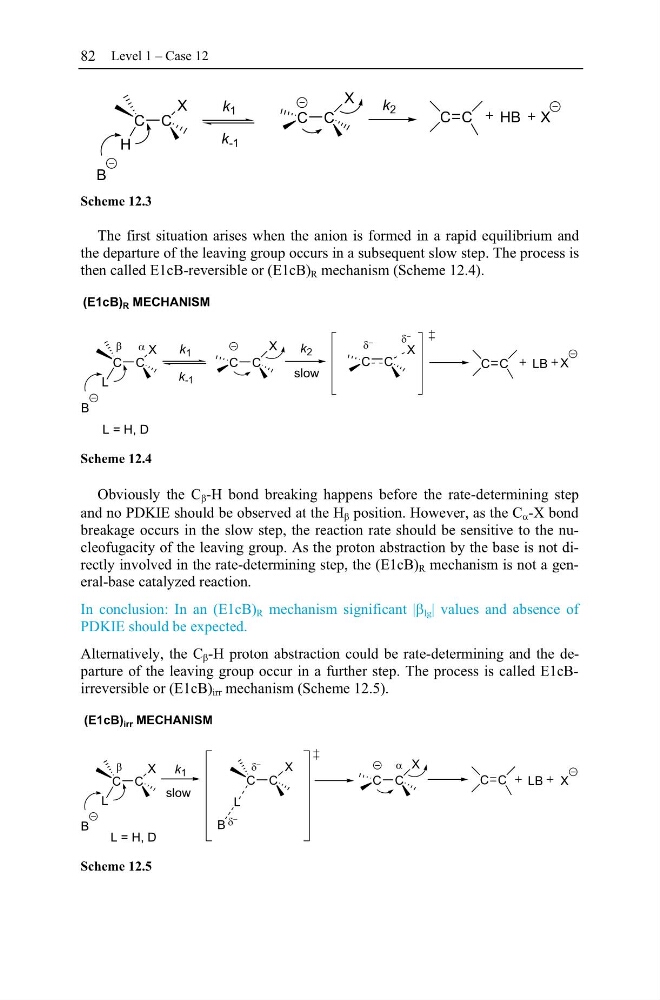
The first situation arises when the anion is formed in a rapid equilibrium and
the departure of the leaving group occurs in a subsequent slow step. The process is
then called E1cB-reversible or (E1cB) R mechanism (Scheme 12.4).
R
C C
L
X
B
C C
X
C C
X
C C
LB X
(E1cB) R MECHANISM
R
k 1
k -1
k k
k 2
k k
E
D
G
G
slow
L = H, D
Scheme 12.4
Obviously the C E -H bond breaking happens before the rate-determining step
and no PDKIE should be observed at the H E position. However, as the C D -X bond
breakage occurs in the slow step, the reaction rate should be sensitive to the nucleofugacity of the leaving group. As the proton abstraction by the base is not directly involved in the rate-determining step, the (E1cB) R mechanism is not a genR
eral-base catalyzed reaction.
In conclusion: In an (E1cB) R mechanism significant |E lg | values and absence of
PDKIE should be expected.
Alternatively, the C E -H proton abstraction could be rate-determining and the departure of the leaving group occur in a further step. The process is called E1cBirreversible or (E1cB) irr mechanism (Scheme 12.5).
r
C C
L
X
C C
X
L
B G
G
C C
X
D
C C
LB X
E
B
k 1
slow
L = H, D
(E1cB) irr MECHANISM
r
Scheme 12.5
82
C C
H
X
B
C C
X
C C
HB X
HB
k 1
k -1
k k
k 2
k k
Scheme 12.3
The first situation arises when the anion is formed in a rapid equilibrium and
the departure of the leaving group occurs in a subsequent slow step. The process is
then called E1cB-reversible or (E1cB) R mechanism (Scheme 12.4).
R
C C
L
X
B
C C
X
C C
X
C C
LB X
(E1cB) R MECHANISM
R
k 1
k -1
k k
k 2
k k
E
D
G
G
slow
L = H, D
Scheme 12.4
Obviously the C E -H bond breaking happens before the rate-determining step
and no PDKIE should be observed at the H E position. However, as the C D -X bond
breakage occurs in the slow step, the reaction rate should be sensitive to the nucleofugacity of the leaving group. As the proton abstraction by the base is not directly involved in the rate-determining step, the (E1cB) R mechanism is not a genR
eral-base catalyzed reaction.
In conclusion: In an (E1cB) R mechanism significant |E lg | values and absence of
PDKIE should be expected.
Alternatively, the C E -H proton abstraction could be rate-determining and the departure of the leaving group occur in a further step. The process is called E1cBirreversible or (E1cB) irr mechanism (Scheme 12.5).
r
C C
L
X
C C
X
L
B G
G
C C
X
D
C C
LB X
E
B
k 1
slow
L = H, D
(E1cB) irr MECHANISM
r
Scheme 12.5