

Level 1 – Case 12
80
X
N
(D) H
O C
O
C
Y
DBU
MeCN
C N
(D) H
O C
O
Y
X
X
CN
Y
COO
N
N
DBU
DBUH
E D
2 Z-isomer
E D
1 E-isomer
X, Y = H, p-MeO, m-Br, p-NO 2
Scheme 12.1
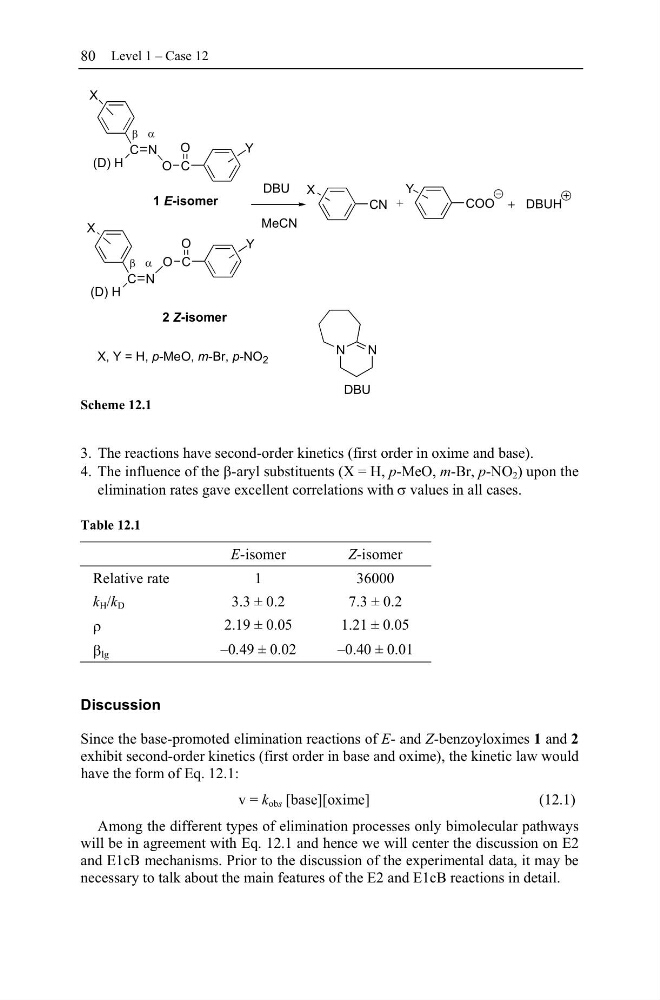
3. The reactions have second-order kinetics (first order in oxime and base).
4. The influence of the E-aryl substituents (X = H, p-MeO, m-Br, p-NO 2 ) upon the
elimination rates gave excellent correlations with V values in all cases.
Table 12.1
E-isomer
Z-isomer Z Z
Relative rate
1
36000
k H
k k /k D
k k
3.3 ± 0.2
7.3 ± 0.2
U
2.19 ± 0.05
1.21 ± 0.05
E lg
–0.49 ± 0.02
–0.40 ± 0.01
Discussion
Since the base-promoted elimination reactions of E- and Z-benzoyloximes Z Z
1 and 2
exhibit second-order kinetics (first order in base and oxime), the kinetic law would
have the form of Eq. 12.1:
v = k ob
k k s [base][oxime]
(12.1)
Among the different types of elimination processes only bimolecular pathways
will be in agreement with Eq. 12.1 and hence we will center the discussion on E2
and E1cB mechanisms. Prior to the discussion of the experimental data, it may be
necessary to talk about the main features of the E2 and E1cB reactions in detail.
80
X
N
(D) H
O C
O
C
Y
DBU
MeCN
C N
(D) H
O C
O
Y
X
X
CN
Y
COO
N
N
DBU
DBUH
E D
2 Z-isomer
E D
1 E-isomer
X, Y = H, p-MeO, m-Br, p-NO 2
Scheme 12.1
3. The reactions have second-order kinetics (first order in oxime and base).
4. The influence of the E-aryl substituents (X = H, p-MeO, m-Br, p-NO 2 ) upon the
elimination rates gave excellent correlations with V values in all cases.
Table 12.1
E-isomer
Z-isomer Z Z
Relative rate
1
36000
k H
k k /k D
k k
3.3 ± 0.2
7.3 ± 0.2
U
2.19 ± 0.05
1.21 ± 0.05
E lg
–0.49 ± 0.02
–0.40 ± 0.01
Discussion
Since the base-promoted elimination reactions of E- and Z-benzoyloximes Z Z
1 and 2
exhibit second-order kinetics (first order in base and oxime), the kinetic law would
have the form of Eq. 12.1:
v = k ob
k k s [base][oxime]
(12.1)
Among the different types of elimination processes only bimolecular pathways
will be in agreement with Eq. 12.1 and hence we will center the discussion on E2
and E1cB mechanisms. Prior to the discussion of the experimental data, it may be
necessary to talk about the main features of the E2 and E1cB reactions in detail.