

The Hydrolysis of p-Substituted Styrene Oxides 71
O
H
MeO
-
MeOH
X
CH 2 OMe
H
OH
X
CH 2 OH
H
OMe
1
X = MeO (3:4, 70:30)
X = Me (3:4, 51:49)
X = H
(3:4, 38:62)
X = Cl (3:4, 29:71)
X = NO 2 (3:4,15:85)
D
E
3
4
Scheme 11.3
Discussion
The second and third terms in rate expression Eq. 11.1 (k H
k k [H 3 O
+ ] and k OH
k k [OH
– ],
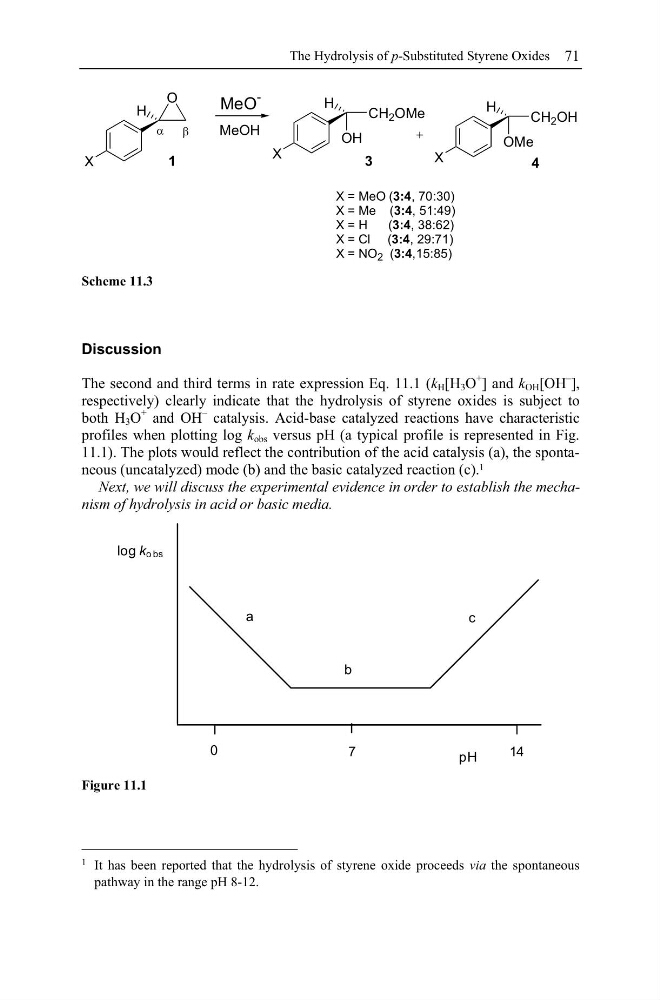
respectively) clearly indicate that the hydrolysis of styrene oxides is subject to
both H 3 O
+ and OH
– catalysis. Acid-base catalyzed
–
reactions have characteristic
profiles when plotting log k obs
k k versus pH (a typical profile is represented in Fig.
11.1). The plots would reflect the contribution of the acid catalysis (a), the spontaneous (uncatalyzed) mode (b) and the basic catalyzed reaction (c).
1
Next, we will discuss the experimental evidence in order to establish the mechanism of hydrolysis in acid or basic media.
log k o bs
k k
pH
I I
I
I
I
I
I I
0
7
1 4
pH
a
b
c
Figure 11.1
1 It has been reported that the hydrolysis of styrene oxide proceeds via the spontaneous
pathway in the range pH 8-12.
O
H
MeO
-
MeOH
X
CH 2 OMe
H
OH
X
CH 2 OH
H
OMe
1
X = MeO (3:4, 70:30)
X = Me (3:4, 51:49)
X = H
(3:4, 38:62)
X = Cl (3:4, 29:71)
X = NO 2 (3:4,15:85)
D
E
3
4
Scheme 11.3
Discussion
The second and third terms in rate expression Eq. 11.1 (k H
k k [H 3 O
+ ] and k OH
k k [OH
– ],
respectively) clearly indicate that the hydrolysis of styrene oxides is subject to
both H 3 O
+ and OH
– catalysis. Acid-base catalyzed
–
reactions have characteristic
profiles when plotting log k obs
k k versus pH (a typical profile is represented in Fig.
11.1). The plots would reflect the contribution of the acid catalysis (a), the spontaneous (uncatalyzed) mode (b) and the basic catalyzed reaction (c).
1
Next, we will discuss the experimental evidence in order to establish the mechanism of hydrolysis in acid or basic media.
log k o bs
k k
pH
I I
I
I
I
I
I I
0
7
1 4
pH
a
b
c
Figure 11.1
1 It has been reported that the hydrolysis of styrene oxide proceeds via the spontaneous
pathway in the range pH 8-12.