

Level 1 – Case 11
70
Hydrolysis in Acidic Medium (H 3 3 O
+ +
)
1. The rate of hydrolysis of p-substituted styrene oxides in acidic medium is
strongly affected by the nature of the substituent in the para position, varying
from k H
k k = 1.10u10
4 M
–1 s
–1 for the MeO substituent to k H
k k = 3.41u10
–3 M
–1 s
–1 in
the case of the NO 2 group. A plot of log k H
k k versus V
+ for all para-substituents
gives an excellent Hammett correlation with a slope U
+ = –4.2.
2. The hydrolysis in H 2
18
O yields glycol products in which all of the
18 O is incorporated into the benzyl hydroxyl group.
3. The acid hydrolysis of (+)-styrene oxide yields a totally racemic diol, whereas
the acid methanolysis of (+)-styrene oxide yields a product with 89% inversion
of configuration at the benzylic position.
Hydrolysis in Basic Medium (OH
)
4. The rates of hydrolyses in basic medium of p-NO 2 , p-Cl, p-H and p-Me substituted styrene oxides are essentially independent of the nature of the substituent
(i.e. k OH
k k = 1.02u10
–4 M
–1 s
–1 in the case of p-NO 2 and k OH
k k = 1.62u10
–4 M
–1 s
–1
in the case of p-Me).
5. The reactions with K
18 OH/H 2
18
O show that the addition of
18 OH
– to styrene ox–
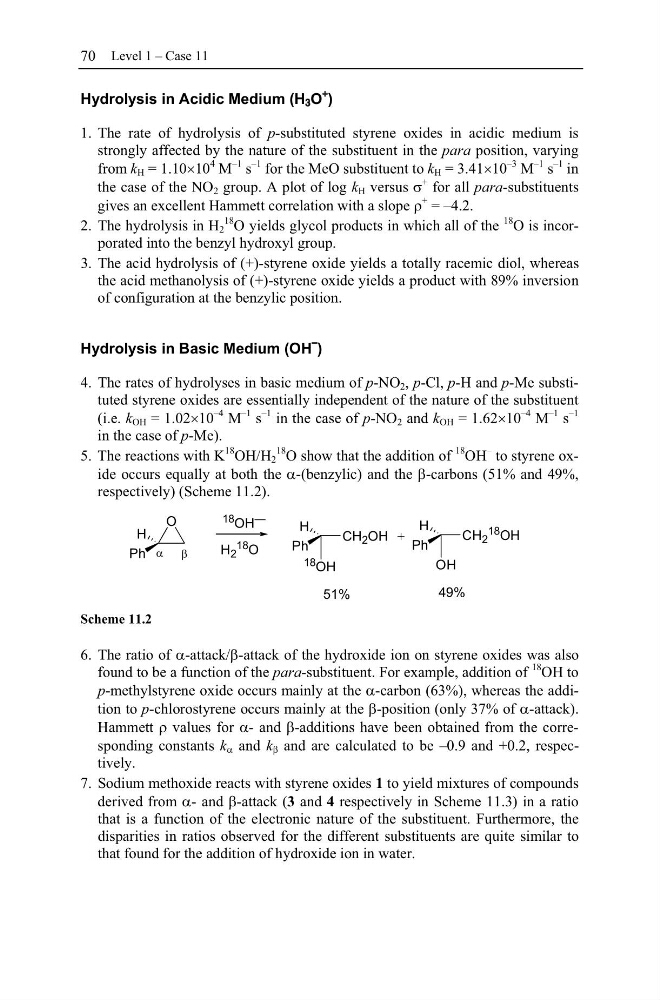
ide occurs equally at both the D-(benzylic) and the E-carbons (51% and 49%,
respectively) (Scheme 11.2).
O
Ph
H
CH 2
18 OH
Ph
H
OH
18 OH —
H 2
18 O
CH 2 OH
Ph
H
18 OH
D
E
51%
49%
Scheme 11.2
6. The ratio of D-attack/E-attack of the hydroxide ion on styrene oxides was also
found to be a function of the para-substituent. For example, addition of
18 OH to
p-methylstyrene oxide occurs mainly at the D-carbon (63%), whereas the addition to p-chlorostyrene occurs mainly at the E-position (only 37% of D-attack).
Hammett U values for D- and E-additions have been obtained from the corresponding constants k D
k k and k E
k and are calculated to be –0.9 and +0.2, respectively.
7. Sodium methoxide reacts with styrene oxides 1 to yield mixtures of compounds
derived from D- and E-attack (3 and 4 respectively in Scheme 11.3) in a ratio
that is a function of the electronic nature of the substituent. Furthermore, the
disparities in ratios observed for the different substituents are quite similar to
that found for the addition of hydroxide ion in water.
70
Hydrolysis in Acidic Medium (H 3 3 O
+ +
)
1. The rate of hydrolysis of p-substituted styrene oxides in acidic medium is
strongly affected by the nature of the substituent in the para position, varying
from k H
k k = 1.10u10
4 M
–1 s
–1 for the MeO substituent to k H
k k = 3.41u10
–3 M
–1 s
–1 in
the case of the NO 2 group. A plot of log k H
k k versus V
+ for all para-substituents
gives an excellent Hammett correlation with a slope U
+ = –4.2.
2. The hydrolysis in H 2
18
O yields glycol products in which all of the
18 O is incorporated into the benzyl hydroxyl group.
3. The acid hydrolysis of (+)-styrene oxide yields a totally racemic diol, whereas
the acid methanolysis of (+)-styrene oxide yields a product with 89% inversion
of configuration at the benzylic position.
Hydrolysis in Basic Medium (OH
)
4. The rates of hydrolyses in basic medium of p-NO 2 , p-Cl, p-H and p-Me substituted styrene oxides are essentially independent of the nature of the substituent
(i.e. k OH
k k = 1.02u10
–4 M
–1 s
–1 in the case of p-NO 2 and k OH
k k = 1.62u10
–4 M
–1 s
–1
in the case of p-Me).
5. The reactions with K
18 OH/H 2
18
O show that the addition of
18 OH
– to styrene ox–
ide occurs equally at both the D-(benzylic) and the E-carbons (51% and 49%,
respectively) (Scheme 11.2).
O
Ph
H
CH 2
18 OH
Ph
H
OH
18 OH —
H 2
18 O
CH 2 OH
Ph
H
18 OH
D
E
51%
49%
Scheme 11.2
6. The ratio of D-attack/E-attack of the hydroxide ion on styrene oxides was also
found to be a function of the para-substituent. For example, addition of
18 OH to
p-methylstyrene oxide occurs mainly at the D-carbon (63%), whereas the addition to p-chlorostyrene occurs mainly at the E-position (only 37% of D-attack).
Hammett U values for D- and E-additions have been obtained from the corresponding constants k D
k k and k E
k and are calculated to be –0.9 and +0.2, respectively.
7. Sodium methoxide reacts with styrene oxides 1 to yield mixtures of compounds
derived from D- and E-attack (3 and 4 respectively in Scheme 11.3) in a ratio
that is a function of the electronic nature of the substituent. Furthermore, the
disparities in ratios observed for the different substituents are quite similar to
that found for the addition of hydroxide ion in water.