

Level 1 – Case 11
The Hydrolysis of p-Substituted Styrene Oxides
Key point: Catalysis. Hammett constants
H
O
Ar
H
OH
CH 2 OH
Ar
H 3 O
+ or HO
-
hydrolysis
The Hydrolysis of p-Substituted Styrene Oxides
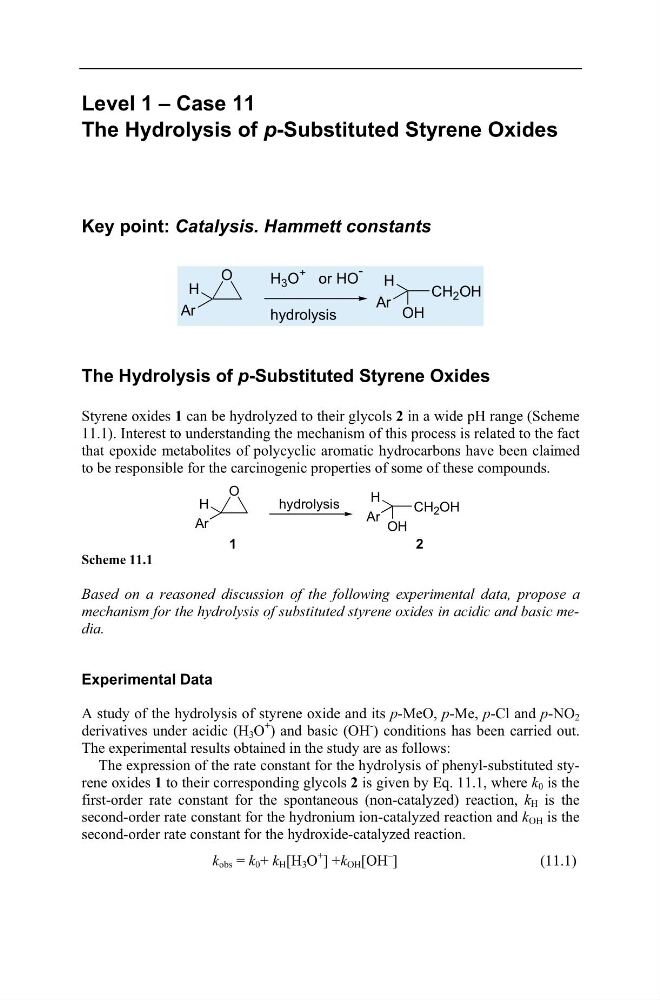
Styrene oxides 1 can be hydrolyzed to their glycols 2 in a wide pH range (Scheme
11.1). Interest to understanding the mechanism of this process is related to the fact
that epoxide metabolites of polycyclic aromatic hydrocarbons have been claimed
to be responsible for the carcinogenic properties of some of these compounds.
O
Ar
H
CH 2 OH
Ar
H
OH
hydrolysis
1
2
Scheme 11.1
Based on a reasoned discussion of the following experimental data, propose a
mechanism for the hydrolysis of substituted styrene oxides in acidic and basic media.
Experimental Data
A study of the hydrolysis of styrene oxide and its p-MeO, p-Me, p-Cl and p-NO 2
derivatives under acidic (H 3 O
+ ) and basic (OH
- ) conditions has been carried out.
The experimental results obtained in the study are as follows:
The expression of the rate constant for the hydrolysis of phenyl-substituted styrene oxides 1 to their corresponding glycols 2 is given by Eq. 11.1, where k 0
k k is the
first-order rate constant for the spontaneous (non-catalyzed) reaction, k H
k k is the
second-order rate constant for the hydronium ion-catalyzed reaction and k OH
k k is the
second-order rate constant for the hydroxide-catalyzed reaction.
k obs
k k = k 0
k k + k H
k k [H 3 O
+ ] +k OH
k k [OH
–
]
(11.1)
The Hydrolysis of p-Substituted Styrene Oxides
Key point: Catalysis. Hammett constants
H
O
Ar
H
OH
CH 2 OH
Ar
H 3 O
+ or HO
-
hydrolysis
The Hydrolysis of p-Substituted Styrene Oxides
Styrene oxides 1 can be hydrolyzed to their glycols 2 in a wide pH range (Scheme
11.1). Interest to understanding the mechanism of this process is related to the fact
that epoxide metabolites of polycyclic aromatic hydrocarbons have been claimed
to be responsible for the carcinogenic properties of some of these compounds.
O
Ar
H
CH 2 OH
Ar
H
OH
hydrolysis
1
2
Scheme 11.1
Based on a reasoned discussion of the following experimental data, propose a
mechanism for the hydrolysis of substituted styrene oxides in acidic and basic media.
Experimental Data
A study of the hydrolysis of styrene oxide and its p-MeO, p-Me, p-Cl and p-NO 2
derivatives under acidic (H 3 O
+ ) and basic (OH
- ) conditions has been carried out.
The experimental results obtained in the study are as follows:
The expression of the rate constant for the hydrolysis of phenyl-substituted styrene oxides 1 to their corresponding glycols 2 is given by Eq. 11.1, where k 0
k k is the
first-order rate constant for the spontaneous (non-catalyzed) reaction, k H
k k is the
second-order rate constant for the hydronium ion-catalyzed reaction and k OH
k k is the
second-order rate constant for the hydroxide-catalyzed reaction.
k obs
k k = k 0
k k + k H
k k [H 3 O
+ ] +k OH
k k [OH
–
]
(11.1)