

Level 1 – Case 11
72
Acid (H 3 3 O
+ +
) Catalysis
The expression Eq. 11.1 indicates that k obs
k k is linearly dependent upon the hydronium ion concentration [H 3 O
+ ]. That is, the acid hydrolysis of substituted styrene oxides is catalyzed by H 3 O
+ but not by any other unionized weak acid (AH)
present in the medium. This is distinctive for a specific acid catalysis reaction.
k obs
k k = k 0
k k + k H [H 3 O
+ ] +k OH
k k [OH
–
]
(11.1)
On the other hand, the experimental data indicate that the hydronium ioncatalyzed hydrolysis of styrene oxides is highly influenced by the electronic substituent effects in the aromatic ring, being accelerated by p-electron-donating
groups. The values of Hammett substituent constants V measure the electronic interaction between a substituent and the aromatic ring. However, in this case, the
best Hammett correlation was obtained when the V
+ values were employed. The
V
+ (or V
– ) scales modify and improve the V values by considering that some psubstituents could resonate directly with the reactive center when this is directly
linked to the aromatic ring. This effect is known as through conjugation and it is
associated with the development of charge (positive or negative) at the position
next to the ring. The excellent correlation with the V
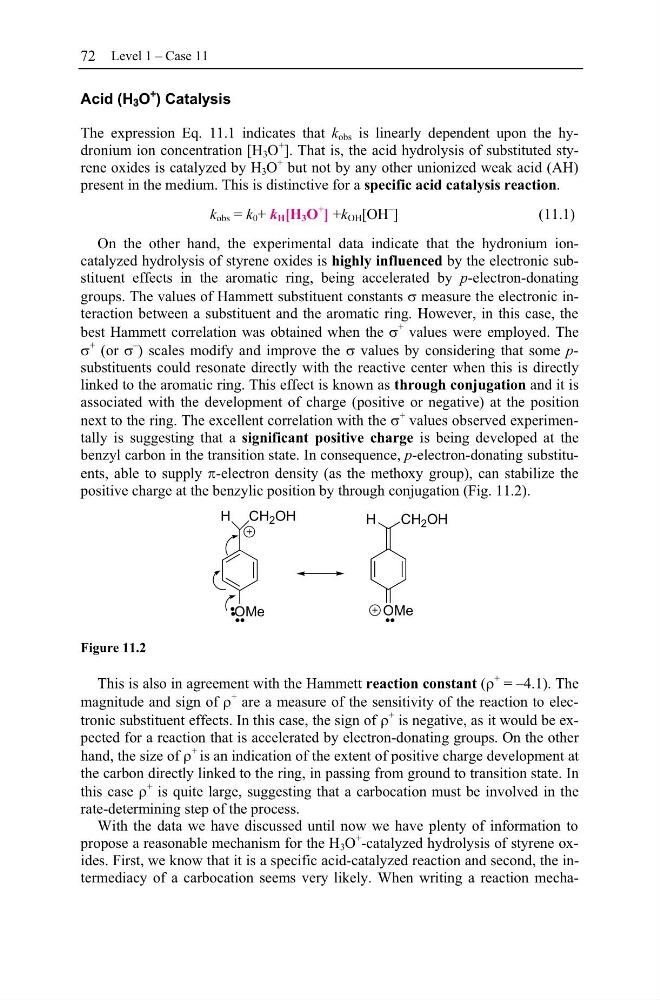
+ values observed experimentally is suggesting that a significant positive charge is being developed at the
benzyl carbon in the transition state. In consequence, p-electron-donating substituents, able to supply S-electron density (as the methoxy group), can stabilize the
t
positive charge at the benzylic position by through conjugation (Fig. 11.2).
OMe O
CH 2 OH
H
OMe
CH 2 OH
H
Figure 11.2
This is also in agreement with the Hammett reaction constant (U
+ = –4.1). The
magnitude and sign of U
+ are a measure of the sensitivity of the reaction to electronic substituent effects. In this case, the sign of U
+ is negative, as it would be expected for a reaction that is accelerated by electron-donating groups. On the other
hand, the size of U
+ is an indication of the extent of positive charge development at
the carbon directly linked to the ring, in passing from ground to transition state. In
this case U
+ is quite large, suggesting that a carbocation must be involved in the
rate-determining step of the process.
With the data we have discussed until now we have plenty of information to
propose a reasonable mechanism for the H 3 O
+ -catalyzed hydrolysis of styrene oxides. First, we know that it is a specific acid-catalyzed reaction and second, the intermediacy of a carbocation seems very likely. When writing a reaction mecha-
72
Acid (H 3 3 O
+ +
) Catalysis
The expression Eq. 11.1 indicates that k obs
k k is linearly dependent upon the hydronium ion concentration [H 3 O
+ ]. That is, the acid hydrolysis of substituted styrene oxides is catalyzed by H 3 O
+ but not by any other unionized weak acid (AH)
present in the medium. This is distinctive for a specific acid catalysis reaction.
k obs
k k = k 0
k k + k H [H 3 O
+ ] +k OH
k k [OH
–
]
(11.1)
On the other hand, the experimental data indicate that the hydronium ioncatalyzed hydrolysis of styrene oxides is highly influenced by the electronic substituent effects in the aromatic ring, being accelerated by p-electron-donating
groups. The values of Hammett substituent constants V measure the electronic interaction between a substituent and the aromatic ring. However, in this case, the
best Hammett correlation was obtained when the V
+ values were employed. The
V
+ (or V
– ) scales modify and improve the V values by considering that some psubstituents could resonate directly with the reactive center when this is directly
linked to the aromatic ring. This effect is known as through conjugation and it is
associated with the development of charge (positive or negative) at the position
next to the ring. The excellent correlation with the V
+ values observed experimentally is suggesting that a significant positive charge is being developed at the
benzyl carbon in the transition state. In consequence, p-electron-donating substituents, able to supply S-electron density (as the methoxy group), can stabilize the
t
positive charge at the benzylic position by through conjugation (Fig. 11.2).
OMe O
CH 2 OH
H
OMe
CH 2 OH
H
Figure 11.2
This is also in agreement with the Hammett reaction constant (U
+ = –4.1). The
magnitude and sign of U
+ are a measure of the sensitivity of the reaction to electronic substituent effects. In this case, the sign of U
+ is negative, as it would be expected for a reaction that is accelerated by electron-donating groups. On the other
hand, the size of U
+ is an indication of the extent of positive charge development at
the carbon directly linked to the ring, in passing from ground to transition state. In
this case U
+ is quite large, suggesting that a carbocation must be involved in the
rate-determining step of the process.
With the data we have discussed until now we have plenty of information to
propose a reasonable mechanism for the H 3 O
+ -catalyzed hydrolysis of styrene oxides. First, we know that it is a specific acid-catalyzed reaction and second, the intermediacy of a carbocation seems very likely. When writing a reaction mecha-