

Level 1 – Case 10
66
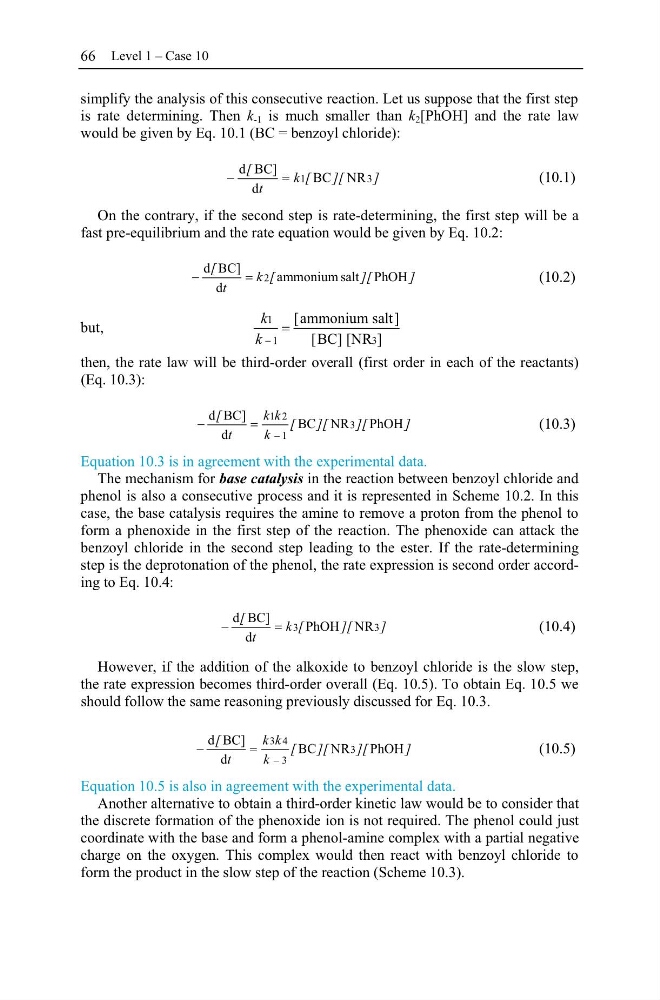
simplify the analysis of this consecutive reaction. Let us suppose that the first step
is rate determining. Then k -1
k k is much smaller than k 2
k k [PhOH] and the rate law
would be given by Eq. 10.1 (BC = benzoyl chloride):
]
][
[
k
t
[
3
1
NR
BC
d
BC]
d
(10.1)
On the contrary, if the second step is rate-determining, the first step will be a
fast pre-equilibrium and the rate equation would be given by Eq. 10.2:
]
][
[
k
t
[
PhOH
salt
ammonium
d
BC]
d
2
(10.2)
but,
k1
k 1
[ammonium salt]
[BC] [NR3 R R ]
then, the rate law will be third-order overall (first order in each of the reactants)
(Eq. 10.3):
]
][
][
[
k
k
k
t
[
–
PhOH
NR
BC
d
BC]
d
3
1
2
1
(10.3)
Equation 10.3 is in agreement with the experimental data.
The mechanism for base catalysis in the reaction between benzoyl chloride and
phenol is also a consecutive process and it is represented in Scheme 10.2. In this
case, the base catalysis requires the amine to remove a proton from the phenol to
form a phenoxide in the first step of the reaction. The phenoxide can attack the
benzoyl chloride in the second step leading to the ester. If the rate-determining
step is the deprotonation of the phenol, the rate expressi
f
on is second order according to Eq. 10.4:
]
][
[
k
t
[
3
3
NR
PhOH
d
BC]
d
(10.4)
However, if the addition of the alkoxide to benzoyl chloride is the slow step,
the rate expression becomes third-order overall (Eq. 10.5). To obtain Eq. 10.5 we
should follow the same reasoning previously discussed for Eq. 10.3.
]
][
][
[
k
k
k
t
[
–
PhOH
NR
BC
d
BC]
d
3
3
4
3
(10.5)
Equation 10.5 is also in agreement with the experimental data.
Another alternative to obtain a third-order kinetic law would be to consider that
the discrete formation of the phenoxide ion is not required. The phenol could just
coordinate with the base and form a phenol-amine complex with a partial negative
charge on the oxygen. This complex would then react with benzoyl chloride to
form the product in the slow step of the reaction (Scheme 10.3).
66
simplify the analysis of this consecutive reaction. Let us suppose that the first step
is rate determining. Then k -1
k k is much smaller than k 2
k k [PhOH] and the rate law
would be given by Eq. 10.1 (BC = benzoyl chloride):
]
][
[
k
t
[
3
1
NR
BC
d
BC]
d
(10.1)
On the contrary, if the second step is rate-determining, the first step will be a
fast pre-equilibrium and the rate equation would be given by Eq. 10.2:
]
][
[
k
t
[
PhOH
salt
ammonium
d
BC]
d
2
(10.2)
but,
k1
k 1
[ammonium salt]
[BC] [NR3 R R ]
then, the rate law will be third-order overall (first order in each of the reactants)
(Eq. 10.3):
]
][
][
[
k
k
k
t
[
–
PhOH
NR
BC
d
BC]
d
3
1
2
1
(10.3)
Equation 10.3 is in agreement with the experimental data.
The mechanism for base catalysis in the reaction between benzoyl chloride and
phenol is also a consecutive process and it is represented in Scheme 10.2. In this
case, the base catalysis requires the amine to remove a proton from the phenol to
form a phenoxide in the first step of the reaction. The phenoxide can attack the
benzoyl chloride in the second step leading to the ester. If the rate-determining
step is the deprotonation of the phenol, the rate expressi
f
on is second order according to Eq. 10.4:
]
][
[
k
t
[
3
3
NR
PhOH
d
BC]
d
(10.4)
However, if the addition of the alkoxide to benzoyl chloride is the slow step,
the rate expression becomes third-order overall (Eq. 10.5). To obtain Eq. 10.5 we
should follow the same reasoning previously discussed for Eq. 10.3.
]
][
][
[
k
k
k
t
[
–
PhOH
NR
BC
d
BC]
d
3
3
4
3
(10.5)
Equation 10.5 is also in agreement with the experimental data.
Another alternative to obtain a third-order kinetic law would be to consider that
the discrete formation of the phenoxide ion is not required. The phenol could just
coordinate with the base and form a phenol-amine complex with a partial negative
charge on the oxygen. This complex would then react with benzoyl chloride to
form the product in the slow step of the reaction (Scheme 10.3).