

Nucleophile Versus Base Catalysis 65
seems also very unlikely. After these considerations, two catalysis mechanisms
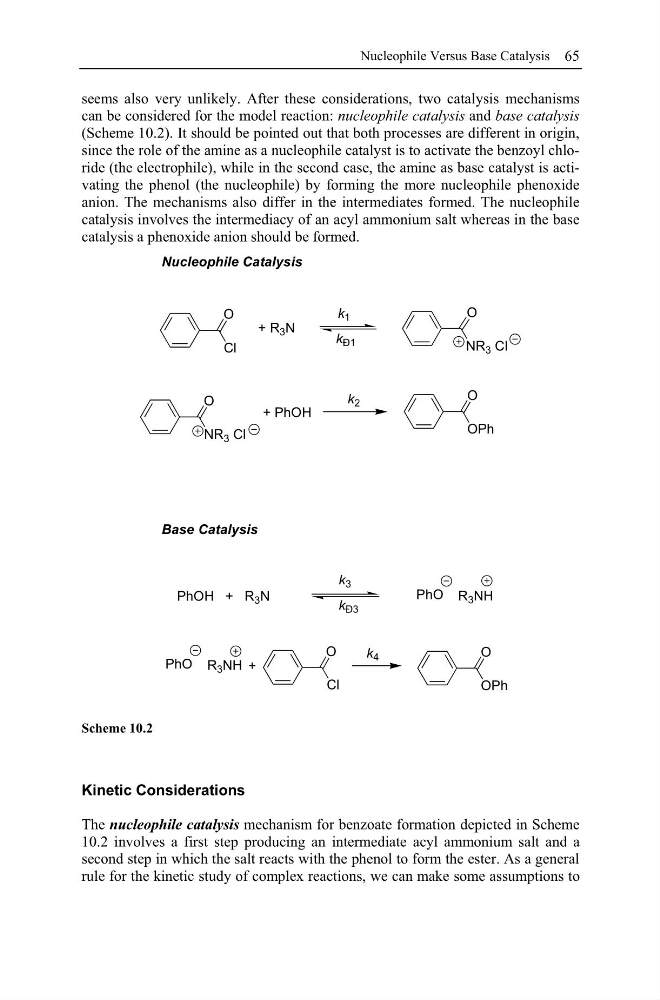
can be considered for the model reaction: nucleophile catalysis and base catalysis
(Scheme 10.2). It should be pointed out that both processes are different in origin,
since the role of the amine as a nucleophile catalyst is to activate the benzoyl chloride (the electrophile), while in the second case, the amine as base catalyst is actid
vating the phenol (the nucleophile) by forming the more nucleophile phenoxide
anion. The mechanisms also differ in the intermediates formed. The nucleophile
catalysis involves the intermediacy of an acyl ammonium salt whereas in the base
catalysis a phenoxide anion should be formed.
Cl
O
NR 3 Cl
O
NR 3 Cl
O
OPh
O
Cl
O
OPh
O
+
PhO
PhO
+ PhOH
k 2
k k
Base Catalysis
PhOH + R 3 N
k 3
k k
k Ð3
k k
k 4
k k
+ R 3 N
k 1
k Ð1
k k
Nucleophile Catalysis
R 3 NH
R 3 NH
Scheme 10.2
Kinetic Considerations
The nucleophile catalysis mechanism for benzoate formation depicted in Scheme
10.2 involves a first step producing an intermediate acyl ammonium salt and a
second step in which the salt reacts with the phenol to form the ester. As a general
rule for the kinetic study of complex reactions, we can make some assumptions to
seems also very unlikely. After these considerations, two catalysis mechanisms
can be considered for the model reaction: nucleophile catalysis and base catalysis
(Scheme 10.2). It should be pointed out that both processes are different in origin,
since the role of the amine as a nucleophile catalyst is to activate the benzoyl chloride (the electrophile), while in the second case, the amine as base catalyst is actid
vating the phenol (the nucleophile) by forming the more nucleophile phenoxide
anion. The mechanisms also differ in the intermediates formed. The nucleophile
catalysis involves the intermediacy of an acyl ammonium salt whereas in the base
catalysis a phenoxide anion should be formed.
Cl
O
NR 3 Cl
O
NR 3 Cl
O
OPh
O
Cl
O
OPh
O
+
PhO
PhO
+ PhOH
k 2
k k
Base Catalysis
PhOH + R 3 N
k 3
k k
k Ð3
k k
k 4
k k
+ R 3 N
k 1
k Ð1
k k
Nucleophile Catalysis
R 3 NH
R 3 NH
Scheme 10.2
Kinetic Considerations
The nucleophile catalysis mechanism for benzoate formation depicted in Scheme
10.2 involves a first step producing an intermediate acyl ammonium salt and a
second step in which the salt reacts with the phenol to form the ester. As a general
rule for the kinetic study of complex reactions, we can make some assumptions to