

Level 1 – Case 10
64
Experimental Data
1. The reaction between benzoyl chloride and phenol, catalyzed by amines, follows a third-order overall rate, being first order on each of the reactants.
2. The reaction rate does not change noticeably when perdeuterated phenol
(C 6 D 5 OD) was used as reagent.
3. In spite of the fact that both phenol and phenoxide ion have different UV absorptions (O max (DCM) phenol = 275 nm; O max (DCM) tetraethylammonium
phenoxide = 250 nm), several UV-visible experiments directed towards the detection of the phenoxide ion were fruitless.
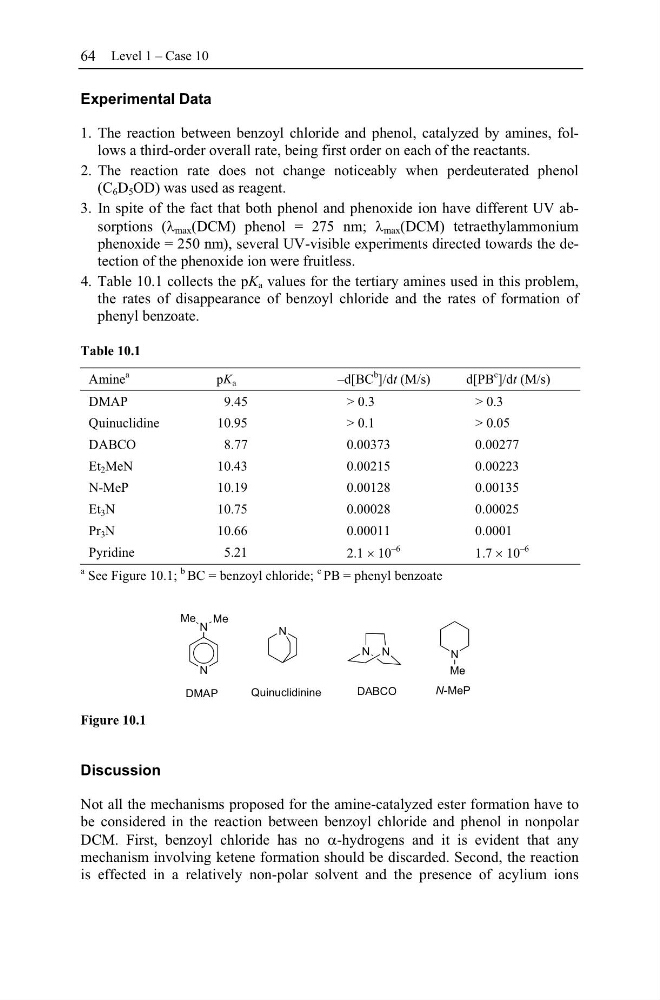
4. Table 10.1 collects the pK a
K K values for the tertiary amines used in this problem,
the rates of disappearance of benzoyl chloride and the rates of formation of
phenyl benzoate.
Table 10.1
Amine
a
pK a
K K
–d[BC
a
b ]/dt (M/s)
d[PB
t
c ]/dt (M/s)
t
DMAP
9.45
> 0.3
> 0.3
Quinuclidine
10.95
> 0.1
> 0.05
DABCO
8.77
0.00373
0.00277
Et 2 MeN
10.43
0.00215
0.00223
N-MeP
10.19
0.00128
0.00135
Et 3 N
10.75
0.00028
0.00025
Pr 3 N
10.66
0.00011
0.0001
Pyridine
5.21
2.1 u 10
–6
1.7 u 10
–6
a See Figure 10.1;
a
b BC = benzoyl chloride;
c PB = phenyl benzoate
N
N
Me
Me
DMAP
N N
Quinuclidinine
N
N
Me
N-MeP
Figure 10.1
Discussion
Not all the mechanisms proposed for the amine-catalyzed ester formation have to
be considered in the reaction between benzoyl chloride and phenol in nonpolar
DCM. First, benzoyl chloride has no D-hydrogens and it is evident that any
mechanism involving ketene formation should be discarded. Second, the reaction
is effected in a relatively non-polar solvent and the presence of acylium ions
64
Experimental Data
1. The reaction between benzoyl chloride and phenol, catalyzed by amines, follows a third-order overall rate, being first order on each of the reactants.
2. The reaction rate does not change noticeably when perdeuterated phenol
(C 6 D 5 OD) was used as reagent.
3. In spite of the fact that both phenol and phenoxide ion have different UV absorptions (O max (DCM) phenol = 275 nm; O max (DCM) tetraethylammonium
phenoxide = 250 nm), several UV-visible experiments directed towards the detection of the phenoxide ion were fruitless.
4. Table 10.1 collects the pK a
K K values for the tertiary amines used in this problem,
the rates of disappearance of benzoyl chloride and the rates of formation of
phenyl benzoate.
Table 10.1
Amine
a
pK a
K K
–d[BC
a
b ]/dt (M/s)
d[PB
t
c ]/dt (M/s)
t
DMAP
9.45
> 0.3
> 0.3
Quinuclidine
10.95
> 0.1
> 0.05
DABCO
8.77
0.00373
0.00277
Et 2 MeN
10.43
0.00215
0.00223
N-MeP
10.19
0.00128
0.00135
Et 3 N
10.75
0.00028
0.00025
Pr 3 N
10.66
0.00011
0.0001
Pyridine
5.21
2.1 u 10
–6
1.7 u 10
–6
a See Figure 10.1;
a
b BC = benzoyl chloride;
c PB = phenyl benzoate
N
N
Me
Me
DMAP
N N
Quinuclidinine
N
N
Me
N-MeP
Figure 10.1
Discussion
Not all the mechanisms proposed for the amine-catalyzed ester formation have to
be considered in the reaction between benzoyl chloride and phenol in nonpolar
DCM. First, benzoyl chloride has no D-hydrogens and it is evident that any
mechanism involving ketene formation should be discarded. Second, the reaction
is effected in a relatively non-polar solvent and the presence of acylium ions