

Nucleophile Versus Base Catalysis 67
OPh
O
Cl
O
+
PhOH H H
NR 3
G G
G
k 5
k k
slow
S Sc ch he em me e 1 10 0. .3 3
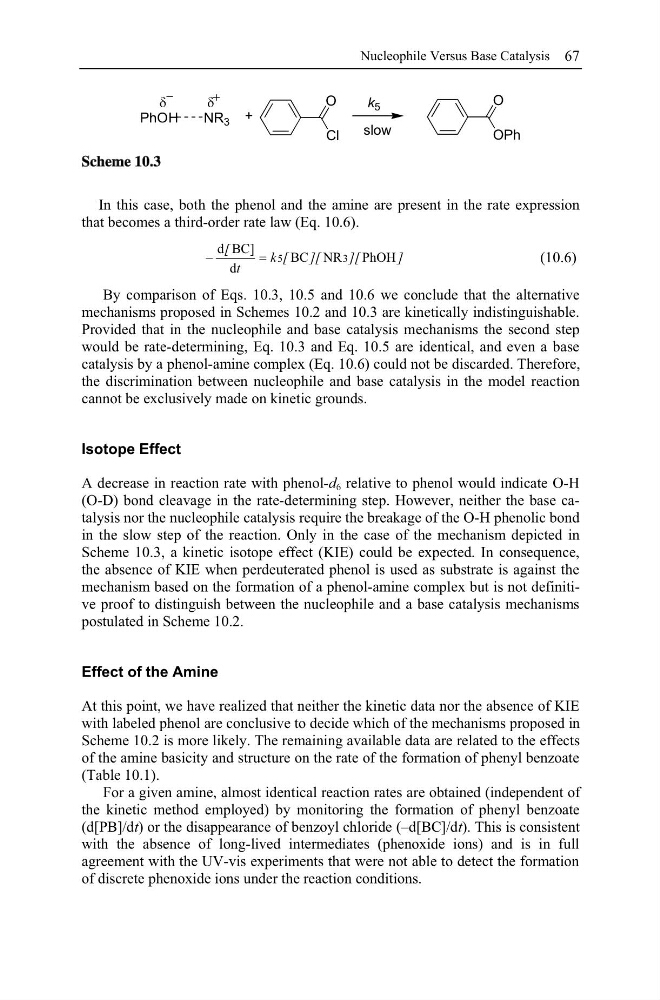
In this case, both the phenol and the amine are present in the rate expression
that becomes a third-order rate law (Eq. 10.6).
]
][
][
[
k
t
[
PhOH
NR
BC
d
BC]
d
3
5
(10.6)
By comparison of Eqs. 10.3, 10.5 and 10.6 we conclude that the alternative
mechanisms proposed in Schemes 10.2 and 10.3 are kinetically indistinguishable.
Provided that in the nucleophile and base catalysis mechanisms the second step
would be rate-determining, Eq. 10.3 and Eq. 10.5 are identical, and even a base
catalysis by a phenol-amine complex (Eq. 10.6) could not be discarded. Therefore,
the discrimination between nucleophile and base catalysis in the model reaction
cannot be exclusively made on kinetic grounds.
Isotope Effect
A decrease in reaction rate with phenol-d 6
d d relative to phenol would indicate O-H
(O-D) bond cleavage in the rate-determining step. However, neither the base catalysis nor the nucleophile catalysis require the breakage of the O-H phenolic bond
in the slow step of the reaction. Only in the case of the mechanism depicted in
Scheme 10.3, a kinetic isotope effect (KIE) could be expected. In consequence,
the absence of KIE when perdeuterated phenol is used as substrate is against the
mechanism based on the formation of a phenol-amine complex but is not definitive proof to distinguish between the nucleophile and a base catalysis mechanisms
postulated in Scheme 10.2.
Effect of the Amine
At this point, we have realized that neither the kinetic data nor the absence of KIE
with labeled phenol are conclusive to decide which of the mechanisms proposed in
Scheme 10.2 is more likely. The remaining available data are related to the effects
of the amine basicity and structure on the rate of the formation of phenyl benzoate
(Table 10.1).
For a given amine, almost identical reaction rates are obtained (independent of
the kinetic method employed) by monitoring the formation of phenyl benzoate
(d[PB]/dt) or the disappearance of benzoyl chloride (–d[BC]/d
t
t). This is consistent
t
with the absence of long-lived intermediates (phenoxide ions) and is in full
agreement with the UV-vis experiments that were not able to detect the formation
of discrete phenoxide ions under the reaction conditions.
OPh
O
Cl
O
+
PhOH H H
NR 3
G G
G
k 5
k k
slow
S Sc ch he em me e 1 10 0. .3 3
In this case, both the phenol and the amine are present in the rate expression
that becomes a third-order rate law (Eq. 10.6).
]
][
][
[
k
t
[
PhOH
NR
BC
d
BC]
d
3
5
(10.6)
By comparison of Eqs. 10.3, 10.5 and 10.6 we conclude that the alternative
mechanisms proposed in Schemes 10.2 and 10.3 are kinetically indistinguishable.
Provided that in the nucleophile and base catalysis mechanisms the second step
would be rate-determining, Eq. 10.3 and Eq. 10.5 are identical, and even a base
catalysis by a phenol-amine complex (Eq. 10.6) could not be discarded. Therefore,
the discrimination between nucleophile and base catalysis in the model reaction
cannot be exclusively made on kinetic grounds.
Isotope Effect
A decrease in reaction rate with phenol-d 6
d d relative to phenol would indicate O-H
(O-D) bond cleavage in the rate-determining step. However, neither the base catalysis nor the nucleophile catalysis require the breakage of the O-H phenolic bond
in the slow step of the reaction. Only in the case of the mechanism depicted in
Scheme 10.3, a kinetic isotope effect (KIE) could be expected. In consequence,
the absence of KIE when perdeuterated phenol is used as substrate is against the
mechanism based on the formation of a phenol-amine complex but is not definitive proof to distinguish between the nucleophile and a base catalysis mechanisms
postulated in Scheme 10.2.
Effect of the Amine
At this point, we have realized that neither the kinetic data nor the absence of KIE
with labeled phenol are conclusive to decide which of the mechanisms proposed in
Scheme 10.2 is more likely. The remaining available data are related to the effects
of the amine basicity and structure on the rate of the formation of phenyl benzoate
(Table 10.1).
For a given amine, almost identical reaction rates are obtained (independent of
the kinetic method employed) by monitoring the formation of phenyl benzoate
(d[PB]/dt) or the disappearance of benzoyl chloride (–d[BC]/d
t
t). This is consistent
t
with the absence of long-lived intermediates (phenoxide ions) and is in full
agreement with the UV-vis experiments that were not able to detect the formation
of discrete phenoxide ions under the reaction conditions.